-
新人教版高中英语必修2Unit 2 Wildlife Protection-Listening and Speaking教案
This lesson is about wildlife protection. The listening and speaking is about “How to protect endangered wildlife ?” Faced with the facts and numbers of wildlife loss, people begin to detect the reasons, then people such as the celebrities (Prince William and Yao Ming) are calling on to protect them. So students are guided to enhance the awareness of protecting wildlife and try to take part in some volunteer activities of protecting wildlife.1. Predict the content by using visuals. 2. Learn to use the sentences such as “I’m concerned about.... But now they are in danger. I want to know the reasons/why./ What can we do to protect them ?3. Learn from the stars like Prince William and Yao Ming and enhance the awareness of protecting wildlife.4. Guide students to try to put forward the solutions to the problems of wildlife protection and then discuss them with partners and present the results of discussion.5. Master the pronunciation of stressed syllables.1. Learn from the stars like Prince William and Yao Ming and enhance the awareness of protecting wildlife.2. Guide students to try to put forward the solutions to the problems of wildlife protection and then discuss them with partners and present the results of discussion.3. Learn to use the sentences such as “I’m concerned about.... But now they are in danger. I want to know the reasons/why./ What can we do to protect them ?4. Master the pronunciation of stressed syllables.Part A Listening and Speaking--- How to save endangered wildlifeStep 1 Lead in1. Point at the pictures on P14 and ask Q1: What message do these posters share?
新人教版高中英语必修2Unit 2 Wildlife Protection-Reading and Thinking教案二
The theme of this unit is human and nature, focusing on the theme of wildlife protection. Nature is a complex ecosystem, in which there are delicate balance between animals and plants. Because of the role of the food chain, the extinction of one species will produce influence, causing a series of chain reaction. Large scale extinction of species will have a serious and even irreversible impact on the ecosystem, resulting in immeasurable losses. Therefore, it is of great significance to protect wild species. To protect wild species is to protect human beings themselves. The motto of this unit is "when the buying stops, the killing can too,” which is a public service advertising slogan to protect wildlife. It tells people that every rhinoceros horn, every fur, every bowl of shark fin soup, every Ivory product, and every tiger bone product, etc. consumed by human beings, are innocent wild animals slaughtered behind them. The mission of wild aid is to ban illegal trade in endangered wildlife and mitigate climate change. It aims to educate the public to reduce the consumption demand for endangered wildlife products through public publicity and improve the awareness of environmental protection.1. Improve the awareness of wildlife protection by acquiring the knowledge of wildlife protection.2. Focus on environmental protection and protection of all lives.3. Analysis of the living environment of wild animals with appropriate thinking mode.4. Skillfully use the vocabulary and grammar knowledge of this unit to cultivate self-study ability according to the unit content5. Develop cooperative learning ability through discussion and other ways1. Enable the Ss to talk about the current situation of wild animals.2. Guide the Ss to summarize the main idea of each paragraph as well as the main idea of the text.
新人教版高中英语必修2Unit 4 History and Traditions-Discovering Useful Structure教案二
This teaching period mainly deals with grammar: The past participle is used as attributive and objective complement.1. Guide students to review the basic usages of the past participle used as attributive and objective complement.2. Lead students to learn to use some special cases concerning the past participle used as attributive and objective complement flexibly.3. Strengthen students’ great interest in grammar learning.1. Help students to appreciate the function of the past participle used as attributive and objective complement.2. Instruct students to write essays using the past participle used as attributive and objective complement.Step1:温故而知新。Analyze the underlined phrases and then sum up the common usages of the past participles.1.(教材P41)They had castles built(build) all around England, and made changes to the legal system.2.(教材P42)They use the same flag, known(know) as the Union Jack,...3.(教材P42)Judy and I had our car parked(park) in an underground car park near Trafalgar Square, where we could get our car battery charged(charge).Common points: f the past participle used as attributive and objective complement.Step 2:过去分词作定语时的意义1.及物动词的过去分词作定语,在语态上表示被动;在时间上,常表示动作已经发生或完成,有时也不表示时间性。Our teacher watched us doing the experiment and gave us a satisfied smile at last.我们的老师看着我们做实验,最后给了我们一个满意的微笑。The plan put forward at the meeting will be carried out soon.会上提出的计划将很快被执行。2.不及物动词的过去分词作定语,它不表示被动意义,只强调动作完成。Many little kids like gathering fallen leaves in the yard.
新人教版高中英语必修2Unit 4 History and Traditions-Reading and Thinking教案二
Step 5 While reading---Task 3Read the text again and answer the following questions.Q1: How many countries does the UK consist of ?4 Q2: What are the four countries of the United Kingdom?England, Wales, Scotland and Northern Ireland Q3: Which two were the first to be joined together ?England and WalesQ4: What are the two chief advantages of studying the history of a country ?The first one is to help you understand more about the country and its traditions.The second one is to make visiting it more enjoyable.Q5: What’s the author’s attitude towards studying the history ?Supportive/positiveStep 6 Post reading---Retell the textThe United Kingdom, Great Britain, Britain, England—many people are confused by (1)_____ these different names mean. In the 16th century, the nearby country of Wales (2) __________(join) to the Kingdom of England. In the 19 th century, the Kingdom of Ireland was added to create the United Kingdom of Great Britain and Ireland. Finally, the southern part of Ireland (3) ______ (break) away from the UK, which resulted in the full name we have today. However, most people just use the (4)_________(shorten) name: the UK. The four countries (5)__________ belong to the United Kingdom work together in some areas. There were four sets of invaders and the last group were the Normans. They had castles (6)_________(build) all around England and made changes (7)__________ the legal system. Studying the history of the country will make your visit much more (8)_________(enjoy). The capital city London is (9)___ ancient port city that has a history (10)______(date) back to Roman times. 1. what 2.was joined 3.broke 4.shortened 5.that 6. built 7.to 8.enjoyable 9.an 10.dating Step 6 Homework
新人教版高中英语必修2Unit 4 History and traditions教案
这个地区有着深厚的传统。既学既练:为了让更多的外国游客了解中国文化,欣赏中国美丽的自然风光,感受中国发生的巨大变化,某外文杂志社将出版一本英语小册子来介绍中国的旅游景点。该杂志社邀请你为该小册子写一篇英语短文来介绍杭州,内容包括:1.杭州的位置(中国东南部)、面积(16 000多平方公里)及历史(2 200多年)等;2.杭州的旅游特色(自然风景、传统文化、特色小吃等);3.希望更多的游客来杭州参观。注意:1.词数80左右;2.可适当增加细节,以使行文连贯。Located in the southeast of China, Hangzhou is a beautiful city.Dating back more than 2,200 years, Hangzhou covers an area of more than 16,000 square kilometers.In Hangzhou, you can visit the West Lake, whose scenery is fascinating.In addition, you can’t miss its cultural relics and historical sites, from which you will learn more about excellent Chinese traditional culture and traditions.In Hangzhou, the special snacks are famous and visitors from different parts of the world think highly of them.As a tourist attraction, Hangzhou attracts a large number of visitors from home and abroad every year.Once you come to China, Hangzhou is a scenic spot you can’t miss.
新人教版高中英语必修2Unit 5 Music-Listening&Speaking&Talking教案
choir memberspeople to run food stands people to sell festival ticketspeople to sell music CDspeople to set up equipmentmusical performersStep 2: Listen to the announcement again and answer the questions. ? 1. What kind of songs will Grace Davis sing at the festival?? 2. Who can try out as a performer?? 3. What can those who think they do not have musical talent do?? 4. How can students volunteer to take part?? Talking about preferences:? Would you prefer doing ..?? What would you prefer to do?? Would you rather do .... or ….?? What would you rather do?? I'd prefer .... to ..? I'd rather have ... than .. Step 3: Speaking ProjectWork in groups. Role-play the conversation or make a new one.? Debbie: Where have you been? You missed the announcement about the music festival.? John: I was at the doctor's office. Music festival?? Frank: Yes, it's going to be next month on the school sports field. John, you can play the piano. How about playing it at the festival?? John: Well, I'd rather play the violin. I can play Liang Zhu.? Frank: Wow! Sounds good. What about you, Debbie? ? Debbie: Actually, I don't have much musical ability. I'd prefer just to help out with the crowds.? Frank: You can sell tickets or work at a food stand.? John: So can I assume that the aim of the festival is to raise money?? Debbie: Yes. All of the money will go to charity.
新人教版高中英语必修2Unit 5 Music-Listening and Speaking教案
This lesson is about music. Students can classify the types of music through the instruments and its sound and can talk about their preferences about music, even join some activities and play a role in them according to their musical talents. On the basis, they are guided to use the languages to express their preferences and some plosive sounds and their rules.1. Classify the music types through the instruments and its sound.2. Listen and understand what the speakers’ preferences are and the reasons; talk about their own preferences and give their own reasons, using these sentences: “What kind of music do you like? And why? “ “Because it makes/gives me energy/peaceful.../touches my heart...”.3. Learn some plosives and the rules.4. Join some activities and play a role in them according to the talents. 1. Listen and understand what the speakers’ preferences are and the reasons;2. talk about their own preferences and give their own reasons, using these sentences: “What kind of music do you like? And why? “ “Because it makes/gives me energy/peaceful.../touches my heart...”.3. Learn some plosives and incomplete plosives and its rules.Step 1 Lead inPoint at the pictures on P50 and ask Q1: What are the people doing in the pictures below?Q2: What kind of music they are?Then play the MP3s one by oneStep 2 ListeningTask 1: A reporter from the school newspaper is interviewing students about music. Listen to the interviews. Draw lines between the words to make complete sentences. Some words will not be used.
新人教版高中英语必修2Unit 5 Music-Reading and Thinking教案二
1. Get basic information about Eric; read deeply to understand the history and development of the virtual choir.2. Understand what the function of the virtual choir is and how to make a virtual choir.3. Understand the meaning of some languages in the context of the text through question guidance, such as “Many people do not have close friends or contacts who have the same interest in music.” and so on.Step 1 Leading-in1. Answer the following questions.Q1:Do you know the Apps like Tik Tok and Quick Hand?Q2: Do you want to make a Tik Tok video or a Quick Hand video?2. Play a Tik Tok video Step 2: Understanding the title Q1:What does the title mean ?Q2: Is the article a narration or exposition? Why? Q3: Can you change the title ? If you can, what is the title?Step 3: Scanning the whole text and getting the basic information1. Answer the following questions.Q1:Who came up with the idea for a virtual choir?Q2: Where did Eric studied the musical composition?Q3: What is his song?2. Find the main idea of each paragraph3. Deal with some new words.Step 4: Reading carefully to get detailed informationPara 1 How to make a virtual choir1. PreparationA. tools: a virtual camera; an Internet connectionB. hero/heroin: friends or some individuals who have the same interests2. Process
新人教版高中英语必修2Unit 5 Music-Reading for Writing教案二
The Internet celebrity Gao Yifeng. Years ago, he owned 5 companies and the staffs over 1,000, but during the economy crisis, he became nothing but debt. He was so worried that his hair became white overnight. There was a time when he wanted to killed himself. But after listening to the song Start Over by Liu Huan, he decided to cheer himself up. He started a steamed bun shop and gradually became a national chain shops. Now he became successful again.Walter Haddon said, “Music is the medicine of a troubled mind.” Music contains such a pleasant and inspiring force. Music gave him courage and bravery. When he listened to the song, it made his spirit fly like a kite in the wind. Music gave him strength and brought him relief. It was the rock I leant on to become strong and to get through those hard times. I hope none of us have to go through the same kind of suffering that he did. At the same time, we all go through various periods when we feel sad or alone. During those times, music can help us in the same way that it helped him. I hope we all will somehow begin to treasure music and make it a part of our life. Thank you for your listening !5.Revise your writing each other.Does he/she explain how music has changed his/her/someone else’s life?Are some of the rhetorical devices included and used properly ?Does he/she talk about how music makes him/her/someone feel?Is the first word in each sentences capitalised?Does he/she use correct punctuation ?
《场景》教案
感知乐曲。1、看课件,配合舞剧画面欣赏乐曲《场景》,感受乐曲情绪。2、介绍乐曲的相关故事情节。柴可夫斯基的《天鹅湖》取材于德国作家姆宙斯的童话《天鹅湖)和俄国民间故事《天鹅公主》,讲述了一位美丽善良的公主奥杰塔被施魔法变成了天鹅,只有在夜晚,天鹅才能恢复人形。一天晚上,一位王子在湖边发现了公主,并决心搭救它。《场景》便是该剧第一幕的终场音乐,给我们描绘出纯洁、温柔、忧愁、悲伤的天鹅奥杰塔形象。3、通过天鹅资料库,讨论天鹅的话题。(1)在大家心目中,天鹅是什么样子的?(学生自由描述天鹅形象)(2)学生在天鹅资料库了解自己最感兴趣的话题。(3)指名学生相互交流。
《春游》教案
一、导入1、师:“同学们现在是什么季节?”师:“我们常说一年之计在于春,春是四季之首,是充满希望的季节,是新的开始,是一个如诗如画的季节。古往今来,多少文人墨客都用自己的智慧抒发了对“春”的赞美,诗歌、散文中到处都留有春的足迹。你知到哪些诗词是描写春天的吗?”2、师:“同学们说的很好,在这阳春三月,春暖花开的季节,你最想干什么?”3、师:“杨老师最想做的是迎着和煦的春风,看杨柳依依,去踏青春游,那今天就让我们循着花香,伴着歌声一起去踏青春游,感受扑面而来的春的气息吧。”
《春游》教案
一、营造氛围,了解作者。1、播放歌曲《送别》,学生欣赏跟唱,说出歌曲的词作者——李叔同。2、教师引出另外一首由李叔同作词作曲的歌曲:《春游》。二、真情演唱、感受音乐。1、播放歌曲春游后,学生交流听后感受,说说歌曲情绪。2、再次播放歌曲,学生感受歌曲节拍及旋律。3、练习两条6/8拍的节奏。A、6/8 x x x x |;B、6/8 x x x . | 尝试把这两条节奏组合起来练习。按组合后的节奏读一读《春游》歌词。4、歌曲演唱。通过朗读我们感到歌曲春游结构工整,请学生给歌曲分乐句:A、熟悉歌曲的旋律,用“噜”模唱。B、歌曲不但结构工整,乐句间还有什么特点?请学生边听边找。学习完全重复的第二句和第四句的歌词。引导学生发现第一句和二、四两句一音之差。填歌词唱一唱。学生完整把第一句、第二句、第四句唱一唱,第三句听一听。
《春游》教案
教学过程:(一)学吹竖笛《春游》1.教师弹琴,学生轻声哼唱旋律,熟悉曲谱。2.学生练习吹奏。学生相互帮助掌握技术难点。3.引导学生找出乐曲中旋律的相同和不同之处。如:二、四句旋律完全相同,第三句变化;结尾不同,培养学生的观察能力和分析能力。4.为乐曲配打击乐伴奏,在有标记的地方敲击三角铁或其他打击乐器。(二)创作与表演1.请学生即兴为《春游》的旋律配一段歌词,并试着唱一唱。分小组创编,然后为大家展示成果。2.师生共同表演《春游》音乐片段。形式:弹奏、舞蹈、扭秧歌、敲锣打鼓、演唱,教师要将全体学生调动起来,积极参与表演,表演形式由学生自主选择,也可教师、学生讨论安排角色。
登高教案 3篇
一、激趣导入 多媒体显示写杜甫的对联: 诗史数千言,秋天一鹄先生骨;草堂三五里,春水群殴野老心。 1、提问:同学们知道这幅对联是写谁的吗?请大家回忆一下我们学过他的那些作品?能背诵一首我们共同欣赏吗?(学生背诵)今天我们来学习他的另一首诗歌《登高》(板书)
《甘美兰》教案
东南亚锣群文化的代表——甘美兰。教师:那么印尼真正的本土音乐文化的代表则是名为“甘美兰”的乐器合奏形式。(1)出示“甘美兰”乐器图片,引导学生分析这种合奏形式是以锣和鼓等打击乐为主的。“甘美兰”被西方人认为是亚洲锣群文化的代表。(2)请学生听赏“甘美兰”演奏音频。听前提问:其旋律是多重复还是多变化?(3)带领学生模仿简化为两个声部的节奏敲击。教师先数拍子,指导学生分为两个声部(一声部可作拍手的声势、另一声部可作跺脚的声势,也可由学生自己创造两种不同的声音进行参与)进行模仿敲击。待学生做得较准确后,教师模唱录音中的旋律,指挥学生参与敲击。教师总结:这种旋律的不断重复是表达了印尼人民对生命轮回的渴望。世界上许多国家的人们都曾以各自不同的艺术形式传达这种渴望!
《火把节》教案
教学过程一、导入新课师:同学们,少数民族的节日非常多,其中火把节就是彝族人最著名的节日,关于火把节,还有一个传说呢。今天我们就到彝族朋友的火把节上去看一看。欣赏“火把节的传说”动画。二、介绍彝族的火把节彝族的火把节盛名天下,从每年的农历6月24日起,连续三天三夜,彝族人民在宽广的草地上纵情歌舞、赛马、斗牛、射箭、摔跤,到了晚上,青年男子就点燃火把,穿行于田野山村之间,以驱除妖魔,保佑平安。密密的火把犹如一条长龙在山道、田间缓缓游动,场面十分壮观,与此同时,处处点燃篝火,男女老少围着篝火欢乐歌舞,直至深夜。三、欣赏乐曲1.初听乐曲《火把节》音频。师:火把节真是盛大的节日,现在我们就来欣赏一首乐曲《火把节》。提问:同学们能听出这首乐曲是用哪种乐器演奏的吗?音色有什么特点?学生自由回答。教师总结:阮的历史有近2000年了,有大、中、小之分,常用的是中阮和大阮,他们有四根弦,演奏时左手持琴,右手用拨子演奏。这首《火把节》是用中阮演奏的。中阮的音色柔和,表现力很强。2.听辨乐段。
有理数教案
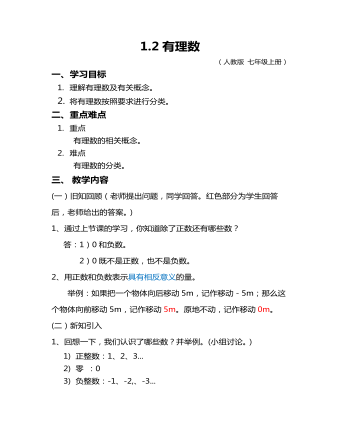
(一)旧知回顾(老师提出问题,同学回答。红色部分为学生回答后,老师给出的答案。)1、通过上节课的学习,你知道除了正数还有哪些数?答:1)0和负数。2)0既不是正数,也不是负数。2、用正数和负数表示具有相反意义的量。举例:如果把一个物体向后移动5m,记作移动-5m;那么这个物体向前移动5m,记作移动5m。原地不动,记作移动0m。
《一分钟》教案
说教材 今天,我说的课文是人教版一年级下册的《一分钟》。课文以小学生喜爱的形式出现,内容较为通俗。主人公元元因为早上多睡了一分钟,带来的却是20分钟的迟到,是一路焦急地等待和不停地叹息,是步行的辛苦和脸红的尴尬,是深深的后悔和宝贵的教训。故事与学生实际生活联系十分紧密,教学中要引导学生联系自己的生活实际体验、理解课文内容,从中受到教育和影响。 由于学生小,时间观念不强,对于如何珍惜时间缺乏感性认识。本文正是一篇十分优秀的文章。教学时要充分利用教材资源创设情境,在读中感悟,从中体会元元的焦急与尴尬,也使这件事成为宝贵的教训,促使每个学生都能对自己严格要求,珍惜时间、科学利用时间。
《千人糕》教案
一、谈话导入师:同学们,中国有句俗话叫“民以食为天”,你们喜欢美食吗?(喜欢)老师也喜欢吃,不过我们可别光顾着吃,我们要认识它,还要记住他们的名字。(课件出示米糕图片)。1、师:看,老师给你们带来了什么?(米糕)生活中,你们除了吃过米糕,还吃过什么糕呢?(课件出示词语:蛋糕、雪糕、糕点。)领读词语。2、师:不论是蛋糕、雪糕,还是糕点,味道上都有一个共同点是()?甜,是因为在里面加入了糖,(出示糖的卡片认读生字“糖”)课件出示生活中常见的糖的图片,齐读词语。3、引导观察生字“糕、糖”,发现共同点,引出“粉”。交流“粉”的识字方法,引出“芬、份、纷、扮”,出示词语:粉丝、粉笔、面粉。齐读。
人教版新课标高中物理必修1匀变速直线运动的速度与时间的关系教案2篇
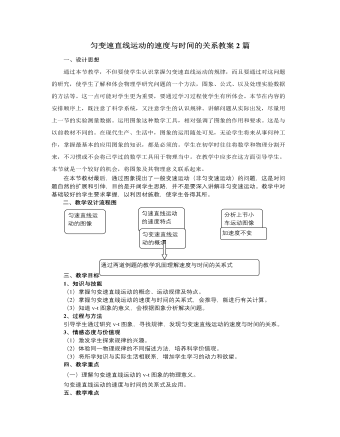
一、设计思想通过本节教学,不但要使学生认识掌握匀变速直线运动的规律,而且要通过对这问题的研究,使学生了解和体会物理学研究问题的一个方法,图象、公式、以及处理实验数据的方法等。这一点可能对学生更为重要,要通过学习过程使学生有所体会。本节在内容的安排顺序上,既注意了科学系统,又注意学生的认识规律。讲解问题从实际出发,尽量用上一节的实验测量数据。运用图象这种数学工具,相对强调了图象的作用和要求。这是与以前教材不同的。在现代生产、生活中,图象的运用随处可见,无论学生将来从事何种工作,掌握最基本的应用图象的知识,都是必须的。学生在初学时往往将数学和物理分割开来,不习惯或不会将已学过的数学工具用于物理当中。在教学中应多在这方面引导学生。本节就是一个较好的机会,将图象及其物理意义联系起来。