-
新人教版高中英语必修2Unit 1 Cultural Heritage-Reading and Thinking教案二
1. This section focuses on "Understanding how a problem was solved”, which is aimed to guide students to analyze and discuss the challenges and problems faced by cultural heritage protection during the construction of Aswan Dam, as well as the solutions. On the basis of understanding, students should pay attention to the key role of international cooperation in solving problems, and attach importance to the balance and coordination between cultural heritage protection and social and economic development. Students are encouraged to face challenges actively, be good at cooperation, and make continuous efforts to find reasonable ways and means to solve problems.2. Enable students to understand the main information and text structure of the reading text;3. Motivate students to use the reading strategy "make a timeline" according to the appropriate text genre;4. Enable students to understand how a problem was solved;5. Enable students to understand the value of protecting cultural heritage by teamwork and global community;1. Guide students to pay attention to reading strategies, such as prediction, self-questioning and scanning.2. Help students sort out the topic language about protecting cultural relics and understand the narrative characteristics of "time-event" in illustrative style3. Lead students to understand the value of protecting cultural heritage by teamwork and global community;
新人教版高中英语必修2Unit 1 Cultural Heritage-Reading and Thinking教案一
The theme of the reading and thinking is about “Understanding how a problem was solved”.The Listening & Speaking & Talking is about international co-work to protect the Mount Tai, in which the students from seven countries came up with many solutions even create the Mount Tai App. This section aims at showing how to solve a difficult and even tough problem about protecting the cultural heritage by the international co-work. So in this section, cultivating students’ international awareness is very clear and important. Concretely, with the economic development, how to balance the protection of cultural relics and social development is a big challenge for human. In the 1950s, the Egyptian government wanted to build the Aswan Dam across the Nile to control floods, produce electricity and water farms. But the proposal led to protests because it would destroy a lot of cultural relics. The Egyptian had no choice but ask the UN for help. Therefore, a international cooperation about how to protect the cultural relics began, which involved the time length about 20 years and a large amount of fund. Then, the problems was solved. 1. Read quickly to get the main idea and the structure of the article; read careful to get detailed information.2. Learn to use the reading strategy---making a timeline3. Learn how to solve a tough problem by asking for help and cooperation4. Have the international awareness and understand the great strength of international cooperation.1. Read quickly to get the main idea and the structure of the article; read careful to get detailed information.2. Learn to use the reading strategy---making a timeline.3. Learn how to solve a tough problem by asking for help and cooperation.
新人教版高中英语必修2Unit 3 The Internet-Discovering Useful Structure教案一
This unit is about the Internet, which has a great influence to our humans and our lives. During the Listening & Speaking & Talking and Reading and Thinking section, the influence in examples has been shown. Thus, use the Present Perfect Tense is appropriate. However, in order to show the justice or weaken the doer of the behavior/action, it’s better to use the Present Perfect Passive Voice than the Present Perfect Tense. Besides, having learned to use the Present Perfect Passive Voice, students can beautify their language in their writing. 1. Learn the structure of the Present Perfect Passive Voice and its functions. 2. Learn to change the sentences with the Present Perfect Passive Voice into the sentences with the Present Perfect Passive Voice. 3. Learn to write sentences with the Present Perfect Passive Voice flexibly according to the context. 1. Learn the structure of the Present Perfect Passive Voice and its functions. 2. Learn to change the sentences with the Present Perfect Passive Voice into the sentences with the Present Perfect Passive Voice. 3. Learn to write sentences with the Present Perfect Passive Voice flexibly according to the context. Step 1 Observe the following sentences, then change the sentences into passive voice.He has been selected to take part in the sports meeting.(肯定句)他已被挑选出来参加运动会。The ink has not been removed from his overcoat.(否定句)墨迹还没有从他外套上去掉。
新人教版高中英语必修2Unit 3 The Internet-Listening &Speaking&Talking教案一
Listening and Speaking introduces the topic of “ask about online habits”. Many middle school students have been surfing the Internet for many years, but what they do with the Internet and how much time they spend every day may not be very clear to themselves, nor to other students. This section allows students to investigate their peers' Internet use, which is conducive to their mutual understanding and understanding of the Internet. It can also help them reflect on their own online behavior, learn from other people's good online habits, and get rid of their bad online behavior.The listening text of this section is an investigation interview. The investigators interview specific groups with the same questions to obtain information, so as to understand their views, practices or attitudes on this issue. There are two specific questions: “how much time do you spend online every day? What do you usually do online?”. The answers of the three respondents provide rich and different information, and achieve the purpose of the investigators. The oral discourse structure of survey interviews generally includes greeting and explaining the purpose of the interview, presenting the interview questions and the respondents' answers. Listening and Talking introduces the theme of “choosing the right application ". Listening text is a conversation between Laura and Xiao Bo. In this part of listening, “oink”; “piggy bank” may cause the students' hearing comprehension limitation. Oink refers to sound word and pig's sound. So, add some oink to my piggy bank is often used to describe "making a little money".1. Guide students to understand the content of listening texts in terms of listening for definitions.2. Cultivate students' ability to define words and understand an investigation interview.
新人教版高中英语必修2Unit 4 History and Traditions-Discovering Useful Structure教案一
Step 5 Practice一、完成下列句子。1. Judy and I _______________(把车停下来(park))in an underground car Park near Trafalgar Square, where we could ______________________(让我们的车充电(charge)).2. When we finally reached the service desk to ask for audio guides, we heard it ___________ that there were no audio guides____________(留下,剩下).3. We__________________________(发现自己对...很惊讶)the large number of visitors and the amount of noise at the entrance of the National Gallery.4. Judy ____________________(眼神专注于) Van Gogh’s Sunflowers. It was hard to approach the painting as there were so many people around.5. She ____________________(把这幅画的复制品装箱(box)) to ensure that it was delivered safely.答案:1.had our car parked get our car battery charged 2. announced left 3. found ourselves very surprised 4. had her eyes fixed on 5. had a copy of the painting boxed二、用过去分词对下列句子进行改写。1. Loch Ness was surrounded by beautiful natural landscape, which made it look amazing.2. Carl and his friend stayed with a generous family who offered them bread with butter and honey that was homemade.3. The family’s ancestors once attended to soldiers who were wounded in the First World War.4. The young people were attracted by the legend of Loch Ness. They watched over the lake with their cameras and binoculars, which were positioned on the hill.答案:1. Loch Ness surrounded by beautiful natural landscape looks amazing.2. Carl and his friends stayed with a generous family who offered them homemade bread with butter and honey.3. The family’s ancestors once attended to wounded soldiers in the First World War.4. The young people attracted by the legend of Loch Ness watched over the lake with their cameras and binoculars positioned on the hill.
新人教版高中英语必修2Unit 3 The Internet-Reading for Writing教案二
8. However, the more polite you are, the less likely it is you will be attacked. 然而, 你越有礼貌, 你被攻击的可能性就越小。 Step 8 Writing---the articleHow to stay safe in the online chat roomToday I thought I’d blog about a question that has been asked many times--- how do you stay safe online and avoid bad experiences in the online chat room ? I’m not an expert, but many years as a blogger have taught me a thing or two.First of all, there’s the golden rule of the Internet: keep out of what makes you uneasy. Don’t post comments or click on anything. Second, protect your privacy. Don’t give out too much private information like your address, phone numbers, the ID numbers, etc. Third, be polite. If you are polite to others on the Internet, you won’t be attacked in normal situation. Finally, don’t believe in others easily and never meet someone you met online alone. It is very dangerous.Have you had any bad experiences online, or do you have some good advice for staying safe? Post your comments below!Step 9 Pair workExchange drafts with a partner. Use this checklist to help your partner revise his/her draft.1. Does the writer tell the reader what he/she know about the topic ?2. Are the tips and suggestions well organised ?3. Has the writer defined the new words ?4. Does the author include examples, comparison, or explanations ?5. Does the writer end by asking readers to leave comments and/or suggestions ?6. Can you find any grammar or spelling mistakes.Step 6 HomeworkPut up your revised draft in the classroom or read it to your class.
新人教版高中英语必修2Unit 4 History and Traditions-Discovering Useful Structure教案二
This teaching period mainly deals with grammar: The past participle is used as attributive and objective complement.1. Guide students to review the basic usages of the past participle used as attributive and objective complement.2. Lead students to learn to use some special cases concerning the past participle used as attributive and objective complement flexibly.3. Strengthen students’ great interest in grammar learning.1. Help students to appreciate the function of the past participle used as attributive and objective complement.2. Instruct students to write essays using the past participle used as attributive and objective complement.Step1:温故而知新。Analyze the underlined phrases and then sum up the common usages of the past participles.1.(教材P41)They had castles built(build) all around England, and made changes to the legal system.2.(教材P42)They use the same flag, known(know) as the Union Jack,...3.(教材P42)Judy and I had our car parked(park) in an underground car park near Trafalgar Square, where we could get our car battery charged(charge).Common points: f the past participle used as attributive and objective complement.Step 2:过去分词作定语时的意义1.及物动词的过去分词作定语,在语态上表示被动;在时间上,常表示动作已经发生或完成,有时也不表示时间性。Our teacher watched us doing the experiment and gave us a satisfied smile at last.我们的老师看着我们做实验,最后给了我们一个满意的微笑。The plan put forward at the meeting will be carried out soon.会上提出的计划将很快被执行。2.不及物动词的过去分词作定语,它不表示被动意义,只强调动作完成。Many little kids like gathering fallen leaves in the yard.
新人教版高中英语必修2Unit 4 History and Traditions-Listening&Speaking&Talking教案二
Listening and Speaking introduces the topic of “Take part in a youth project”. The listening text is an interview about "sharing views on historical sites". Through listening to a dialogue between Chinese and foreign students on the way to the Confucius Temple, students can understand their views on the Confucius Temple, Confucius, Confucius' descendants and Confucius' educational thoughts, so as to realize and think about the profound influence of Confucius and his thoughts on Chinese historical tradition. At the same time, the dialogue naturally integrates English idioms and mentions Shakespeare, the British playwright, so as to provide language materials and context for students to understand English idioms and related cultural allusions, as well as to compare Chinese and foreign cultures, which is helpful for students to understand and express the language such as history, tradition, culture and custom significant impact.Text analysis: listening text is a dialogue between a British student and a Chinese student when he goes to the Confucius Temple. When William, a British student, visited the Confucius Temple, he asked Xiao Kong, a Chinese student, for directions. Xiao Kong was just going to the Confucius Temple to meet with the members of the research group, so they went together and exchanged their views on the Confucius Temple, Confucius, Confucius' descendants and Confucius' educational thoughts. From the perspective of foreign tourists, this paper describes their thoughts on Confucius, the great son of Confucius, who had a profound impact on Chinese history and cultural tradition, and his education.Listening and Talking introduces a visit to a historic tourist destination. Tourism is a common way to understand a country's history, culture, and customs and so on. Students listen to the dialogue between Xiao Yan, a youth hostel Usher, and Paul, a backpacker, to learn about Pingyao's famous historical and cultural attractions and Paul's travel experience and experience as a foreign tourist.
新人教版高中英语必修2Unit 4 History and Traditions-Reading for Writing教案
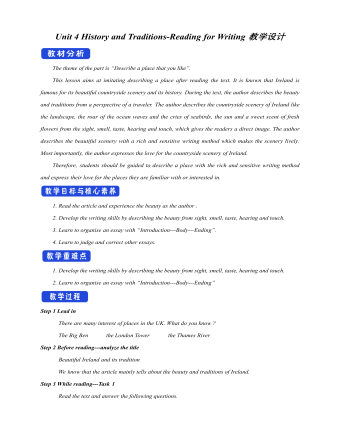
Step 1 Lead inThere are many interest of places in the UK. What do you know ?The Big Ben the London Tower the Thames RiverStep 2 Before reading---analyze the titleBeautiful Ireland and its traditionWe know that the article mainly tells about the beauty and traditions of Ireland. Step 3 While reading---Task 1Read the text and answer the following questions.Q1: What makes the Irish countryside exciting and inspiring?Its beauty and how it offers something for all the scenes.Q2: What are the best ways to experience some Irish traditions and cultures?By stopping by a village pub and relaxing with a drink and traditional meal while listening to music and watching dancingQ3: What is the meaning of “breathe in the sweet scent of fresh flowers while birds greet the new day with their morning song ?”It means to not just smell but also breathe in the smell of fresh flowers early in the morning as the birds sing their first song of the new day.Q4: What are the best ways to experience Chinese traditions and customs ?By travelling to different places and using all your senses to experience everything and by interacting with local people.Step 4 While reading---Task 2Analyze the descriptive paragraph1. Identify and underline the paragraph’s introductory sentence and the ending sentence.Introductory sentence: Ireland’s beautiful countryside has always had a great influence on its people and traditions.Ending sentence: And if you introduce yourself to a friendly face, you are more than likely to experience local culture and customs first-hand.2. The paragraph talks about different senses in different places. Write the senses and places in the order that they appear.
新人教版高中英语必修2Unit 5 Music-Listening&Speaking&Talking教案
choir memberspeople to run food stands people to sell festival ticketspeople to sell music CDspeople to set up equipmentmusical performersStep 2: Listen to the announcement again and answer the questions. ? 1. What kind of songs will Grace Davis sing at the festival?? 2. Who can try out as a performer?? 3. What can those who think they do not have musical talent do?? 4. How can students volunteer to take part?? Talking about preferences:? Would you prefer doing ..?? What would you prefer to do?? Would you rather do .... or ….?? What would you rather do?? I'd prefer .... to ..? I'd rather have ... than .. Step 3: Speaking ProjectWork in groups. Role-play the conversation or make a new one.? Debbie: Where have you been? You missed the announcement about the music festival.? John: I was at the doctor's office. Music festival?? Frank: Yes, it's going to be next month on the school sports field. John, you can play the piano. How about playing it at the festival?? John: Well, I'd rather play the violin. I can play Liang Zhu.? Frank: Wow! Sounds good. What about you, Debbie? ? Debbie: Actually, I don't have much musical ability. I'd prefer just to help out with the crowds.? Frank: You can sell tickets or work at a food stand.? John: So can I assume that the aim of the festival is to raise money?? Debbie: Yes. All of the money will go to charity.
新人教版高中英语必修2Unit 5 Music-Listening and Speaking教案
This lesson is about music. Students can classify the types of music through the instruments and its sound and can talk about their preferences about music, even join some activities and play a role in them according to their musical talents. On the basis, they are guided to use the languages to express their preferences and some plosive sounds and their rules.1. Classify the music types through the instruments and its sound.2. Listen and understand what the speakers’ preferences are and the reasons; talk about their own preferences and give their own reasons, using these sentences: “What kind of music do you like? And why? “ “Because it makes/gives me energy/peaceful.../touches my heart...”.3. Learn some plosives and the rules.4. Join some activities and play a role in them according to the talents. 1. Listen and understand what the speakers’ preferences are and the reasons;2. talk about their own preferences and give their own reasons, using these sentences: “What kind of music do you like? And why? “ “Because it makes/gives me energy/peaceful.../touches my heart...”.3. Learn some plosives and incomplete plosives and its rules.Step 1 Lead inPoint at the pictures on P50 and ask Q1: What are the people doing in the pictures below?Q2: What kind of music they are?Then play the MP3s one by oneStep 2 ListeningTask 1: A reporter from the school newspaper is interviewing students about music. Listen to the interviews. Draw lines between the words to make complete sentences. Some words will not be used.
新人教版高中英语必修2Unit 5 Music-Reading and Thinking教案一
This section focuses on "learning about experiencing music Online". This virtual choir is a new form of music performance. Members from all over the world don't need to love to come to a place. Instead, they use the new technology to model the various parts and wonderful virtual harmony group of music in the family. Students need to understand the main meaning of each paragraph. Finding topic sentences is an important way to understand the general idea of a paragraph. After the topic sentence, it is usually the detail sentence that supports and explains the topic sentence. Some paragraphs have obvious subject sentences, for example, the first sentence of the second paragraph is the subject sentence of the paragraph, and the following sentenceStudents need to pay attention to the topic sentences and key sentences, and then pay attention to how the sentences after the meaning explain, explain and support the topic sentences or key sentences before.1.Guide students to learn about experiencing music online2.Guide students to scan and circle the information in the text.3.Guide students to find the numbers and dates to fill in the timeline.4.Guide students to learn more about music by completing the sentences with the correct forms of the words and phrases. And then make a mind map about the outline of the passage.1. Guide students to pay attention to reading strategies, such as prediction, self-questioning and scanning.2. Help students sort out the main meaning of each paragraph and understand the narrative characteristics of "timeline” in illustrative style.3. Lead students to understand the changes that have been caused by the Internet.
新人教版高中英语必修2Unit 5 Music-Reading For Writing教案一
(4)Now we have heard a number of outstanding speeches ... 我们已经聆听了许多精彩的发言……(5)Because we wanted the nations of the world, working together, to deal with ... 因为我们希望全世界各国团结起来去应对……(6)And if we do not act ... 如果我们不采取行动……(7)Now, I share the concerns that have been expressed ... 我也同意对于……表达的担心(8)Let us show the world that by working together we can ... 让我们告诉全世界,通过一起努力我们可以……(9)It is now time for us to ... 是时候我们……(10)And I have always wished that ... 我一直希望……(11)Thank you for letting me share this day with me.感谢你们和我共度这一天。实践演练:假如你是高中生李华,你校将举办一次以“音乐”为主题的演讲比赛,请你按照主题,写下你的演讲稿。注意:词数100左右。First of all, thank you for listening to my speech. My topic is: love music like love yourself.Music is like the air we need to maintain our normal lives around us. You can't imagine how terrible a world without music would be. Movies and TV shows have no music, only dry conversations and scenes; mobile phones only vibrations; streets only noisy crowds; cafes, western restaurants only depressed meals. What a terrible world it is!As a student, I hope we all can enjoy the fun brought by music in our spare time. Instead of just listening to music, we can even make our own music. Let's enjoy the fun of music!Thanks again for your attention!
人教版高中语文必修1《论语》教案2篇
【教学意图】要了解中国传统文化,必须阅读古诗文名著名篇。但在中国文化形成过程中影响最大的是什么?可以说是儒家学说,包括《论语》这部经典。《论语》等书是读书人求仕做官的必修课本,是知识分子的思想言行基础,而且影响到整个社会生活,内容包括伦理道德、教育体制、民间习俗等方面的思想。因此,要了解中国传统文化,有必要读一读《论语》。【教学设计】因《论语》的年代已久远,对学生而言,要理解透彻文句是比较深奥困难的,因此必须在充分理解文意的基础上,对《论语》进行思想上的解读。可由教师从《论语》中概括出几点与生活、现实相关的要点,要求学生分组进行透彻的学习和领会,如“小人与君子”、“学习的方法”、“教育的理念”等等。〖教学重点、难点〗读《论语》知儒家思想。〖教学方法〗讲解启发、探究梳理、拓展延伸。
人教版高中语文必修1《再别康桥》教案2篇
教学过程:一、交流诵读课文技巧。——节奏、韵脚、感情……(5分钟)二、再读确定自己的学习主题(15分)1、主题提示:音乐美、绘画美、建筑美简介诗歌“三美”追求闻一多先生是我国现代文学史上集诗人、学者和斗士于一身的重要诗人。他不但致力于新诗艺术美的探索,提出了音乐美、绘画美、建筑美的诗歌\"三美\"的新格律诗理论主张,还努力进行创作实践,写出了许多精美诗篇。他的新格律诗理论被后人称为现代诗学的奠基石,影响深远。《诗的格律》是闻一多先生系列诗论中最重要的一篇。在这篇论文中,他系统的提出\"诗的实力不独包括音乐的美(音节)、绘画的美(词藻),并且还有建筑的美(节的匀称和句的均齐)。\"这一关于新诗\"三美\"主张遂成为新格律诗派的理论纲领。

人教版高中语文必修1《奇妙的对联》教案2篇
3、介绍对联的历史引出本课的重点。人类历史上的第一副对联是“新年纳余庆,嘉节号长春”。出现在五代十国时期(公元964年),距离现在已经有1044年了。有着一千多年历史的对联有什么基本的特点呢?这是我们这节课学习的重点。请在座的各位当回医生,给下面这幅对联号号脉,看它对仗是否工整?上联:冬去春来千条杨柳迎风绿下联:冰消雪化梅花万朵扑鼻有什么问题,怎么改?刚才这几位同学指出了这幅对联的两个问题,也提出了两条修改意见。第一是下联少了一个字,最好是添加一个“香”字;第二是下联的“梅花万朵”与上联的“千条杨柳”是数量词对名词,名词对数量词,对仗不工整,要调整为“万朵梅花”。这样,数量词“万朵”对“千条”,名词“梅花”对“杨柳”。大家还有没有不同的看法。这样我们就可以得出对联的两个特点特点:第一个特点是上下联字数要相等(板书)。就是上联有几个字,下联也要有几个字。大家记下来,对联基本要求一,“上下联字数相等”。这个要求是很严格的,一般来说,违反这个规则就不成对联了。
人教版高中语文必修2《荷塘月色》教案3篇
请问,作者究竟听到歌声没有?”学生回答:“没有。”“这里是比喻,因为这里用得是‘仿佛’一词……”对,是比喻。也就是说,作者是用歌声来比喻荷香,是吧?“但是,“荷香与歌声有什么可比的共同点吗?”“荷香与歌声都是断断续续、若有若无的。”“而且朦朦胧胧的。”“对。“荷香和歌声都是‘缕缕’的、‘渺茫’的。这是比喻。这是一种特殊的比喻,钱钟书先生把它叫做‘通感’。人们通过视觉、听觉、触觉、味觉、嗅觉等五官感知外界事物时,在一般情况下,彼此不能交错;但在特殊情况下,五官功能却能出现互相转化、彼此沟通的现象叫“通感”,也叫“移觉”。举几个例子来说明:诗人艾青曾写诗这样描绘日本著名指挥家小泽征尔:‘你的耳朵在侦察,你的眼睛在倾听……’这也是通感。又如:“那笛声里有故乡绿色平原上青草的香味,有四月的龙眼花的香味,有太阳的光明。”(郭风《叶笛》)
人教版高中语文必修2《兰亭集序》教案3篇
三、指导第一段的背诵,点拨理解句意,强调关键词语,注重文言基础知识教学。过程中要让学生反复读背。背诵线索:时间——地点——事件——人物——环境——活动——天气——感觉。时间:永和九年,岁在癸丑,暮春之初。地点:会于会稽山阴之兰亭。事件:修稧事也。人物:群贤毕至,少长咸集。环境:此地有崇山峻岭,茂林修竹;又有清流激湍,映带左右。活动:引以为流觞曲水,列坐其次。虽无丝竹管弦之盛,一觞一咏,亦足以畅叙幽情。天气:是日也,天朗气清,惠风和畅。感觉:仰观宇宙之大,俯察品类之盛,所以极视听之娱,信可乐也。四、学生自读背诵5分钟。五、抽一至二名学生试背课文,教师可作必要的线索提示。第二课时一、听名家示范朗诵,学生小声跟读。二、复习巩固第一自然段的阅读背诵。三、朗读、解析第二自然段,理解文章“由叙入感”的写作结构。
人教版高中语文必修3《马嵬(其二)》教案2篇
结合历史自古以来,江山美人历来都是引无数英雄豪杰竞折腰的,如果说英雄选择了美人却丢了江山,把所有罪名都归结于“女人是祸水”。但是,纣王无道,和有了妲己有必然的联系吗?有人说妲己坏透了,坏透了的妲己如果不是取得纣王的信任是坏不起来的,纣王听信了妲己的谗言,听与不听决定权在纣王,而不在妲己。强势永远在纣王一边。再来看看西施和杨贵妃:西施是作为越国贡献给吴国的供品来到吴王夫差的身边的,杨贵妃更是先是李隆基的儿媳妇被看中而得宠的。所以,西施和杨贵妃这两个可怜的女人根本没有自己的独立选择,没有独立的爱情,如果没有西施,就会有南施,或北施;如果没有杨贵妃,就会有李贵妃,王贵妃,总之什么施,什么妃是不能少的,因为那是吴王和李隆基的需要。
人教版高中语文必修3《蜀道难》教案2篇
【明确】“一夫当关,万夫莫开”言剑阁有易守难攻的险要形势,暗示中央朝廷的部队很不容易打进来,因而野心家可以据险发动叛乱,“化为狼与豺”,搞地方割据。如果割据势力之间出现矛盾冲突,难免要发生混战,结果必定是“杀人如麻”。诗人这番预言在十多年后就得到了证实:从上元二年到大历初即有段子璋、徐知道、崔旰等人相继发动叛乱。诗人的意图是要严防野心家发难。诗人从剑阁的险要引出对政治形势的描写。他化用西晋张载《剑阁铭》中形胜之地,匪亲勿居的语句,目的在于劝人引以为鉴戒,警惕战乱的发生,并联系当时的社会背景,揭露了蜀中豺狼的磨牙吮血,杀人如麻,这既是描写蜀道猛兽,又是影射政治黑暗的双关语句,表达了对国事的忧虑与关切,为诗篇增加了现实的内涵、深厚的意蕴。唐天宝初年,太平景象背后正潜伏着危机,后来发生的安史之乱,证明诗人的忧虑是有现实意义的。