-
新人教版高中英语必修3Unit 1 Festivals and celebrations-Discovering Useful Structure教学设计
4.That was an experience that frightened everyone. →That was _____________________. 答案:1. taking 2. being discussed 3. in the reading room 4. a frightening experienceStep 6 The meaning and function of V-ing as the predicative动词-ing形式作表语,它通常位于系动词后面,用以说明主语“是什么”或“怎么样”一种表示主语的特质、特征和状态, 其作用相当于形容词; 另一种具体说明主语的内容, 即主语等同于表语, 两者可互换。The music they are playing sounds so exciting. 他们演奏的音乐听起来令人激动。The result is disappointing. 结果令人失望。Our job is playing all kinds of music. 我们的工作就是演奏各种音乐。Seeing is believing. 眼见为实。Step 7 Practice1. It is ________(amaze) that the boy is able to solve the problem so quickly.2. Buying a car is simply _______(waste) money. 3. Please stop making the noise—it’s getting ________(annoy). 4. complete the passage with the appropriate -ing form.La Tomatina is a festival that takes place in the Spanish town Bunol every August. I think many food festivals are __________ because people are just eating. however, this festival is _________ because people don't actually eat the tomatoes. Instead, they throw them at each other! the number of people ________ part in this tomato fight, can reach up to 20,000, and it is a very __________ fight that lasts for a whole hour. The _______ thing is how clean Bunol is after the tomatoes are washed away after the fight. this is because the juice form tomatoes is really good for making surfaces clean!答案:1. amazing 2. wasting 3. annoying4. boring interesting taking exciting amazing
新人教版高中英语必修3Unit 1 Festivals and Celebrations-Reading for writing教学设计二
Step 3 Analyzing article structureActivity 31. Teachers raise questions to guide students to analyze the chapter structure of this diary and think about how to describe the festival experience. (1)What should be included in the opening/body/closing paragraph(s)?(2)How did the writer arrange his/her ideas?(3)What kind of interesting details did the writer describe?(4)How did the writer describe his/her feelings/emotions during the event?2. Students read and compare the three sentence patterns in activity 2. Try to rewrite the first paragraph of the diary with these three sentence patterns. After that, students exchange corrections with their partners. Such as:●This was my first time spending three days experiencing the Naadam Festival in China’s Inner Mongolia Autonomous Region and it was an enjoyable and exciting experience. ●I'll never forget my experience at the Naadam Festival because it was my first time to watch the exciting Mongolian games of horse racing, wrestling, and archery so closely. ●I'll always remember my first experience at the Naadam Festival in China’s Inner Mongolia Autonomous Region because it was so amazing to spend three days witnessing a grand Mongolian ceremony. Step 4 Accumulation of statementsActivity 41. Ask the students to read the diary again. Look for sentences that express feelings and emotions, especially those with the -ing form and the past participle. Such as:● …horse racing, wrestling, and archery, which are all so exciting to watch. ● some amazing performances● I was surprised to see…● I was a little worried about. . . ● feeling really tiredOther emotional statements:●I absolutely enjoyed the archery, too, but the horse races were my favourite part. ●I'm finally back home now, feeling really tired, but celebrating Naadam with my friend was totally worth it. ●He invited me back for the winter to stay in a traditional Mongolian tent and cat hot pot. I can’t wait!2. In addition to the use of the -ing form and the past participle, the teacher should guide the students in the appreciation of these statements, ask them to memorize them, and encourage them to use them reasonably in writing practice.
新人教版高中英语选修2Unit 1 Science and Scientists-Learning about Language教学设计
Step 7: complete the discourse according to the grammar rules.Cholera used to be one of the most 1.__________ (fear) diseases in the world. In the early 19th century, _2_________ an outbreak of cholera hit Europe, millions of people died. But neither its cause, 3__________ its cure was understood. A British doctor, John Snow, wanted to solve the problem and he knew that cholera would not be controlled _4_________ its cause was found. In general, there were two contradictory theories 5 __________ explained how cholera spread. The first suggested that bad air caused the disease. The second was that cholera was caused by an _6_________(infect) from germs in food or water. John Snow thought that the second theory was correct but he needed proof. So when another outbreak of cholera hit London in 1854, he began to investigate. Later, with all the evidence he _7_________ (gather), John Snow was able to announce that the pump water carried cholera germs. Therefore, he had the handle of the pump _8_________ (remove) so that it couldn't be used. Through his intervention,the disease was stopped in its tracks. What is more, John Snow found that some companies sold water from the River Thames that __9__________________ (pollute) by raw waste. The people who drank this water were much more likely _10_________ (get) cholera than those who drank pure or boiled water. Through John Snow's efforts, the _11_________ (threaten) of cholera around the world saw a substantial increase. Keys: 1.feared 2.when 3. nor 4.unless 5.that/which 6.infection 7.had gathered 8.removed 9.was polluted 10.to get 11. threat
新人教版高中英语选修2Unit 1 Science and Scientists-Reading and thinking教学设计
Step 5: After learning the text, discuss with your peers about the following questions:1.John Snow believed Idea 2 was right. How did he finally prove it?2. Do you think John Snow would have solved this problem without the map?3. Cholera is a 19th century disease. What disease do you think is similar to cholera today?SARS and Covid-19 because they are both deadly and fatally infectious, have an unknown cause and need serious public health care to solve them urgently.keys:1. John Snow finally proved his idea because he found an outbreak that was clearly related to cholera, collected information and was able to tie cases outside the area to the polluted water.2. No. The map helped John Snow organize his ideas. He was able to identify those households that had had many deaths and check their water-drinking habits. He identified those houses that had had no deaths and surveyed their drinking habits. The evidence clearly pointed to the polluted water being the cause.3. SARS and Covid-19 because they are both deadly and fatally infectious, have an unknown cause and need serious public health care to solve them urgently.Step 6: Consolidate what you have learned by filling in the blanks:John Snow was a well-known _1___ in London in the _2__ century. He wanted to find the _3_____ of cholera in order to help people ___4_____ it. In 1854 when a cholera __5__ London, he began to gather information. He ___6__ on a map ___7___ all the dead people had lived and he found that many people who had ___8____ (drink) the dirty water from the __9____ died. So he decided that the polluted water ___10____ cholera. He suggested that the ___11__ of all water supplies should be _12______ and new methods of dealing with ____13___ water be found. Finally, “King Cholera” was __14_____.Keys: 1. doctor 2. 19th 3.cause 4.infected with 5.hit 6.marked 7.where 8.drunk 9.pump 10.carried 11.source 12.examined 13.polluted 14.defeatedHomework: Retell the text after class and preview its language points
新人教版高中英语必修3Unit 1 Festivals and Celebrations-Reading and Thinking教学设计
The topic of this part is “Discover the reasons for festivals and celebrations.The Listening & Speaking & Talking part aims at talking about the experiences and feelings or emotions about the festivals and celebrations. This section aims at detecting the reason why the people celebrate the festivals, the time, the places, the types and the way of celebrations. It also explains why some traditions in the old celebrations are disappearing, like the firecrackers in the big cities and some new things are appearing like the prosperity of business or commerce. 1. Students can talk about what festivals they know and the reasons and the way of celebrating them.2. Students should learn the reading skills such as the headline and get the topic sentences, the structures of articles.3. Students can understand the past, the present situation of some festival around the world and why there are some changes about them. 4. Students can have the international awareness about the festivals.1. Students should learn the reading skills such as the headline and get the topic sentences, the structures of articles.2. Students can understand the past, the present situation of some festival around the world and why there are some changes about them.Step 1 Lead in---Small talkWhat festival do you like best ? Why ?I like the Spring Festivals because I can set off the fireworks, receive the lucky money and enjoy the Gala with my families.Step 2 Before reading---Pair workWhy do people celebrate different festivals ?The Spring Festivals is to celebrate the end of winter and the coming of spring and new life.The Mid-autumn Day is to celebrate the harvest and admire the moon.
新人教版高中英语必修3Unit 1 Festivals and Celebrations-Reading for Writing教学设计一
The topic of this part is “Write about your festival experience”.During the Listening and Speaking and Talking, students are just asked to say out their festival experiences such as the Spring Festival, Mid-autumn Day, but this part students will be asked to write down their own festival experiences. During the reading part, it introduces the Naadam Festival in Inner Mongolia Autonomous Region, which can give students a good example to imitate. Students not only learn the festival, but touch and feel the Inner Mongolian’s character, the spirit and cultural atmosphere, which can help students form the cultural awareness and learn to enjoy and value the diversity of Chinese culture.Concretely, the dairy tells the experience that the author spent the Naadam Festival in Inner Mongolia Autonomous Region with his/her friend. The structure is clear. In the opening paragraph, it introduces the topic of the Naadam Festival and the whole feeling. Then it introduces the items of the festival like the ceremony, wrestling and horse racing. Finally, it summarizes this experience. Because this part is a travel journal, we must guide students pay more attention to these details: 1. use the first person. 2. use the past tense to tell the past thing and use the present or future tense to describe the scenery. 3. use the timeline to tell the development. 4. be careful for the author’s psychology, emotion and feeling, etc.1. Read quickly to get main idea; read carefully to get the detailed information about Naadam Festival.2. Learn the structure of the reading article and language.3. Write an article about a festival experience4. Learn to use the psychology, emotions and feeling in the writing.1. Write an article about a festival experience.2. Use the structure of the reading article and language.
新人教版高中英语选修2Unit 1 Science and Scientists-Using langauge教学设计
This happens because the dish soap molecules have a strong negative charge, and the milk molecules have a strong positive charge. Like magnets, these molecules are attracted to each other, and so they appear to move around on the plate, taking the food coloring with them, making it look like the colors are quickly moving to escape from the soap.Listening text:? Judy: Oh, I'm so sorry that you were ill and couldn't come with us on our field trip. How are you feeling now? Better?? Bill: Much better, thanks. But how was it?? Judy: Wonderful! I especially liked an area of the museum called Light Games.it was really cool. They had a hall of mirrors where I could see myself reflected thousands of times!? Bill: A hall of mirrors can be a lot of fun. What else did they have?? Judy: Well, they had an experiment where we looked at a blue screen for a while, and then suddenly we could see tiny bright lights moving around on it. You'll never guess what those bright lights were!? Bill: Come on, tell me!? Judy: They were our own blood cells. For some reason, our eyes play tricks on us when we look at a blue screen, and we can see our own blood cells moving around like little lights! But there was another thing I liked better. I stood in front of a white light, and it cast different shadows of me in every color of the rainbow!? Bill: Oh, I wish I had been there. Tell me more!? Judy: Well, they had another area for sound. They had a giant piano keyboard that you could use your feet to play. But then, instead of playing the sounds of a piano, it played the voices of classical singers! Then they had a giant dish, and when you spoke into it, it reflected the sound back and made it louder. You could use it to speak in a whisper to someone 17 meters away.? Bill: It all sounds so cool. I wish I could have gone with you? Judy: I know, but we can go together this weekend. I'd love to go there again!? Bill: That sounds like a great idea!
高教版中职数学基础模块下册:10.4《用样本估计总体》教学设计
教 学 过 程教师 行为学生 行为教学 意图时间 *揭示课题 10.4 用样本估计总体 *创设情境 兴趣导入 【知识回顾】 初中我们曾经学习过频数分布图和频数分布表,利用它们可以清楚地看到数据分布在各个组内的个数. 【知识巩固】 例1 某工厂从去年全年生产某种零件的日产记录(件)中随机抽取30份,得到以下数据: 346 345 347 357 349 352 341 345 358 350 354 344 346 342 345 358 348 345 346 357 350 345 352 349 346 356 351 355 352 348 列出频率分布表. 解 分析样本的数据.其最大值是358,最小值是341,它们的差是358-341=17.取组距为3,确定分点,将数据分为6组. 列出频数分布表 【小提示】 设定分点数值时需要考虑分点值不要与样本数据重合. 分 组频 数 累 计频 数340.5~343.5┬2343.5~346.5正 正10346.5~349.5正5349.5~352.5正  ̄6352.5~355.5┬2355.5~358.5正5合 计3030 介绍 质疑 引领 分析 讲解 说明 了解 观察 思考 解答 启发 学生思考 0 10*动脑思考 探索新知 【新知识】 各组内数据的个数,叫做该组的频数.每组的频数与全体数据的个数之比叫做该组的频率. 计算上面频数分布表中各组的频率,得到频率分布表如表10-8所示. 表10-8 分 组频 数频 率340.5~343.520.067343.5~346.5100.333346.5~349.550.167349.5~352.560.2352.5~355.520.067355.5~358.550.166合 计301.000 根据频率分布表,可以画出频率分布直方图(如图10-4). 图10-4 频率分布直方图的横轴表示数据分组情况,以组距为单位;纵轴表示频率与组距之比.因此,某一组距的频率数值上等于对应矩形的面积. 【想一想】 各小矩形的面积之和应该等于1.为什么呢? 【新知识】 图10-4显示,日产量为344~346件的天数最多,其频率等于该矩形的面积,即 . 根据样本的数据,可以推测,去年的生产这种零件情况:去年约有的天数日产量为344~346件. 频率分布直方图可以直观地反映样本数据的分布情况.由此可以推断和估计总体中某事件发生的概率.样本选择得恰当,这种估计是比较可信的. 如上所述,用样本的频率分布估计总体的步骤为: (1) 选择恰当的抽样方法得到样本数据; (2) 计算数据最大值和最小值、确定组距和组数,确定分点并列出频率分布表; (3) 绘制频率分布直方图; (4) 观察频率分布表与频率分布直方图,根据样本的频率分布,估计总体中某事件发生的概率. 【软件链接】 利用与教材配套的软件(也可以使用其他软件),可以方便的绘制样本数据的频率分布直方图,如图10-5所示. 图10?5 讲解 说明 引领 分析 仔细 分析 关键 语句 观察 理解 记忆 带领 学生 分析 25
高教版中职数学基础模块下册:10.1《计数原理》教学设计
授课 日期 班级16高造价 课题: §10.1 计数原理 教学目的要求: 1.掌握分类计数原理与分步计数原理的概念和区别; 2.能利用两个原理分析和解决一些简单的应用问题; 3.通过对一些应用问题的分析,培养自己的归纳概括和逻辑判断能力. 教学重点、难点: 两个原理的概念与区别 授课方法: 任务驱动法 小组合作学习法 教学参考及教具(含多媒体教学设备): 《单招教学大纲》、课件 授课执行情况及分析: 板书设计或授课提纲 §10.1 计数原理 1、加法原理 2、乘法原理 3、两个原理的区别
高教版中职数学基础模块下册:10.2《概率》教学设计
课程课题随机事件和概率授课教师李丹丹学时数2授课班级 授课时间 教学地点 背景分析正确使用两个基本原理的前提是要学生清楚两个基本原理使用的条件;分类用加法原理,分步用乘法原理,单纯这点学生是容易理解的,问题在于怎样合理地进行分类和分步教学中给出的练习均在课本例题的基础上稍加改动过的,目的就在于帮助学生对这一知识的理解与应用 学习目标 设 定知识目标能力(技能)目标态度与情感目标1、理解随机试验、随机事件、必然事件、不可能事件等概念 2、理解基本事件空间、基本事件的概念,会用集合表示基本事件空间和事件 1 会用随机试验、随机事件、必然事件、不可能事件等概念 2 会用基本事件空间、基本事件的概念,会用集合表示基本事件空间和事件 3、掌握事件的基本关系与运算 了解学习本章的意义,激发学生的兴趣. 学习任务 描 述 任务一,随机试验、随机事件、必然事件、不可能事件等概念 任务二,理解基本事件空间、基本事件的概念,会用集合表示基本事件空间和事件
高教版中职数学基础模块下册:10.3《总体、样本与抽样方法》教学设计
教 学 过 程教师 行为学生 行为教学 意图时间 *揭示课题 10.3总体、样本与抽样方法(一) *创设情境 兴趣导入 【实验】 商店进了一批苹果,小王从中任意选取了10个苹果,编上号并称出质量.得到下面的数据(如表10-6所示): 苹果编号12345678910质量(kg)0.210.170.190.160.200.220.210.180.190.17 利用这些数据,就可以估计出这批苹果的平均质量及苹果的大小是否均匀. 介绍 质疑 讲解 说明 了解 思考 启发 学生思考 0 10*动脑思考 探索新知 【新知识】 在统计中,所研究对象的全体叫做总体,组成总体的每个对象叫做个体. 上面的实验中,这批苹果的质量是研究对象的总体,每个苹果的质量是研究的个体. 讲解 说明 引领 分析 理解 记忆 带领 学生 分析 20*巩固知识 典型例题 【知识巩固】 例1 研究某班学生上学期数学期末考试成绩,指出其中的总体与个体. 解 该班所有学生的数学期末考试成绩是总体,每一个学生的数学期末考试成绩是个体. 【试一试】 我们经常用灯泡的使用寿命来衡量灯炮的质量.指出在鉴定一批灯泡的质量中的总体与个体. 说明 强调 引领 观察 思考 主动 求解 通过例题进一步领会 35
高教版中职数学基础模块下册:8.2《直线的方程》教学设计
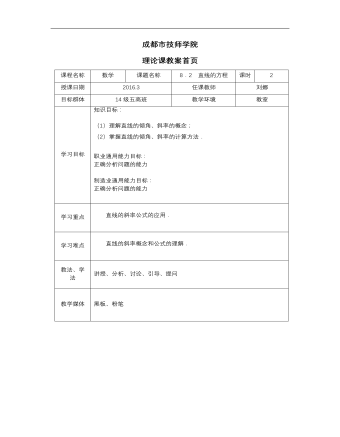
课程名称数学课题名称8.2 直线的方程课时2授课日期2016.3任课教师刘娜目标群体14级五高班教学环境教室学习目标知识目标: (1)理解直线的倾角、斜率的概念; (2)掌握直线的倾角、斜率的计算方法. 职业通用能力目标: 正确分析问题的能力 制造业通用能力目标: 正确分析问题的能力学习重点直线的斜率公式的应用.学习难点直线的斜率概念和公式的理解.教法、学法讲授、分析、讨论、引导、提问教学媒体黑板、粉笔
高教版中职数学基础模块下册:9.1《平面的基本性质》教学设计
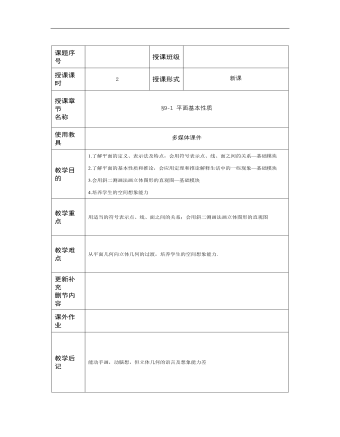
课题序号 授课班级 授课课时2授课形式新课授课章节 名称§9-1 平面基本性质使用教具多媒体课件教学目的1.了解平面的定义、表示法及特点,会用符号表示点、线、面之间的关系—基础模块 2.了解平面的基本性质和推论,会应用定理和推论解释生活中的一些现象—基础模块 3.会用斜二测画法画立体图形的直观图—基础模块 4.培养学生的空间想象能力教学重点用适当的符号表示点、线、面之间的关系;会用斜二测画法画立体图形的直观图教学难点从平面几何向立体几何的过渡,培养学生的空间想象能力.更新补充 删节内容 课外作业 教学后记能动手画,动脑想,但立体几何的语言及想象能力差
高教版中职数学基础模块下册:6.2《等差数列》教学设计
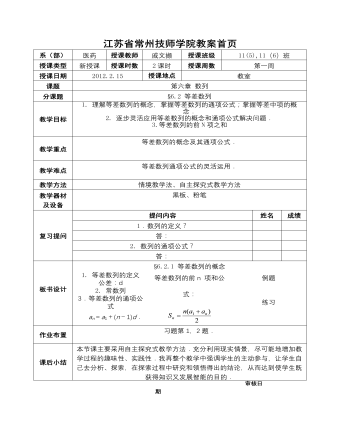
系(部)医药授课教师戚文撷授课班级11(5),11(6)班授课类型新授课授课时数2课时授课周数第一周授课日期2012.2.15授课地点 教室课题第六章数列分课题§6.2 等差数列教学目标1. 理解等差数列的概念,掌握等差数列的通项公式;掌握等差中项的概念. 2. 逐步灵活应用等差数列的概念和通项公式解决问题. 3.等差数列的前N项之和 . 4.培养学生分析、比较、归纳的逻辑思维能力. . 2. 3.教学重点等差数列的概念及其通项公式. 教学难点等差数列通项公式的灵活运用. 教学方法情境教学法、自主探究式教学方法教学器材及设备黑板、粉笔复习提问提问内容姓名成绩1.数列的定义? 答: 2. 数列的通项公式? 答: 板书设计 §6.2.1等差数列的概念 1. 1.等差数列的定义 公差:d 2.常数列 3.等差数列的通项公式 an=a1+(n-1)d. 等差数列的前n 项和公式: 例题 练习作业布置习题第1,2题.课后小结本节课主要采用自主探究式教学方法.充分利用现实情景,尽可能地增加教学过程的趣味性、实践性.我再整个教学中强调学生的主动参与,让学生自己去分析、探索,在探索过程中研究和领悟得出的结论,从而达到使学生既获得知识又发展智能的目的.
高教版中职数学基础模块下册:6.3《等比数列》教学设计
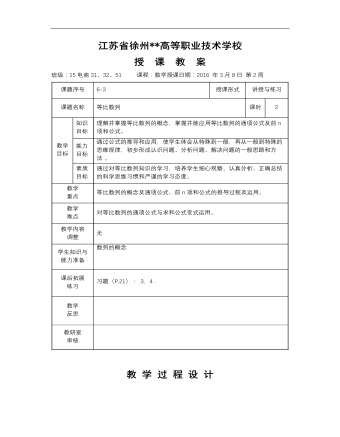
课题序号6-3授课形式讲授与练习课题名称等比数列课时2教学 目标知识 目标理解并掌握等比数列的概念,掌握并能应用等比数列的通项公式及前n项和公式。能力 目标通过公式的推导和应用,使学生体会从特殊到一般,再从一般到特殊的思维规律,初步形成认识问题、分析问题、解决问题的一般思路和方法 。素质 目标通过对等比数列知识的学习,培养学生细心观察、认真分析、正确总结的科学思维习惯和严谨的学习态度。教学 重点等比数列的概念及通项公式、前n项和公式的推导过程及运用。教学 难点对等比数列的通项公式与求和公式变式运用。教学内容 调整无学生知识与 能力准备数列的概念课后拓展 练习 习题(P.21): 3,4.教学 反思 教研室 审核
高教版中职数学基础模块下册:9.5《柱、锥、球及其简单组合体》教学设计
课题序号 授课班级 授课课时2授课形式 教学方法 授课章节 名称9.5柱、锥、球及其组合体使用教具 教学目的1、使学生认识柱、锥、球及其组合体的结构特征,并能运用这些特征描述生活中简单物体的结构。 2、让学生了解柱、锥、球的侧面积和体积的计算公式。 3、培养学生观察能力、计算能力。
小学数学人教版一年级上册《第几》说课稿
一、教材简析及学情分析1.教材简析:本课是人教版1年级上册数学三单元第三节第一课时的内容。教材通过一幅旅游窗口购票图,让学生在数购票人次序的过程中感知自然数的另一个含义——序数。让学生在具体情境中理解几和第几的不同,能准确表达几和第几的意思。2.学情分析在学习本节课之前学生早已有了“第几”这个概念,在学校无论是站队,还是自己的学号,以及在课表中学生们都会接触到“第几”这个知识。但是对于“几和第几”学生们并没有认真区分过,本节课的重点就是让学生在深刻理解第几的基础上明白“几和第几”的区别。二、教学目标1.通过情境体验与参与,使学生感知自然数序数的含义,知道自然数除了可用来表示事物有多少外,还可以用来表示事物的次序。2.通过教学,培养学生遵守公共秩序,文明守纪的良好品德。3.让学生感受到生活中处处有数学,增强学习的乐趣和自信心。三、教材处理1.主题图的使用:由于学生很少有独自购票的经历,书中主题图与学生的生活实际情况不相符,大胆将主题图舍去,换成同学排排队、小动物排排队、圆片排排队三次活动,层层递进,突破教学重难点。
(说课稿)部编人教版三年级下册《 慢性子裁缝和急性子顾客》
一、说教材《慢性子裁缝和急性子顾客》是统编小学语文三年级下册第八单元的第一篇课文,这篇课文讲述了急性子顾客让慢性子裁缝做衣服,结果到最后慢性子裁缝还没裁剪的事,告诉我们做事情要讲究效率,赶紧做完自己该做的事,才会有更多的时间去干其他事。不管干什么事情都要专心去做,不能磨磨蹭蹭浪费时间。本单元的主题是“有趣的故事,留下的不仅是开心的笑声,还有许多的思考”。本课紧扣单元主题,是一个十分幽默的故事,引人入胜的情节和别出心裁的结局充分体现了故事的精彩性和幽默性。二、说教学目标 1.会认“缝、箱”等12个生字,读准多音字“缝、夹”,会写“性,卷”等12个生字,正确读写“性子、布料”等词语。
人教部编版道德与法制三年级下册我的家在这里说课稿
6.了解小区物业的职责。 7.小结:我们的家就在这里,它是那么的安全,那么的舒适。 通过播放社区生活小视频,让学生产生共鸣,体会到社区人们生活的和谐,并初步理解社区这一概念。 配音图片介绍物管的工作职责形象地让学生明白物管在我们和谐舒适生活中的重要作用,增加对社区的热爱之情。 活动四、社区活动我参与 1.回顾社区开展的活动。 2.社区活动大体验。 活动项目:猜灯谜 套圈圈 3.设计社区活动。 4.小结:我们的家就在这里,我们都愿意为社区出谋划策,因为我们都是社区的小主人。 创设情境,组织学生参加社区活动大体验,让学生再一次体会社区活动带来的快乐,明白社区工作人员为我们和谐生活做出的努力,增加学生的幸福感。 设计社区活动是为了发挥学生的主人翁精神,鼓励他们参加社区建设,共建美好社区。
人教部编版道德与法制三年级下册请到我的家乡来说课稿
1.巧巧给大家带来了自己家乡“西藏”的一个神话传说,播放彔音听一听《“神女峰”的传说》。 2.在小组内分享自己收集的家乡风光照片和有关传说吧。 3.各组的优秀选手迚行全班展示,大屏幕同时展示学生收集的家乡风光照片、景点门票戒者画的家乡风景图。 4.你想到谁的家乡去 小结:同学们能以小组为单位,合作查找同一个家乡不同的资料,真棒正是你们课前像小蜜蜂一样辛勤地劳动,我们的课堂才会如此精彩大家为自己鼓鼓掌。 我们的祖国地大物博,我们的家乡各具特色,请到我的家乡来。 我们的家乡不仅有优美的自然风光和动人的传说,还有丰富的特产和优秀的家乡人,下节课我们继续交流。 5.布置作业 1制作家乡自然风光的剪报和画册。 2收集家乡特产和家乡名人资料,筹备“家乡特产发布会”。