-
新人教版高中英语必修2Unit 1 Cultural Heritage-Discovering Useful Structure教案二
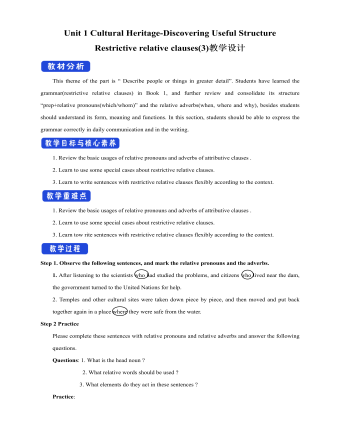
This theme of the part is “ Describe people or things in greater detail”. Students have learned the grammar(restrictive relative clauses) in Book 1, and further review and consolidate its structure “prep+relative pronouns(which/whom)” and the relative adverbs(when, where and why), besides students should understand its form, meaning and functions. In this section, students should be able to express the grammar correctly in daily communication and in the writing. 1. Review the basic usages of relative pronouns and adverbs of attributive clauses . 2. Learn to use some special cases about restrictive relative clauses.3. Learn to write sentences with restrictive relative clauses flexibly according to the context.1. Review the basic usages of relative pronouns and adverbs of attributive clauses .2. Learn to use some special cases about restrictive relative clauses.3. Learn tow rite sentences with restrictive relative clauses flexibly according to the context.Step 1. Observe the following sentences, and mark the relative pronouns and the adverbs. 1. After listening to the scientists who had studied the problems, and citizens who lived near the dam, the government turned to the United Nations for help.2. Temples and other cultural sites were taken down piece by piece, and then moved and put back together again in a place where they were safe from the water.Step 2 PracticePlease complete these sentences with relative pronouns and relative adverbs and answer the following questions.Questions: 1. What is the head noun ?2. What relative words should be used ?3. What elements do they act in these sentences ?
新人教版高中英语必修2Unit 1 Cultural Heritage-Listening&Speaking&Talking教案
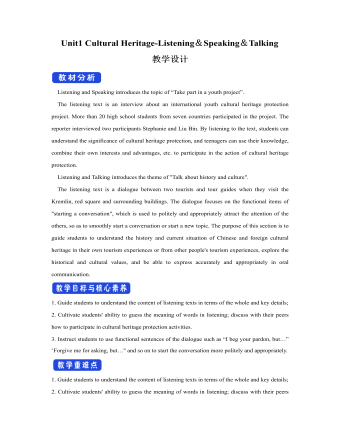
Listening and Speaking introduces the topic of “Take part in a youth project”. The listening text is an interview about an international youth cultural heritage protection project. More than 20 high school students from seven countries participated in the project. The reporter interviewed two participants Stephanie and Liu Bin. By listening to the text, students can understand the significance of cultural heritage protection, and teenagers can use their knowledge, combine their own interests and advantages, etc. to participate in the action of cultural heritage protection. Listening and Talking introduces the theme of "Talk about history and culture". The listening text is a dialogue between two tourists and tour guides when they visit the Kremlin, red square and surrounding buildings. The dialogue focuses on the functional items of "starting a conversation", which is used to politely and appropriately attract the attention of the others, so as to smoothly start a conversation or start a new topic. The purpose of this section is to guide students to understand the history and current situation of Chinese and foreign cultural heritage in their own tourism experiences or from other people's tourism experiences, explore the historical and cultural values, and be able to express accurately and appropriately in oral communication.1. Guide students to understand the content of listening texts in terms of the whole and key details; 2. Cultivate students' ability to guess the meaning of words in listening; discuss with their peers how to participate in cultural heritage protection activities.3. Instruct students to use functional sentences of the dialogue such as “I beg your pardon, but…” “Forgive me for asking, but…" and so on to start the conversation more politely and appropriately.
新人教版高中英语必修2Unit 4 History and Traditions-Reading and Thinking教案二
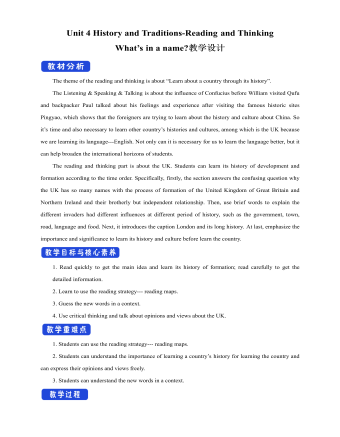
Step 5 While reading---Task 3Read the text again and answer the following questions.Q1: How many countries does the UK consist of ?4 Q2: What are the four countries of the United Kingdom?England, Wales, Scotland and Northern Ireland Q3: Which two were the first to be joined together ?England and WalesQ4: What are the two chief advantages of studying the history of a country ?The first one is to help you understand more about the country and its traditions.The second one is to make visiting it more enjoyable.Q5: What’s the author’s attitude towards studying the history ?Supportive/positiveStep 6 Post reading---Retell the textThe United Kingdom, Great Britain, Britain, England—many people are confused by (1)_____ these different names mean. In the 16th century, the nearby country of Wales (2) __________(join) to the Kingdom of England. In the 19 th century, the Kingdom of Ireland was added to create the United Kingdom of Great Britain and Ireland. Finally, the southern part of Ireland (3) ______ (break) away from the UK, which resulted in the full name we have today. However, most people just use the (4)_________(shorten) name: the UK. The four countries (5)__________ belong to the United Kingdom work together in some areas. There were four sets of invaders and the last group were the Normans. They had castles (6)_________(build) all around England and made changes (7)__________ the legal system. Studying the history of the country will make your visit much more (8)_________(enjoy). The capital city London is (9)___ ancient port city that has a history (10)______(date) back to Roman times. 1. what 2.was joined 3.broke 4.shortened 5.that 6. built 7.to 8.enjoyable 9.an 10.dating Step 6 Homework
新人教版高中英语必修2Unit 4 History and Traditions-Reading for Writing教案
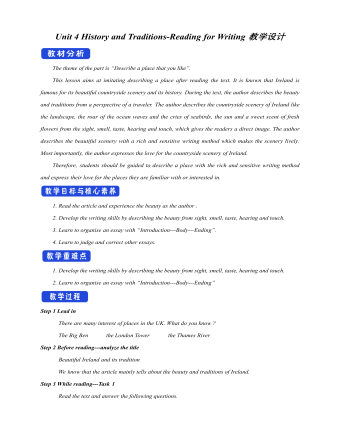
Step 1 Lead inThere are many interest of places in the UK. What do you know ?The Big Ben the London Tower the Thames RiverStep 2 Before reading---analyze the titleBeautiful Ireland and its traditionWe know that the article mainly tells about the beauty and traditions of Ireland. Step 3 While reading---Task 1Read the text and answer the following questions.Q1: What makes the Irish countryside exciting and inspiring?Its beauty and how it offers something for all the scenes.Q2: What are the best ways to experience some Irish traditions and cultures?By stopping by a village pub and relaxing with a drink and traditional meal while listening to music and watching dancingQ3: What is the meaning of “breathe in the sweet scent of fresh flowers while birds greet the new day with their morning song ?”It means to not just smell but also breathe in the smell of fresh flowers early in the morning as the birds sing their first song of the new day.Q4: What are the best ways to experience Chinese traditions and customs ?By travelling to different places and using all your senses to experience everything and by interacting with local people.Step 4 While reading---Task 2Analyze the descriptive paragraph1. Identify and underline the paragraph’s introductory sentence and the ending sentence.Introductory sentence: Ireland’s beautiful countryside has always had a great influence on its people and traditions.Ending sentence: And if you introduce yourself to a friendly face, you are more than likely to experience local culture and customs first-hand.2. The paragraph talks about different senses in different places. Write the senses and places in the order that they appear.
新人教版高中英语必修2Unit 5 Music-Listening&Speaking&Talking教案
choir memberspeople to run food stands people to sell festival ticketspeople to sell music CDspeople to set up equipmentmusical performersStep 2: Listen to the announcement again and answer the questions. ? 1. What kind of songs will Grace Davis sing at the festival?? 2. Who can try out as a performer?? 3. What can those who think they do not have musical talent do?? 4. How can students volunteer to take part?? Talking about preferences:? Would you prefer doing ..?? What would you prefer to do?? Would you rather do .... or ….?? What would you rather do?? I'd prefer .... to ..? I'd rather have ... than .. Step 3: Speaking ProjectWork in groups. Role-play the conversation or make a new one.? Debbie: Where have you been? You missed the announcement about the music festival.? John: I was at the doctor's office. Music festival?? Frank: Yes, it's going to be next month on the school sports field. John, you can play the piano. How about playing it at the festival?? John: Well, I'd rather play the violin. I can play Liang Zhu.? Frank: Wow! Sounds good. What about you, Debbie? ? Debbie: Actually, I don't have much musical ability. I'd prefer just to help out with the crowds.? Frank: You can sell tickets or work at a food stand.? John: So can I assume that the aim of the festival is to raise money?? Debbie: Yes. All of the money will go to charity.
新人教版高中英语必修2Unit 5 Music-Reading and Thinking教案二
1. Get basic information about Eric; read deeply to understand the history and development of the virtual choir.2. Understand what the function of the virtual choir is and how to make a virtual choir.3. Understand the meaning of some languages in the context of the text through question guidance, such as “Many people do not have close friends or contacts who have the same interest in music.” and so on.Step 1 Leading-in1. Answer the following questions.Q1:Do you know the Apps like Tik Tok and Quick Hand?Q2: Do you want to make a Tik Tok video or a Quick Hand video?2. Play a Tik Tok video Step 2: Understanding the title Q1:What does the title mean ?Q2: Is the article a narration or exposition? Why? Q3: Can you change the title ? If you can, what is the title?Step 3: Scanning the whole text and getting the basic information1. Answer the following questions.Q1:Who came up with the idea for a virtual choir?Q2: Where did Eric studied the musical composition?Q3: What is his song?2. Find the main idea of each paragraph3. Deal with some new words.Step 4: Reading carefully to get detailed informationPara 1 How to make a virtual choir1. PreparationA. tools: a virtual camera; an Internet connectionB. hero/heroin: friends or some individuals who have the same interests2. Process
人教版高中地理必修2城市化精品教案
1.改善城市环境:治理河流、控制大气污染物、大力加强绿化建设为改善城市环境,上海市全面展开对大气、河流、噪声等多方面的治理工作。如苏州河的治理、降低城市污染物浓度、加强绿化建设,截止1990年,市区绿化覆盖率达到20.3%。2.改善城市交通、改善居住条件扩宽主干道,修建环城公路,修筑了南浦大桥和扬浦大桥,新修城市高架公路和地铁,改造住宅。3.控制城市规模建立卫星城,开发新区,有效地控制城市中心区的规模。思考:什么时候许多国家采取措施保护和改善城市环境?你认为可以采取哪些措施来保护和改善城市环境?上海市保护和改善城市环境的措施:上海的卫星城有哪些?上海新建了哪个新区?目前浦东新区在上海的地位如何?建立卫星城和开发新区可以起到什么作用?上海市为改善交通条件,做了哪些工作?
《一个消逝了的山村》说课稿 2021—2022学年统编版高中语文选择性必修下册
这几段内容传达出的是“要敬畏生命,尊重生命;更要敬畏大自然,尊重大自然,爱护大自然”的主旨内涵,因此让学生通过自由朗读的方式,再次体会冯至对这个消逝了的山村的细致的美好的描绘,感悟冯至传达出的对生命,对自然的理解和思考。5.最后一个自然段的解读依然是交给学生,先齐读课文,再让学生自主分享自己的体会或疑惑。但在这一环节我也设计了两个我认为必须解答的两个问题,一是怎么理解“在风雨如晦的时刻”;二是“意味不尽的关联”是指什么。我认为这两个问题一个涉及到写作背景,一个涉及到对全文主旨的一个整体把握,能够进一步帮助学生理解散文的深刻内涵和主旨,让学生有意识的在阅读散文过程中通过背景知识进行理解。既尊重学生的个性化解读,又能够让学生有意义学习,完成预设的教学目标。如果学生没有提到这两处,那我就需要做出补充。
《登高》说课稿(三)2022-2023学年统编版高中语文必修上册
④结合杜甫的身世遭遇,你认为这里的“艰难苦恨”包含着哪些情感?第五步是拓展延伸对比阅读李白的《梦游天姥吟留别》,讨论诗体形式与诗人情感抒发之间的关系。第六步是达标检测我将紧扣考试题型,以理解性默写的形式,当堂检验学生对诗歌的掌握情况第三环:课后跟踪课后作业:①背诵并默写诗歌②鉴赏诗歌《秋兴八首》 (其一) ,找出诗歌所用意象,体会意境,表达情感。玉露凋伤枫树林,巫山巫峡气萧森。江间波浪兼天涌,塞上风云接地阴。丛菊两开他日泪,孤舟一系故园心。寒衣处处催刀尺,捣衣砧上拂还来。最后,我来说一说我的板书设计,我的板书设计简洁明了,清晰直观,能够突出本课的重点和难点。以上就是我本说课的全部内容,再次感谢各位考官的聆听!
《屈原列传》说课稿 2021—2022学年统编版高中语文选择性必修中册
第一环节:落实基础,整体感知由于本课含有较多的通假字,词类活用和文言句式,如:“离骚者,犹离忧也”中的“离”通罹难的“罹”,以及注释中并没有出现的“齐与楚从亲”的“从”通“纵”,合纵的意思。 “秦虎狼之地”中的“虎狼”是名词做状语。还有判断句如“屈原者,名平,楚之同姓也。”等。字词是学生读懂文章的基础,教师请数位学生通过逐段朗读结合教师的讲解,既订正了字音,又梳理的文言实、虚词和文言句式,体现了语文是基础性和工具性学科。疏通字词和句子后,教师请学生默读课文,划分层次,提取圈点出关键词。学生边读边思考,教师和学生一起完成本课提纲,教师根据学生答复适时板书。(板书内容见第四)此外,对于文本的第12自然段,出现了屈原和渔父的对话,教师请学生分角色朗读,领会人物的情感,又可以活泼课堂气氛和激发学生的表现欲、求知欲。
《包身工》说课稿(三) 2021-2022学年统编版高中语文选择性必修中册
一、说教材(一)、 说教材的地位与作用本单元属于“中国革命传统作品研习任务群”板块,学习的是新闻和报告文学。要求学生体会学生在新时代人民当家做主的豪情和壮志,继承并发扬爱国主义情感。这篇文章是一篇报告文学,通过分析这类文体的主要内容和写作特点能培养学生阅读报告性文。(二)、说课标《普通高中语文课程标准》要求,学习报告性文学要理解其基本内容和社会影响,因此根据课程要求,我会重点讲解包身工的遭遇,并通过对包身工遭遇的分析来引导学生把握作品。(三)、说教学目标根据普通高中课程标准,结合本单元学习目标以及文体特点我制定如下教学目标:1. 知识与能力了解报告文学的一般特征与结构特点,提高阅读能力和筛选信息能力。2. 过程与方法通过对课文的主要内容和写作特点的分析,体会文章主旨,把握报告文学的特征。3. 情感态度与价值观认识包身工制度的残酷与罪恶,尊重人权及劳动权利,关注社会现实,提高社会责任感。
《过秦论》说课稿 2021—2022学年统编版高中语文选择性必修中册
三、教学方法为了突出重点,突破难点,完成教学目标,选择行之有效的教学方法是非常关键的。根据课程标准的要求和本节课的特点,为了关注学生的个体差异和不同的学习需求,充分调动学生学习的积极性,培养学生阅读和分析文章的能力,我主要采用以下的教学方法:1、悬念导入法。用悬念导入能激发起学生对文言文阅读的兴趣,充分调动学生学习的主动性。2、根据教师主导作用与学生主动性相结合的原则,选择了以语言传递信息为主的方法,讲授法。四、学法通过初中的学习,学生对古文知识已经有了一定的掌握,但是对这种古代散文比较少见,特别是叙史和议论结合的写法更是陌生。所以学习这篇课文的时候,通过反复地诵读,分析句型,对比句型的意思,达到疏通文意,这样,学生通过朗读理解法、质疑提问法、自主讨论探究法能复述课文,了解文章层次,理解文章主旨含义。
《乡土中国》说课稿 2021-2022学年统编版高中语文必修上册
活动一:整体感知,梳理要点新修订《课程标准》指出:重视学生的思维发展与提升,如直觉思维、形象思维、抽象思维等。为此,我设计了“梳理要点、绘制思维导图”两个部分,引导学生在阅读中整体感知文本。1、梳理章节要点,明确内容要素《家族》:以西洋家庭特点为对照,分析中国乡土社会家庭的特点。《男女有别》:主要讨论乡土社会感情定向的问题,偏向同性交往,遏制男女交往。2、展示思维导图,凸显整体关联引导同学制作多种思维导图:流程图式、树状图式、爪形图式活动二:走进文本,深化认知新修订《课程标准》指出:学会语文运用的方法,有效地提高语文能力,并在学习语言文字运用的过程中促进方法、习惯及情感、态度与价值观的综合发展。所以在教学中我引导学生掌握整本书阅读的基本方法,即以速读、跳读的方式地毯式地搜索书中关于“中西家庭差别”的内容,得出乡土家族的六个方面的特点,学生分别结合生活中的现象阐述了这六个方面的特点在生活中的具体体现。
《包身工》说课稿(二) 2021-2022学年统编版高中语文选择性必修中册
3、通过分析理解作者是如何在典型环境中刻画出典型人物的。(设计意图:因为《普通高中语文新课程标准》中要求学生把握报告文学的语言特色,所以需要分析文中重点语句的语言特色。同时,由于报告文学的艺术价值体现在文学性上,它不能像新闻报道那样,只有事件梗概,它必须刻画人物形象,必须有环境等方面的描写,加强语言的艺术感染力,所以在教学过程中要注重对典型环境中的典型人物的分析。)三、课时安排:两课时四、教学设计:(第一课时的教学过程)1、通过表格来对比分析报告文学与新闻的异同点。使学生明确理解到报告文学的艺术价值在于它的文学性,而其文学性主要通过对人物的刻画、环境的描写等方面的文学手段的综合运用。2、为了更好的了解本文,要学生相互分享收集到的时代背景资料及作者简介。3、让学生快速浏览课文找出本文的表层结构,初步感知到本文的表层结构是按照时间顺序来叙述描写包身工一天的活动及按事物发展的顺序叙述包身工制度的产生发展及膨大。
《荷花淀》说课稿 2020-2021学年统编版高中语文选择性必修中册
教师深情旁白,歌手的动情演唱,让学生会沉浸在夫妻之情、家国之爱的深深思索中,此时的课堂气氛应是沉静的。学生在这种情感体验中,一定能写出很精彩的对话]为了将这种课堂的高潮气氛不至于因学习问题的转移而跌落,我又设计了过渡语,在同学们的思绪有点紊乱中(我预想此时同学们的思绪是这样的),教师说:毕竟,藕断丝连的妇女们,对丈夫的不辞而别心存依恋。或许她们还有许多悄悄话还未来得及向自己心爱的丈夫表白;或许她们为丈夫的安全茶饭不思;或许她们有一日不见,如隔三秋的感觉。因此,几个青年妇女就聚在水生家里商量探夫的事。虽然我们未能参与其中,但我们可以听其声,见其人,感其情。不信请……)(这就实现了课堂教学环节的自然巧秒过渡,也同样展示了我的上课风格)
《拿来主义》说课稿(二) 2021-2022学年统编版高中语文必修上册
四、说教学过程(一)结合现实、自然导入随着我国开放的深入发展,国外的科学、文化、技术以及资产阶级的腐朽思想,生活作风等等也随之大量涌来,我们应采取怎样的态度和方法才是正确的呢?鲁迅先生在30年代就继承文化遗产问题曾写过一篇杂文,我们可以从中获得那些启示呢?(二)整体感知、疏瀹文意1.请同学介绍“我所知道的鲁迅”,教师补充写作背景。教师有针对性的进行预习检查,能促使学生养成课前预习的习惯。2.理清文章的思路,分析文章的整体结构教师范读课文,针对较难的字音进行正读。学生快速浏览课文,把握全文框架,小组讨论后分出层次。(让学生通过自主合作探究来概括文意可以让同学们参与到教学活动中,锻炼学生实际动手能力)
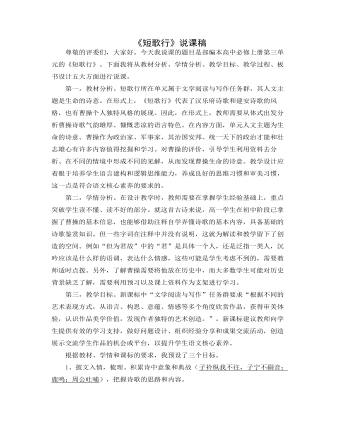
《短歌行》说课稿2022-2023学年统编版高中语文必修上册
第二课时为知人。即利用预习所查到的资料、学生之间的分享以及教师预备的材料,合作探究三个问题:曹操为何如此渴望贤才?天下归心的愿望是否实现?如何评价曹操?本课时采用创设情境的方式,从刘备、曹丕、晚年曹操等多重角度评价曹操,自领角色,利用资料有逻辑地证明自己的观点。教师出示不同学者评价,师生共同研讨评价的技巧和原则,尝试写作短小文学评论。这是解决忧的果。第三课时为回味。创设诵读比赛的情境,在比赛和评价中研讨标点符号的作用,如何读出曹操诗歌独特的特点,以及带着对曹操的认识读出自己的理解。(每组评出最佳朗读者和最佳评论员,上传优秀视频)。这是为了让学生最后读出忧。第五,板书设计。以上是我本节课教学设计的板书,体现了分析本首诗的基本思路和学习方法。
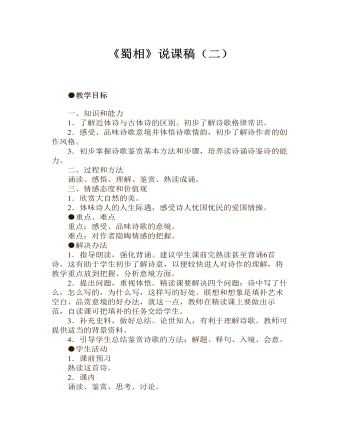
《蜀相》说课稿(二) 2021-2022学年统编版高中语文选择性必修下册
2.体味诗人的人生际遇,感受诗人忧国忧民的爱国情操。●重点、难点重点:感受、品味诗歌的意境。难点:对作者隐晦情感的把握。●解决办法1.指导朗读,强化背诵。建议学生课前完熟读甚至背诵6首诗,这有助于学生初步了解诗意,以便较快进人对诗作的理解,将教学重点放到把握、分析意境方面。2.提出问题,重视体悟。精读课要解决四个问题:诗中写了什么,怎么写的,为什么写,这样写的好处。联想和想象是填补艺术空白、品赏意境的好办法,就这一点,教师在精读课上要做出示范,自读课可把填补的任务交给学生。3.补充史料,做好总结。论世知人,有利于理解诗歌。教师可提供适当的背景资料。4.引导学生总结鉴赏诗歌的方法:解题、释句、入境、会意。
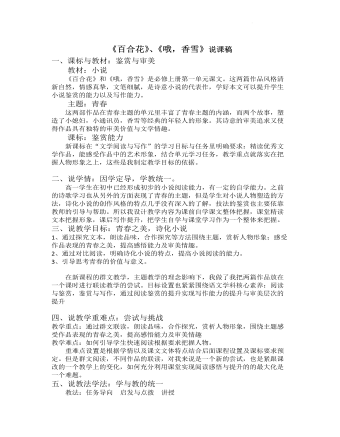
《百合花》《哦,香雪》说课稿 2022-2023学年统编版高中语文必修上册
1、导入:青春之美,弥足珍贵,青春的价值又各不相同,如果革命之志是毛泽东青春的美好,那蓬勃的创造力就是郭沫若的青春之歌,如果奉献与牺牲是闻一多青春的价值,那么自由就是雪莱青春的底色,我们前两节课遨游在诗歌的天空,那么我们这节课我们要来到小说的园地,看看青春在这片小说的沃土里展现怎样的颜色。目的:创设诗意,进入情境,延继单元主题,引出学习内容2、学习任务一:预习检查,概括情节目的:检查预习成果,落实整体感知把握主旨的课前学习任务。3、学习任务二:情境探究:品人物悟青春之美假设我校文学社正在举办“文学中最美的青春人物”评选活动,让同学在《百合花》与《哦,香雪》中推选出最能体现青春美好的人物,还需要附上简短的推荐理由以便评委组评议。谁最美?大家为此争论不休,如果你也参与推荐,那你觉得谁才是最美的青春人物?你会为他写上怎样的推荐理由?(思考提示:依据表格内容思考并完成表格,小组内交流3分钟,推选代表回答)
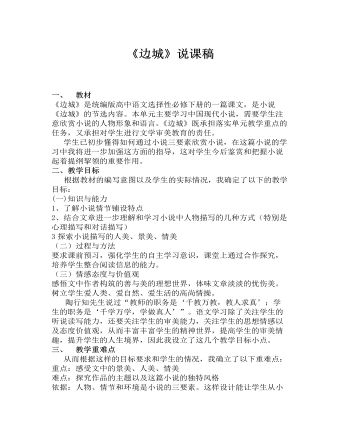
《边城》说课稿2021-2022学年统编版高中语文选择性必修下册
(重点突破一)1、分析环境描写 探讨边城的景美?(重点突破二)2、分析人物形象 探讨边城的人性美和人情美?至此,以三要素为切入口,文章的重点已分析完毕,下一个步骤就是突破难点。第二课时首先回顾上节课所讲的内容 (5分钟)(四)(难点突破)探究主题我设计了这样两个问题:1、小说表达了什么样的主题?(5分钟)2、有人说:《边城》从头到尾都隐藏着一种淡淡的愁绪,说说你的认识?从这篇小说中你可以看出沈从文先生的哪些显著的写作特点?(15分钟)这是两个定向设问的探究题,目的性很明确,就是为了突破难点,探究文章主旨。为了帮助学生理解文章的主旨,我用多媒体向学生 介绍《边城》的写作背景,给出“边城”的解题。对于第一个题,学生的答案可能会有很多种,比如“美”“爱”“纯”“和谐”“自然”等等,只要能基本概括,理由充足即可。