-
新人教版高中英语必修1Unit 4 Natural Disasters-Reading & Thinking教案
5. Read to get detailed information about Paragraph 5.Q1. What shows the revival of Tangshan?Q2. How can Tangshan revive itself and get up on its feet again?Q3. In times of disasters, how can we go through it?T: In times of disasters, we should unify, show the wisdom and stay positive.Step 4 Activity 4 Highlighting the theme and reflecting1. Make a summary of the text.2. Further understand the titleQ: After our learning, why do you think the earth didn’t sleep on that night?T: An earthquake happened. The people in the earthquake suffered a lot, and the people outside Tangshan were concerned about the people there a lot.3. Reflect through discussion on what can be learnt after reading.T: Disasters are powerful. Unpreparedness can be deadly. Life is weak, but if people work together to help each other, disasters can be defeated.There is no love from disaster, but we have love in the human heart.Step 5 Assignment How does the writer convey that the earthquake was deadly, and that people were helpless during the earthquake? Try to find some attractive and impressive expressions and note them down.
新人教版高中英语必修1Unit 5 Languages Around the World-Reading for Writing教案
Step 3: Read to sum upRead it again and sum up the problems of the three students, and then write down the advice that was given from others.Step 4: Work in pairs. List your learning problems in English and brainstorm some useful advice.Useful expressions ? I don't know how to…... Is a big difficulty for me. I cannot ...? You might try …. It's very important to…? I have no idea how/what .My biggest problem is .... ? I (also) have trouble with. My advice is …. This worked for me.? l cannot understand the teachers’ English in class.Step 5 Homework:为提高我校学生的英语口语水平,我们将举办英语演讲比赛(English- speaking contest),请你根据下面的信息,以学生会(the Students‘ Union)的名义写一份海报,欢迎全校同学参加,届时特邀本校美籍教师史密斯先生颁奖。? 报名时间 9月30日以前(报名:signup)? 报名地点 学生会办公室? 比赛时间 10月9日晚7:00~9:00? 比赛地点 学校大会议室? 奖励 前8名
新人教版高中英语必修2Unit 1 Cultural Heritage-Discovering Useful Structure教案二
This theme of the part is “ Describe people or things in greater detail”. Students have learned the grammar(restrictive relative clauses) in Book 1, and further review and consolidate its structure “prep+relative pronouns(which/whom)” and the relative adverbs(when, where and why), besides students should understand its form, meaning and functions. In this section, students should be able to express the grammar correctly in daily communication and in the writing. 1. Review the basic usages of relative pronouns and adverbs of attributive clauses . 2. Learn to use some special cases about restrictive relative clauses.3. Learn to write sentences with restrictive relative clauses flexibly according to the context.1. Review the basic usages of relative pronouns and adverbs of attributive clauses .2. Learn to use some special cases about restrictive relative clauses.3. Learn tow rite sentences with restrictive relative clauses flexibly according to the context.Step 1. Observe the following sentences, and mark the relative pronouns and the adverbs. 1. After listening to the scientists who had studied the problems, and citizens who lived near the dam, the government turned to the United Nations for help.2. Temples and other cultural sites were taken down piece by piece, and then moved and put back together again in a place where they were safe from the water.Step 2 PracticePlease complete these sentences with relative pronouns and relative adverbs and answer the following questions.Questions: 1. What is the head noun ?2. What relative words should be used ?3. What elements do they act in these sentences ?
新人教版高中英语必修2Unit 2 Wildlife Protection-Reading for Writing教案二
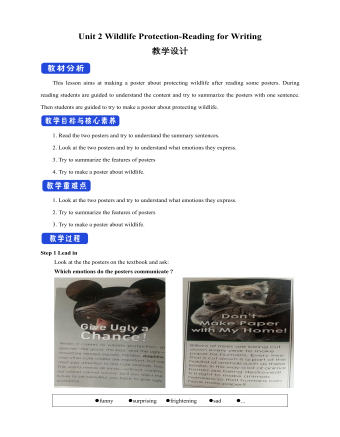
This lesson aims at making a poster about protecting wildlife after reading some posters. During reading students are guided to understand the content and try to summarize the posters with one sentence. Then students are guided to try to make a poster about protecting wildlife.1. Read the two posters and try to understand the summary sentences.2. Look at the two posters and try to understand what emotions they express.3. Try to summarize the features of posters4. Try to make a poster about wildlife.1. Look at the two posters and try to understand what emotions they express.2. Try to summarize the features of posters3. Try to make a poster about wildlife.Step 1 Lead inLook at the the posters on the textbook and ask:Which emotions do the posters communicate ?Step 2 Read the poster and answer the questions.1. What do you think of the animals in the poster on the left ?I think it is frightening and ugly.2. Why do we should protect the ugly animals ?All species--the good, the bad, and the ugly-- should be treated equally.The world needs all kinds--without variety, our planet cannot survive.3. Why are billions of trees being cut down every year ?To make paper for humans.4. What result will be lead to after the trees are cut down ?A lost of animal homes are being destroyed./The habitat of wildlife is being destroyed.Step 3 Find the feature of posters1. What does each poster use to stir up emotions ?On the left, it makes us a little frightened and it looks a little ugly, but it can activate our curiosity--What is it? And What is wrong with it?On the right, it makes us feel a little sad and want to protect them.
新人教版高中英语必修2Unit 2 Wildlife Protection-Listening and Speaking教案
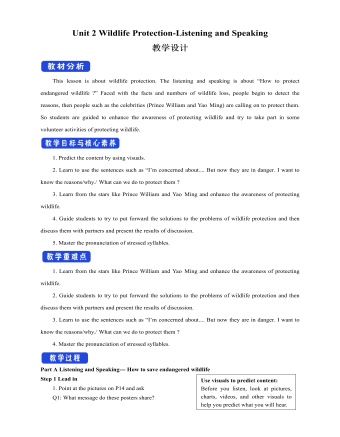
This lesson is about wildlife protection. The listening and speaking is about “How to protect endangered wildlife ?” Faced with the facts and numbers of wildlife loss, people begin to detect the reasons, then people such as the celebrities (Prince William and Yao Ming) are calling on to protect them. So students are guided to enhance the awareness of protecting wildlife and try to take part in some volunteer activities of protecting wildlife.1. Predict the content by using visuals. 2. Learn to use the sentences such as “I’m concerned about.... But now they are in danger. I want to know the reasons/why./ What can we do to protect them ?3. Learn from the stars like Prince William and Yao Ming and enhance the awareness of protecting wildlife.4. Guide students to try to put forward the solutions to the problems of wildlife protection and then discuss them with partners and present the results of discussion.5. Master the pronunciation of stressed syllables.1. Learn from the stars like Prince William and Yao Ming and enhance the awareness of protecting wildlife.2. Guide students to try to put forward the solutions to the problems of wildlife protection and then discuss them with partners and present the results of discussion.3. Learn to use the sentences such as “I’m concerned about.... But now they are in danger. I want to know the reasons/why./ What can we do to protect them ?4. Master the pronunciation of stressed syllables.Part A Listening and Speaking--- How to save endangered wildlifeStep 1 Lead in1. Point at the pictures on P14 and ask Q1: What message do these posters share?
新人教版高中英语必修2Unit 2 Wildlife Protection-Reading and Thinking教案二
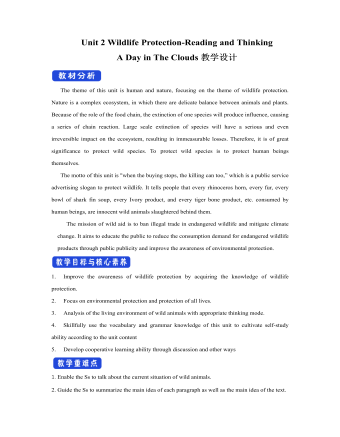
The theme of this unit is human and nature, focusing on the theme of wildlife protection. Nature is a complex ecosystem, in which there are delicate balance between animals and plants. Because of the role of the food chain, the extinction of one species will produce influence, causing a series of chain reaction. Large scale extinction of species will have a serious and even irreversible impact on the ecosystem, resulting in immeasurable losses. Therefore, it is of great significance to protect wild species. To protect wild species is to protect human beings themselves. The motto of this unit is "when the buying stops, the killing can too,” which is a public service advertising slogan to protect wildlife. It tells people that every rhinoceros horn, every fur, every bowl of shark fin soup, every Ivory product, and every tiger bone product, etc. consumed by human beings, are innocent wild animals slaughtered behind them. The mission of wild aid is to ban illegal trade in endangered wildlife and mitigate climate change. It aims to educate the public to reduce the consumption demand for endangered wildlife products through public publicity and improve the awareness of environmental protection.1. Improve the awareness of wildlife protection by acquiring the knowledge of wildlife protection.2. Focus on environmental protection and protection of all lives.3. Analysis of the living environment of wild animals with appropriate thinking mode.4. Skillfully use the vocabulary and grammar knowledge of this unit to cultivate self-study ability according to the unit content5. Develop cooperative learning ability through discussion and other ways1. Enable the Ss to talk about the current situation of wild animals.2. Guide the Ss to summarize the main idea of each paragraph as well as the main idea of the text.
新人教版高中英语必修2Unit 3 The Internet-Listening &Speaking&Talking教案二
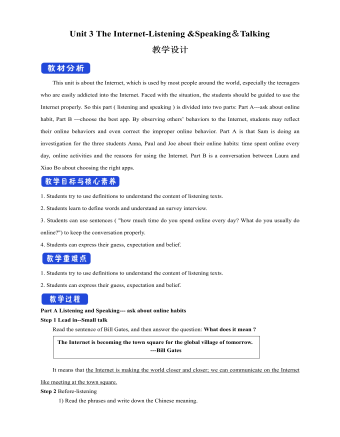
From the pictures in the text and the title--- choose the best app, we can know that this part is about how to save money by using apps.Step 2 While-listening1. Laura and Xiao Bo are talking about apps. Listen to their conversation and find out what apps they want.Xiao Bo is looking for a(n) exercise app to help him get in shape.Laura would like an app for getting rich and another that will make her grades better.2. Listen again. Are the sentences true T or false F?1). Both of Xiao Bo's apps keep track of the steps he takes._____2). Xiao Bo's second app can help him make a fitness plan._____3). Laura needs an app that will help her get discounts.______4). Laura needs an app that will add money to her bank account._______F T F T3. Listen once more and tick the sentence you hear. Underline the words used to express predictions, guesses, and beliefs.Predictions, Guesses, and Beliefs________It might help me walk more.________My guess is that it wouldn't work.________I imagine this app would help me get fit faster________I suppose that would be good.________I guess you could save a little with this app.________I suppose there would be some problems, too.________I believe this app could help me get thinner.
新人教版高中英语必修2Unit 3 The Internet-Reading and Thinking教案二
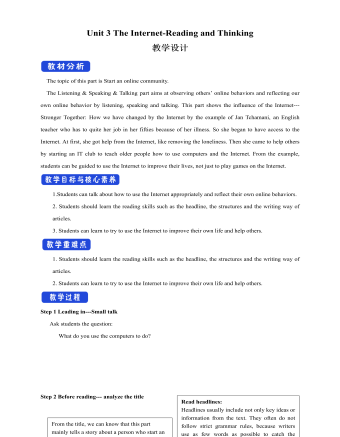
Q5:What's Jan's next goal?Her next goal is to start a charity website to raise money for children in poor countries.Q6:What can we learn from her experiences?We learn that when we go through tough times, we can find help and support from other people online. We learn that we can feel less lonelyStep 5: While reading---rethinkingQ1: What is Jan’s attitude to the Internet ?Thankful/Grateful, because it has changed her and her life.Q2: What writing skills is used in the article ?Examples(Jan’s example, the 59-year-old man’s and the 61-year-old woman’s example)Q3: Can you get the main idea of the article ?The Internet has changed Jan’s life/Jan’s life has been changed by the Internet.Step 6 Post reading---Retell the storyMuch has been written about the wonders of the World Wide Web. There are countless articles (1)telling(tell) us how the Internet has made our lives more convenient. But the Internet has done a lot (2)more(much) for people than simply make life more convenient. People’s lives (3) have been changed(change) by online communities and social networks so far. Take Jan for example, who developed a serious illness that made her (4)stuck(stick) at home with only her computer to keep (5)her(she) company. She joined an online group (6)where she could share problems, support and advice with others. She considered the ability to remove the distance between people as one of the greatest (7)benefits(benefit). She was so inspired (8)that she started an IT club in which many people have been helped. She has started to learn more about how to use the Internet to make society better. Her next goal is to start a charity website to raise money (9)for children in poor countries. Jan’s life has been (10)greatly(great) improved by the Internet.
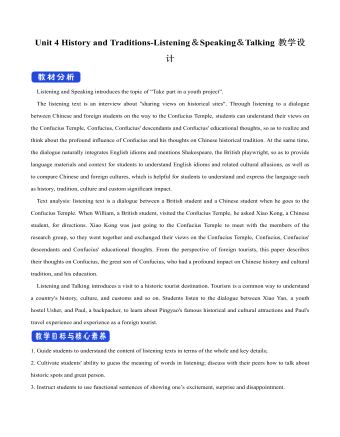
新人教版高中英语必修2Unit 4 History and Traditions-Listening&Speaking&Talking教案二
Listening and Speaking introduces the topic of “Take part in a youth project”. The listening text is an interview about "sharing views on historical sites". Through listening to a dialogue between Chinese and foreign students on the way to the Confucius Temple, students can understand their views on the Confucius Temple, Confucius, Confucius' descendants and Confucius' educational thoughts, so as to realize and think about the profound influence of Confucius and his thoughts on Chinese historical tradition. At the same time, the dialogue naturally integrates English idioms and mentions Shakespeare, the British playwright, so as to provide language materials and context for students to understand English idioms and related cultural allusions, as well as to compare Chinese and foreign cultures, which is helpful for students to understand and express the language such as history, tradition, culture and custom significant impact.Text analysis: listening text is a dialogue between a British student and a Chinese student when he goes to the Confucius Temple. When William, a British student, visited the Confucius Temple, he asked Xiao Kong, a Chinese student, for directions. Xiao Kong was just going to the Confucius Temple to meet with the members of the research group, so they went together and exchanged their views on the Confucius Temple, Confucius, Confucius' descendants and Confucius' educational thoughts. From the perspective of foreign tourists, this paper describes their thoughts on Confucius, the great son of Confucius, who had a profound impact on Chinese history and cultural tradition, and his education.Listening and Talking introduces a visit to a historic tourist destination. Tourism is a common way to understand a country's history, culture, and customs and so on. Students listen to the dialogue between Xiao Yan, a youth hostel Usher, and Paul, a backpacker, to learn about Pingyao's famous historical and cultural attractions and Paul's travel experience and experience as a foreign tourist.
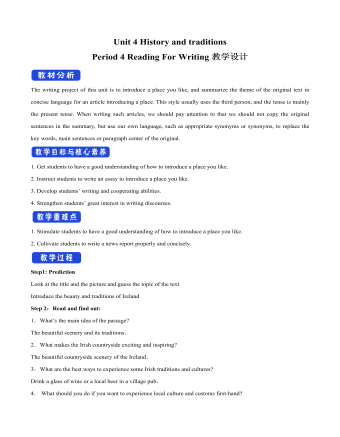
新人教版高中英语必修2Unit 4 History and traditions教案
这个地区有着深厚的传统。既学既练:为了让更多的外国游客了解中国文化,欣赏中国美丽的自然风光,感受中国发生的巨大变化,某外文杂志社将出版一本英语小册子来介绍中国的旅游景点。该杂志社邀请你为该小册子写一篇英语短文来介绍杭州,内容包括:1.杭州的位置(中国东南部)、面积(16 000多平方公里)及历史(2 200多年)等;2.杭州的旅游特色(自然风景、传统文化、特色小吃等);3.希望更多的游客来杭州参观。注意:1.词数80左右;2.可适当增加细节,以使行文连贯。Located in the southeast of China, Hangzhou is a beautiful city.Dating back more than 2,200 years, Hangzhou covers an area of more than 16,000 square kilometers.In Hangzhou, you can visit the West Lake, whose scenery is fascinating.In addition, you can’t miss its cultural relics and historical sites, from which you will learn more about excellent Chinese traditional culture and traditions.In Hangzhou, the special snacks are famous and visitors from different parts of the world think highly of them.As a tourist attraction, Hangzhou attracts a large number of visitors from home and abroad every year.Once you come to China, Hangzhou is a scenic spot you can’t miss.
新人教版高中英语必修3Unit 2 Morals and Virtues教学设计三
The joke set her crying.这个玩笑使她哭起来。Step 5 ReadingActivity 31. Students read the small text in activity 3. The teacher provides several small questions to check whether students understand the content of the text and the ideographic function of the -ing form in the text.*Where are those people?*Why did Dr Bethune come to China?*How did he help the Chinese people during the war?*What did Chairman Mao Zedong say about him?2. Ss try to rewrite some sentences using the -ing form. Then check the answers. When checking the answers, the teacher can ask different students to read the rewritten sentences and give comments.Answers:1. he became very interested in medicine, deciding to become a doctor.2. …after hearing that many people were dying in the war.3. Helping to organise hospitals, he taught doctors and nurses, and showed people how to give first aid./ He helped to organise hospitals, teaching doctors and nurses, and showing people how to give first aid.4. …praising Dr Bethune as a hero to be remembered in China.Step 6 PracticeActivity 4Students complete grammar activities 2 and 3 on page 69 of the workbook.Step 6 Homework1. Understand and master the functions and usage of the -ing form;2. Finish the other exercises in Using structures.1、通过本节内容学习,学生是否理解和掌握动词-ing形式作宾语补足语语和状语语的功能和意义;2、通过本节内容学习,学生能否正确使用动词-ing形式描述人物的行为、动作及其经历;3、通过本节内容学习,学生能否独立完成练习册和导学案中的相关练习。
人教版高中政治必修1第三课多彩的消费教案
二、做理智的消费者1、量入为出,适度消费2、避免盲从,理性消费3、保护环境,绿色消费4、勤俭节约,艰苦奋斗十、教学反思本课的设计采用了课前下发预习学案,学生预习本节内容,找出自己迷惑的地方。课堂上师生主要解决重点、难点、疑点、考点、探究点以及学生学习过程中易忘、易混点等,最后进行当堂检测,课后进行延伸拓展,以达到提高课堂效率的目的。这节课我们主要学习了影响人们消费的几种消费心理和几种科学的消费观。本节课与学生生活十分贴近所以这节课充分的调动了学生学习的兴趣和积极性,并且让学生针对案例进行充分的分组讨论分析,通过学生的展示分析和补充可以知道学生们不但深层次分析了教学原理也透彻理解了教学重难点大大提高了课堂效率.。通过案例的分析进一步领会了教材原理突破了本节课的难点——树立正确的消费观。整堂课学生求知旺盛,复杂的知识变得简单化,从阅读教材到独立思考分析再到合作讨论最后的展示质疑答疑,加深了印象,提高了能力。
人教版新课标高中物理必修1弹力教案2篇
一般情况下,凡是支持物对物体的支持力,都是支持物因发生形变而对物体产生弹力。所以支持力的方向总是垂直于支持面而指向被支持的物体。例1:放在水平桌面上的书书由于重力的作用而压迫桌面,使书和桌面同时发生微小形变,要恢复原状,对桌面产生垂直于桌面向下的弹力f1,这就是书对桌面的压力;桌面由于发生微小的形变,对书产生垂直于书面向上的弹力f2,这就是桌面对书的支持力。学生分析:静止地放在倾斜木板上的书,书对木板的压力和木板对书的支持力。并画出力的示意图。结论:压力、支持力都是弹力。压力的方向总是垂直于支持面而指向被压的物体,支持力的方向总是垂直于支持面而指向被支持的物体。引导学生分析静止时,悬绳对重物的拉力及方向。引导得出:悬挂物由于重力的作用而拉紧悬绳,使重物、悬绳同时发生微小的形变。重物由于发生微小的形变,对悬绳产生竖直向下的弹力f1,这是物对绳的拉力;悬绳由于发生微小形变,对物产生竖直向上的弹力f2,这就是绳对物体的拉力。
人教版新课标高中物理必修1力的分解教案2篇
一、教材内容经全国中小学教材审定委员会2004年初审查通过,人教育出版社出版的普通高中课程标准实验教科书《物理必修①》,第三章第5节内容“力的分解”。二、教学目标1.知识与技能(1)理解分力的概念,理解力的分解是力的合成的逆运算,遵循平行四边形定则。(2)初步掌握一般情况下力的分解要根据实际需要来确定分力的方向。(3)会用作图法和直角三角形的知识求分力。(4)能区别矢量和标量,知道三角形定则,了解三角形定则与平行四边形定则的实质是一样的。2.过程与方法(1)进一步领会“等效替代”的思想方法。(2)通过探究尝试发现问题、探索问题、解决问题能力。(3)掌握应用数学知识解决物理问题的能力。3.情感态度与价值观(1)通过猜测与探究享受成功的快乐。(2)感受物理就在身边,有将物理知识应用于生活和生产实验的意识。三、教学重点、难点在具体问题中如何根据力的实际作用效果和平行四边形定则进行力的分解。
人教版新课标高中物理必修1摩擦力教案2篇
l.知识与技能:(1)知道摩擦力产生的条件。(2)能在简单问题中,根据物体的运动状态,判断静摩擦力的有无、大小和方向;知道存在着最大静摩擦力。(3)掌握动磨擦因数,会在具体问题中计算滑动磨擦力,掌握判定摩擦力方向的方法。(4)知道影响到摩擦因数的因素。2.过程与方法:通过观察演示实验,概括出摩擦力产生的条件及摩擦力的特点,培养学生的观察、概括能力。通过静摩擦力与滑动摩擦力的区别对比,培养学生分析综合能力。3.情感态度价值观:在分析物体所受摩擦力时,突出主要矛盾,忽略次要因素及无关因素,总结出摩擦力产生的条件和规律。二、重点、难点分析1.本节课的内容分滑动摩擦力和静摩擦力两部分。重点是摩擦力产生的条件、特性和规律,通过演示实验得出关系f=μN。2.难点是学生有初中的知识,往往误认为压力N的大小总是跟滑动物体所受的重力相等,因此必须指出只有当两物体的接触面垂直,物体在水平拉力作用下,沿水平面滑动时,压力N的大小才跟物体所受的重力相等。
人教版新课标高中物理必修2功率教案2篇
1.用CAI课件模拟汽车的启动过程。师生共同讨论:①如果作用在物体上的力为恒力,且物体以匀速运动,则力对物体做功的功率保持不变。此情况下,任意一段时间内的平均功率与任一瞬时的瞬时功率都是相同的。②很多动力机器通常有一个额定功率,且通常使其在额定功率状态工作(如汽车),根据P=FV可知:当路面阻力较小时,牵引力也小,速度大,即汽车可以跑得快些;当路面阻力较大,或爬坡时,需要比较大的牵引力,速度必须小。这就是爬坡时汽车换低速挡的道理。③如果动力机器在实际功率小于额定功率的条件下工作,例如汽车刚刚起动后的一段时间内,速度逐渐增大过程中,牵引力仍可增大,即F和v可以同时增大,但是这一情况应以二者乘积等于额定功率为限度,即当实际功率大于额定功率以后,这种情况不可能实现。
人教版新课标高中物理必修2平抛运动教案2篇
(五)平抛运动规律的应用例1:一架老式飞机在高出海面45m的高处,以80m/s的速度水平飞行,为了使飞机上投下的炸弹落在停在海面上的敌船,应该在与轰炸目标的水平距离为多远的地方投弹?不计空气阻力。分析:对于这道题我们可以从以下几个方面来考虑:(1)从水平飞行的飞机上投下的炸弹,做什么运动?为什么?(2)炸弹的这种运动可分解为哪两个什么样的分运动?3)要想使炸弹投到指定的目标处,你认为炸弹落地前在水平方向通过的距离与投弹时飞机离目标的水平距离之间有什么关系?拓展:1、式飞机在高出海面45m的高处,以80m/s的速度水平飞行,尾追一艘以15m/s逃逸的敌船,为了使飞机上投下的炸弹正好击中敌船,应该在与轰炸目标的水平距离为多远的地方投弹?不计空气阻力。2、在一次摩托车跨越壕沟的表演中,摩托车从壕沟的一侧以速度v=40m/s沿水平方向向另一侧,壕沟两侧的高度及宽度如图所示,摩托车可看做质点,不计空气阻力。(1)判断摩托车能否跨越壕沟?请计算说明(2)若能跨过,求落地速度?
人教版新课标高中物理必修2向心力教案2篇
3.进一步体会力是产生加速度的原因,并通过牛顿第二定律来理解匀速圆周运动、变速圆周运动及一般曲线运动的各自特点。(三)、情感、态度与价值观1.在实验中,培养学生动手、探究的习惯。2.体会实验的意义,感受成功的快乐,激发学生探究问题的热情、乐于学习的品质。教学重点1.体会牛顿第二定律在向心力上的应用。2.明确向心力的意义、作用、公式及其变形,并经行计算。教学难点1.对向心力的理解及来源的寻找。2.运用向心力、向心加速度的知识解决圆周运动问题。教学过程(一)、 引入新课:复习提问:匀速圆周运动的物体的加速度——向心加速度,它的方向和大小有何特点呢?学生回答后进一步引导:那做匀速圆周运动物体的受力有什么特点呢?是什么力使物体做圆周运动而不沿直线飞出?请同学们先阅读教材
人教版高中政治必修1第二课多变的价格教案
(四)反思总结,当堂检测。本节内容讲述了价格变动对人们生活、生产的影响作用,主要知识框架如下:(1)、价格变动会影响人们的消费需求,商品价格上涨,人需求就减少,反之,则增大。价格变动对不同商品需求影响程度是不一样的,对生活必需品的需求量影响较小,对高档耐用品的需求量影响较大。相关商品价格变动对消费需求的影响不同,某种商品价格上涨,就会减少需求量,其替代品需求量增加,其互补品需求量则减少。(2)、价格变化也会影响生产经营,价格变动会调节生产,刺激生产者改进技术,提高劳动生产率,促使生产者生产适销对路的高 质量产品。(五)发导学案、布置预习。预习第三课第一框《消费及其类型》,完成预习导学案练习题九、板书设计《价格变动的影响》1、对人们生活的影响(1)商品价格变动与消费需求量之间的关系(2)不同商品的需求量对价格变动的反应程度不同
人教版高中地理必修2城市化教案
读《环境污染组图》思考:造成交通拥挤的原因是什么?有什么危害?(原因:汽车的增加、汽车数量与道路状况的比值越来越大造成的。危害:交通阻塞,导致时间和能源的严重浪费,影响城市环境质量。)3.增加就业困难,失业人数增多思考:产生这个问题的原因是什么?(随着城市化发展,城市科学技术提高,机器化大生产使劳动者数量要求降低,城市人口本来就未充分就业,再加上乡村人口大量涌入,导致失业人数增多。)二、解决办法:(以上海市为例,讲解解决的办法。)1.改善城市环境:治理河流、控制大气污染物、大力加强绿化建设为改善城市环境,上海市全面展开对大气、河流、噪声等多方面的治理工作。如苏州河的治理、降低城市污染物浓度、加强绿化建设,截止1990年,市区绿化覆盖率达到20.3%。