-
新人教版高中英语选修2Unit 2 Reading for writing教学设计
The theme of this section is to express people's views on studying abroad. With the continuous development of Chinese economic construction, especially the general improvement of people's living standards, the number of Chinese students studying abroad at their own expense is on the rise. Many students and parents turn their attention to the world and regard studying abroad as an effective way to improve their quality, broaden their horizons and master the world's advanced scientific knowledge, which is very important for the fever of going abroad. Studying abroad is also an important decision made by a family for their children. Therefore, it is of great social significance to discuss this issue. The theme of this section is the column discussion in the newspaper: the advantages and disadvantages of studying abroad. The discourse is about two parents' contribution letters on this issue. They respectively express their own positions. One thinks that the disadvantages outweigh the advantages, and the other thinks that the advantages outweigh the disadvantages. The two parents' arguments are well founded and logical. It is worth noting that the two authors do not express their views on studying abroad from an individual point of view, but from a national or even global point of view. These two articles have the characteristics of both letters and argumentative essays1.Guide the students to read these two articles, and understand the author's point of view and argument ideas2.Help the students to summarize the structure and writing methods of argumentative writing, and guides students to correctly understand the advantages and disadvantages of studying abroad3.Cultivate students' ability to analyze problems objectively, comprehensively and deeply
新人教版高中英语选修2Unit 2 Using langauge-Listening教学设计
? B: Absolutely! Getting involved with Chinese cultural activities there definitely helped a lot. I got to practice my Chinese on a daily basis, and I could learn how native Chinese speakers spoke.? A: What do you feel is your biggest achievement?? B: Learning Chinese characters! I have learnt about 1,500 so far. When I first started, I didn't think it was even going to be possible to learn so many, but now I find that I can read signs, menus, and even some easy newspaper articles.? A: What are you most keen on?? B: I've really become keen on learning more about the Chinese culture, in particular Chinese calligraphy. As I have learnt Chinese characters, I have developed a great appreciation for their meaning. I want to explore Chinese characters by learning how to write them in a more beautiful way. ? A: Finally, what do you want to say to anyone interested in learning Chinese?? I have really become keen on learning more about the Chinese culture, in particular Chinese Calligraphy. As I have learnt Chinese character, I have developed a great appreciation for their meaning. I want to explore Chinese characters by learning how to write them in a more beautiful way.? A: Finally, what do you want to say to anyone interested in learning Chinese?? B: I'd say, give it a shot! While some aspects may be difficult, it is quite rewarding and you will be happy that you tried.? A: Thanks for your time. ? B:You're welcome.
新人教版高中英语选修2Unit 3 Using langauge-Listening教学设计
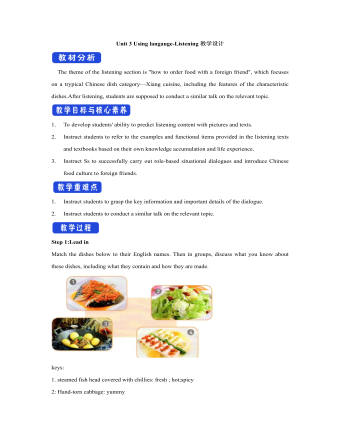
1. How is Hunan cuisine somewhat different from Sichuan cuisine?The heat in Sichuan cuisine comes from chilies and Sichuan peppercorns. Human cuisine is often hotter and the heat comes from just chilies.2.What are the reasons why Hunan people like spicy food?Because they are a bold people. But many Chinese people think that hot food helps them overcome the effects of rainy or wet weather.3.Why do so many people love steamed fish head covered with chilies?People love it because the meat is quite tender and there are very few small bones.4.Why does Tingting recommend bridge tofu instead of dry pot duck with golden buns?Because bridge tofu has a lighter taste.5 .Why is red braised pork the most famous dish?Because Chairman Mao was from Hunan, and this was his favorite food.Step 5: Instruct students to make a short presentation to the class about your choice. Use the example and useful phrases below to help them.? In groups of three, discuss what types of restaurant you would like to take a foreign visitor to, and why. Then take turns role-playing taking your foreign guest to the restaurant you have chosen. One of you should act as the foreign guest, one as the Chinese host, and one as the waiter or waitress. You may start like this:? EXAMPLE? A: I really love spicy food, so what dish would you recommend?? B: I suggest Mapo tofu.? A: Really ? what's that?
新人教版高中英语选修2Unit 4 Learning about Language教学设计
This section guides students to pay attention to the typical context of vocabulary use, helps students accumulate vocabulary around the key vocabulary of this unit, and uses the learned words and word chunks in different contexts to deeply understand their meaning and usage, so as to achieve the purpose of review and consolidation.The teaching design activities aim to guide students to pay attention to the typical context in which the target vocabulary is used, as well as the common vocabulary used in collocation, so that students can complete the sentence with correct words. In terms of vocabulary learning strategies, this unit focuses on cultivating students' ability to pay attention to collocation of words and to use word blocks to express meaning.For vocabulary learning, it is not enough just to know the meaning of a single word, but the most important thing is to master the common collocations of words, namely word blocks.Teachers should timely guide students to summarize common vocabulary collocation, such as verb and noun collocation, verb and preposition collocation, preposition and noun collocation, and so on.1. Guide students to understand and consolidate the meaning and usage of the vocabulary in the context, 2. Guide the students to use the unit topic vocabulary in a richer context3. Let the students sort out and accumulate the accumulated vocabulary, establishes the semantic connection between the vocabulary,4. Enable students to understand and master the vocabulary more effectivelyGuiding the Ss to use unit topic words and the sentence patterns in a richer context.
新人教版高中英语选修2Unit 4 Reading for writing教学设计
假定你是英国的Jack,打算来中国旅行,请你给你的中国笔友李华写一封信,要点如下:1.你的旅行计划:北京→泰山→杭州;2.征求建议并询问他是否愿意充当你的导游。注意:1.词数80左右(开头和结尾已给出,不计入总词数);2.可以适当增加细节,以使行文连贯。参考词汇:故宫 the Forbidden City;泰山 Mount TaiDear Li Hua,I'm glad to tell you that 'm going to visit China.First,I am planning to visit Beijing,the capitalof China,where I am looking forward to enjoying the Great Wall,the Forbidden City and somebeautiful parks.Then I intend to go to visit Mount Tai in Shandong Province.I've heard that it is one ofthe most famous mountains in China and I can't wait to enjoy the amazing sunrise there.After that,I amalso going to Hangzhou.It is said that it is a beautiful modern city with breathtaking natural sights,among which the West Lake is a well- known tourist attraction.What do you think of my travel plan? Will you act as my guide? Hope to hear from you soon.
新人教版高中英语选修2Unit 4 Using langauge-Listening教学设计
The theme of the listening section is " talking about scenery and culture along a journey."The part is designed to further lead the students to understand Canadian natural geography and social environment, and integrated into the cultural contrast by mentioning the long train journey from Beijing to Moscow routes. On this basis, the part activates students related travel experience, lets the student serial dialogue, guides the student to explore further the pleasure and meaning of the long journey, and Chinese and foreign cultural comparison.The part also provides a framework for the continuation of the dialogue, which is designed to provide a framework for students to successfully complete their oral expressions, and to incorporate an important trading strategy to end the dialogue naturally.1. Help students to understand and master some common English idioms in the context, and experience the expression effect of English idioms.2. Guide the students to understand the identity of different people in the listening context, and finish the dialogue according to their own experience.3. Instruct the students to use appropriate language to express surprise and curiosity about space and place in the dialogue, and master the oral strategy of ending the dialogue naturally.1. Instruct students to grasp the key information and important details of the dialogue.2. Instruct students to conduct a similar talk on the relevant topic.
新人教版高中英语选修2Unit 5 Learning about Language教学设计
The purpose of this section of vocabulary exercises is to consolidate the key words in the first part of the reading text, let the students write the words according to the English definition, and focus on the detection of the meaning and spelling of the new words. The teaching design includes use English definition to explain words, which is conducive to improving students' interest in vocabulary learning, cultivating their sense of English language and thinking in English, and making students willing to use this method to better grasp the meaning of words, expand their vocabulary, and improve their ability of vocabulary application. Besides, the design offers more context including sentences and short passage for students to practice words flexibly.1. Guide students to understand and consolidate the meaning and usage of the vocabulary in the context, 2. Guide the students to use the unit topic vocabulary in a richer context3. Let the students sort out and accumulate the accumulated vocabulary, establishes the semantic connection between the vocabulary,4. Enable students to understand and master the vocabulary more effectivelyGuiding the Ss to use unit topic words and the sentence patterns in a richer context.Step1: Read the passage about chemical burns and fill in the blanks with the correct forms of the words in the box.
新人教版高中英语选修2Unit 5 Reading and thinking教学设计
The theme of this activity is to learn the first aid knowledge of burns. Burns is common in life, but there are some misunderstandings in manual treatment. This activity provides students with correct first aid methods, so as not to take them for granted in an emergency. This section guides students to analyze the causes of scald and help students avoid such things. From the perspective of text structure and collaborative features, the text is expository. Expository, with explanation as the main way of expression, transmits knowledge and information to readers by analyzing concepts and elaborating examples. This text arranges the information in logical order, clearly presents three parts of the content through the subtitle, accurately describes the causes, types, characteristics and first aid measures of burns, and some paragraphs use topic sentences to summarize the main idea, and the level is very clear.1. Guide students to understand the causes, types, characteristics and first aid methods of burns, through reading2. Enhance students’ ability to deal withburnss and their awareness of burns prevention3. Enable students to improve the ability to judge the types of texts accurately and to master the characteristics and writing techniques of expository texts.Guide students to understand the causes, types, characteristics and first aid methods of burns, through readingStep1: Lead in by discussing the related topic:1. What first-aid techniques do you know of ?CPR; mouth to mouth artificial respiration; the Heimlich Manoeuvre
新人教版高中英语选修2Unit 5 Using langauge-Listening教学设计
The theme of this section is to learn how to make emergency calls. Students should learn how to make emergency calls not only in China, but also in foreign countries in English, so that they can be prepared for future situations outside the home.The emergency telephone number is a vital hotline, which should be the most clear, rapid and effective communication with the acute operator.This section helps students to understand the emergency calls in some countries and the precautions for making emergency calls. Through the study of this section, students can accumulate common expressions and sentence patterns in this context. 1.Help students accumulate emergency telephone numbers in different countries and learn more about first aid2.Guide the students to understand the contents and instructions of the telephone, grasp the characteristics of the emergency telephone and the requirements of the emergency telephone.3.Guide students to understand the first aid instructions of the operators.4.Enable Ss to make simulated emergency calls with their partners in the language they have learned1. Instruct students to grasp the key information and important details of the dialogue.2. Instruct students to conduct a similar talk on the relevant topic.Step1:Look and discuss:Match the pictures below to the medical emergencies, and then discuss the questions in groups.
中班艺术:我来设计课件教案
活动目标:1、在对自己的家进行观察后,能大胆地表达出自己的见解。2、充分发挥幼儿的想象,设计自己心中的家庭用具。活动准备:1、课前对自己家进行观察。2、积木若干;绘画材料。3、多媒体课件。活动过程:一、课件出示,直导课题。 前几天,我们说起了家,都说自己家里的东西好,那请你们来讲讲看,你们家的什么东西好,好在什么地方?(鼓励幼儿发表见解)二、启发讨论。 今天老师给你们带来了一个“家”,你们来看看,这个家怎么样?(引导幼儿讨论`如何为这个家设计家庭用具)
美术活动:设计邮票课件教案
2.增进幼儿装饰美和色彩美的感受和经验。 活动准备:1.剪好花边的铅画纸2.记号笔、油画棒。(人手一份) 3.集邮册3本。活动重点: 幼儿学会用鲜明、柔和的色彩装饰邮票。活动流程:欣赏邮票--师生讨论--幼儿作画--评价活动
体育活动设计《熊来啦》课件教案
我设计的这个活动是受到一个经典的体育游戏的启发对其加以修改而成。游戏的名字叫《熊和小孩》,为了提高幼儿的兴趣,我为游戏编了一首简短的儿歌《熊来啦》,将规则反映在了儿歌中,帮助幼儿掌握游戏规则。同时我发现大班幼儿的求知欲很强,所以这个游戏中也插入熊的习性方面的内容。另外,其实很多幼儿早就会玩《木头人》的游戏,这两个游戏的玩法很相似,然而游戏换一首儿歌体现,会带给幼儿新鲜感。我设计了让幼儿自己商定游戏规则的环节,这样幼儿在活动中能主动学习,并且按自己的想法玩游戏,能提高幼儿的积极性,并体验成功感。活动名称:体育游戏《熊来啦》活动目标:1、幼儿喜欢参与游戏,情绪积极愉快。2、幼儿通过游戏培养抑制自己行为的能力,训练反应的灵敏性。 3、幼儿能按游戏规则进行游戏。活动准备:“熊”头饰一只,圈划幼儿活动范围和“熊家”活动过程:1、导入活动。 教师:“如果你突然遇到一头大狗熊,你该怎么样,它才不会吃你?”幼儿讨论提出意见。
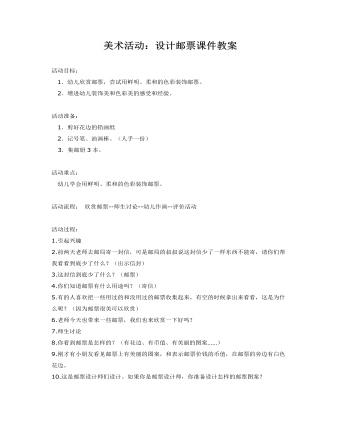
美术活动:设计邮票课件教案
2.增进幼儿装饰美和色彩美的感受和经验。 活动准备:1.剪好花边的铅画纸2.记号笔、油画棒。(人手一份) 3.集邮册3本。活动重点: 幼儿学会用鲜明、柔和的色彩装饰邮票。活动流程:欣赏邮票--师生讨论--幼儿作画--评价活动
高教版中职数学基础模块下册:9.5《柱、锥、球及其简单组合体》教学设计
课题序号 授课班级 授课课时2授课形式 教学方法 授课章节 名称9.5柱、锥、球及其组合体使用教具 教学目的1、使学生认识柱、锥、球及其组合体的结构特征,并能运用这些特征描述生活中简单物体的结构。 2、让学生了解柱、锥、球的侧面积和体积的计算公式。 3、培养学生观察能力、计算能力。
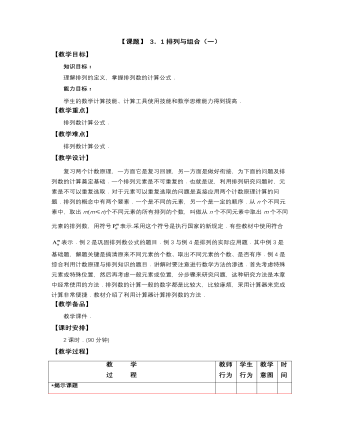
【高教版】中职数学拓展模块:3.1《排列与组合》优秀教学设计
教 学 过 程教师 行为学生 行为教学 意图时间 *揭示课题 3.1 排列与组合. *创设情境 兴趣导入 基础模块中,曾经学习了两个计数原理.大家知道: (1)如果完成一件事,有N类方式.第一类方式有k1种方法,第二类方式有k2种方法,……,第n类方式有kn种方法,那么完成这件事的方法共有 = + +…+(种). (3.1) (2)如果完成一件事,需要分成N个步骤.完成第1个步骤有k1种方法,完成第2个步骤有k2种方法,……,完成第n个步骤有kn种方法,并且只有这n个步骤都完成后,这件事才能完成,那么完成这件事的方法共有 = · ·…·(种). (3.2) 下面看一个问题: 在北京、重庆、上海3个民航站之间的直达航线,需要准备多少种不同的机票? 这个问题就是从北京、重庆、上海3个民航站中,每次取出2个站,按照起点在前,终点在后的顺序排列,求不同的排列方法的总数. 首先确定机票的起点,从3个民航站中任意选取1个,有3种不同的方法;然后确定机票的终点,从剩余的2个民航站中任意选取1个,有2种不同的方法.根据分步计数原理,共有3×2=6种不同的方法,即需要准备6种不同的飞机票: 北京→重庆,北京→上海,重庆→北京,重庆→上海,上海→北京,上海→重庆. 介绍 播放 课件 质疑 了解 观看 课件 思考 引导 启发学生得出结果 0 15*动脑思考 探索新知 我们将被取的对象(如上面问题中的民航站)叫做元素,上面的问题就是:从3个不同元素中,任取2个,按照一定的顺序排成一列,可以得到多少种不同的排列. 一般地,从n个不同元素中,任取m (m≤n)个元素,按照一定的顺序排成一列,叫做从n个不同元素中取出m个元素的一个排列,时叫做选排列,时叫做全排列. 总结 归纳 分析 关键 词语 思考 理解 记忆 引导学生发现解决问题方法 20
第四单元《教学设计》 说课稿 2021—2022学年统编版高中语文必修下册
(六)说教学策略1.专题性海量的媒介信息必须加以选择或者整合,以项目为依据,进行信息筛选,形成专题性阅读与交流;培养学生对文本信息“化零为整”的能力,提升跨媒介阅读与交流学习的充实感。2.情境化情境教学应指向学生的应用,建构富有符合时代气息的内容,与生活经验更加贴合,对学生的语言建构与运用有所提升,在情境中能够有效地进行交流。3.任务化以任务为导向的序列化学习,可以为学生构建学习路线图、学习框架等具体任务引导;或以跨媒介的认识与应用为任务的设置引导;甚至以阅读和交流作为序列化安排的实践引导。4.整合性跨媒介阅读与交流是结合线上线下的资源,形成新的“超媒介”,也能实现对信息进行“深加工”,多种媒介的信息整合只为一个核心教学内容服务。5.互文性语言文字是语文之生命,我们是立足于语言文字的探讨,音乐、图像、视频等文本与传统语言文字文本形成互文,触发学生对学习内容立体化和具体化的感悟,提升学生的审美能力。
高教版中职数学基础模块下册:10.3《总体、样本与抽样方法》教学设计
教 学 过 程教师 行为学生 行为教学 意图时间 *揭示课题 10.3总体、样本与抽样方法(一) *创设情境 兴趣导入 【实验】 商店进了一批苹果,小王从中任意选取了10个苹果,编上号并称出质量.得到下面的数据(如表10-6所示): 苹果编号12345678910质量(kg)0.210.170.190.160.200.220.210.180.190.17 利用这些数据,就可以估计出这批苹果的平均质量及苹果的大小是否均匀. 介绍 质疑 讲解 说明 了解 思考 启发 学生思考 0 10*动脑思考 探索新知 【新知识】 在统计中,所研究对象的全体叫做总体,组成总体的每个对象叫做个体. 上面的实验中,这批苹果的质量是研究对象的总体,每个苹果的质量是研究的个体. 讲解 说明 引领 分析 理解 记忆 带领 学生 分析 20*巩固知识 典型例题 【知识巩固】 例1 研究某班学生上学期数学期末考试成绩,指出其中的总体与个体. 解 该班所有学生的数学期末考试成绩是总体,每一个学生的数学期末考试成绩是个体. 【试一试】 我们经常用灯泡的使用寿命来衡量灯炮的质量.指出在鉴定一批灯泡的质量中的总体与个体. 说明 强调 引领 观察 思考 主动 求解 通过例题进一步领会 35
人教版高中数学选修3离散型随机变量的方差教学设计
3.下结论.依据均值和方差做出结论.跟踪训练2. A、B两个投资项目的利润率分别为随机变量X1和X2,根据市场分析, X1和X2的分布列分别为X1 2% 8% 12% X2 5% 10%P 0.2 0.5 0.3 P 0.8 0.2求:(1)在A、B两个项目上各投资100万元, Y1和Y2分别表示投资项目A和B所获得的利润,求方差D(Y1)和D(Y2);(2)根据得到的结论,对于投资者有什么建议? 解:(1)题目可知,投资项目A和B所获得的利润Y1和Y2的分布列为:Y1 2 8 12 Y2 5 10P 0.2 0.5 0.3 P 0.8 0.2所以 ;; 解:(2) 由(1)可知 ,说明投资A项目比投资B项目期望收益要高;同时 ,说明投资A项目比投资B项目的实际收益相对于期望收益的平均波动要更大.因此,对于追求稳定的投资者,投资B项目更合适;而对于更看重利润并且愿意为了高利润承担风险的投资者,投资A项目更合适.
人教A版高中数学必修二总体取值规律的估计教学设计
可以通过下面的步骤计算一组n个数据的第p百分位数:第一步:按从小到大排列原始数据;第二步:计算i=n×p%;第三步:若i不是整数,而大于i的比邻整数位j,则第p百分位数为第j项数据;若i是整数,则第p百分位数为第i项与第i+1项的平均数。我们在初中学过的中位数,相当于是第50百分位数。在实际应用中,除了中位数外,常用的分位数还有第25百分位数,第75百分位数。这三个分位数把一组由小到大排列后的数据分成四等份,因此称为四分位数。其中第25百分位数也称为第一四分位数或下四分位数等,第75百分位数也称为第三四分位数或上四分位数等。另外,像第1百分位数,第5百分位数,第95百分位数,和第99百分位数在统计中也经常被使用。例2、根据下列样本数据,估计树人中学高一年级女生第25,50,75百分位数。
人教A版高中数学必修二总体集中趋势的估计教学设计
(2)平均数受数据中的极端值(2个95)影响较大,使平均数在估计总体时可靠性降低,10天的用水量有8天都在平均值以下。故用中位数来估计每天的用水量更合适。1、样本的数字特征:众数、中位数和平均数;2、用样本频率分布直方图估计样本的众数、中位数、平均数。(1)众数规定为频率分布直方图中最高矩形下端的中点;(2)中位数两边的直方图的面积相等;(3)频率分布直方图中每个小矩形的面积与小矩形底边中点的横坐标之积相加,就是样本数据的估值平均数。学生回顾本节课知识点,教师补充。 让学生掌握本节课知识点,并能够灵活运用。