-
人教版高中政治必修1影响价格的因素教案
(2)、价值规律 教师总结:通过这一节的学习我们明白了一个道理:商品的价值量由生产商品的社会必要劳动时间决定,商品交换以价值量为基础实行等价交换。这一经济原则就叫做价值规律。受供求关系影响,商品价格围绕价值上下波动,是价值规律要求发生作用的具体表现。(3)、价格围绕价值上下波动是价值规律的表现形式(三)课堂总结、点评 本节内容讲述的主要知识如下:1、气候、时间、地域、生产、习俗等因素会改变供求关系状况,供求关系变化影响价格变动,形成卖方市场和买方市场。2、商品价格由价值决定,价值量与社会必要劳动时间成正比,与劳动生产率成反比。3、商品价格由价值决定,并受供求关系影响,在二者共同作用下形成市场价格。4、社会必要劳动时间决定商品价值量,商品交换以价值量为基础实行等价交换,是价值规律的基本内容,价格围绕价值上下波动是价值规律的表现形式。
人教版高中政治必修1依法纳税教案
(3)骗税 骗税是指纳税人用欺骗手段获得国家税收优惠的行为。教师活动:请同学们看教材87页“相关链接”,了解骗税行为的特点和法律处罚规定。学生活动:认真阅读,积极思考。(4)抗税 抗税是指纳税人以暴力、威胁等手段,拒不缴纳税款的行为。教师活动:请同学们看教材87页“相关链接”,了解骗税行为的特点和法律处罚规定。学生活动:认真阅读,积极思考。3、公民要增强税收监督意识教师活动:请同学们看教材88页“相关链接”,思考公民如何维护国家税收工作?学生活动:认真阅读,积极思考。教师总结:公民是国家税收的最终负税人,应自觉增强税收监督意识,以主人翁的态度积极监督国家公职人员及公共权力的行为,关注税收的征收和使用情况,对他们的违法行为进行批评、检举,维护国家利益和自身利益。
人教版高中政治必修4价值与价值观精品教案
一、教材分析我们使用的是人教版第四册《生活与哲学》教材,本框属于第四单元第十二课第一框题。其内容主要分两目,第一目主要介绍价值的含义、人是社会一切财富的创造者、人的价值在于创造价值和对社会的责任和贡献,以及对一个人的评价主要看他的贡献等内容。第二目主要介绍价值观的导向作用,内容包括价值观的含义、价值观对人们认识世界和改造世界的活动具有导向作用以及对人生道路的选择具有导向作用。二、教学目标知识目标:1、识记价值和价值观的基本含义;价值观的导向作用。2、理解人的价值是什么?如何评价人的价值。3、运用所学知识及相关哲学原理,分析物的价值和人的价值的 不同,从中加深对人的价值的理解评论分析为什么对一个人的评价要看他的贡献,而不是索取了多少。
新人教版高中英语必修1Unit 1 Teenage Life-Discovering Useful Structure教案
(形容词短语most beautiful的构成形式为:副词+形容词,该短语在句中作定语修饰名词bird)④A good friend is someone who makes you really happy.好朋友就是能让你真正高兴的人。(形容词短语really happy的构成形式为:副词+形容词,该短语在句中作宾语补足语)[即学即练]画出下例句中的形容词短语并指明构成形式如:It is less cold today than it was yesterday.构成形式: 副词+形容词(1)Our country is becoming more and more beautiful.(2)The road is long enough.(3)The medicine is good for stomach.三、副词短语(Adverb Phrases)副词短语:指以一个副词为中心构成的短语,在句中的功能相当于副词,可以修饰动词、形容词或副词。常见副词短语的构成形式有:(副词)+副词如: much more beautifully①He did his work here yesterday.他昨天在这里工作。(副词短语here yesterday修饰动词did)②Bill did the work very well.比尔做的这份工作很好。副词短语very well修饰动词did③We are all entirely responsible for our action(副词短语all entirely, 修饰形容词短语responsible for)
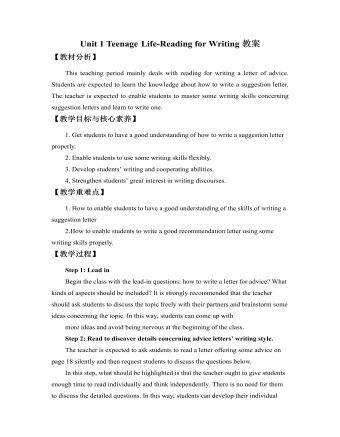
新人教版高中英语必修1Unit 1 Teenage Life-Reading for Writing教案
【教材分析】This teaching period mainly deals with reading for writing a letter of advice. Students are expected to learn the knowledge about how to write a suggestion letter. The teacher is expected to enable students to master some writing skills concerning suggestion letters and learn to write one.【教学目标与核心素养】1. Get students to have a good understanding of how to write a suggestion letter properly.2. Enable students to use some writing skills flexibly.3. Develop students’ writing and cooperating abilities.4. Strengthen students’ great interest in writing discourses.【教学重难点】1. How to enable students to have a good understanding of the skills of writing a suggestion letter2.How to enable students to write a good recommendation letter using some writing skills properly.【教学过程】Step 1: Lead in Begin the class with the lead-in questions: how to write a letter for advice? What kinds of aspects should be included? It is strongly recommended that the teacher should ask students to discuss the topic freely with their partners and brainstorm some ideas concerning the topic. In this way, students can come up with more ideas and avoid being nervous at the beginning of the class.Step 2: Read to discover details concerning advice letters’ writing style.The teacher is expected to ask students to read a letter offering some advice on page 18 silently and then request students to discuss the questions below.
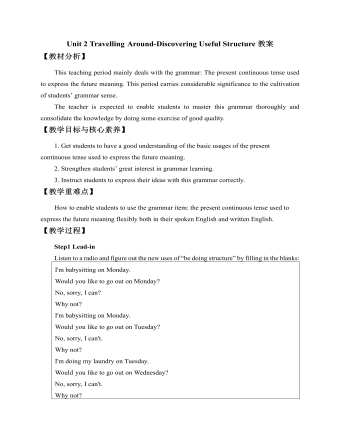
新人教版高中英语必修1Unit 2 Travelling Around-Discovering Useful Structure教案
(5)be to do (可以和具体的时间状语连用)①表示按计划、安排即将发生的动作。②用于时间、条件状语从句中,表示“如果要……,想要……”。The students are to meet at the school gate tomorrow. 明天学生们将在学校大门口集会。 If you are to succeed, you must work as hard as possible. 如果你想要成功,比必须努力工作。(6)be about to do (不与具体的时间状语连用) 表示即将要发生的动作。We are about to start. 我们就要出发了。The new school year is about to begin. 新学年开学在即。(7)一般现在时表将来①表示按时间表规定将要发生的动作。常限于表示位置移动的短暂性动词。②在时间、条件或让步状语从句中,用一般现在时表将来。Look at the timetable. Hurry up! Flight 4026 takes off at 18:20. 你看看时刻表,快点!4026次航班的起飞时间是下午6点20分。Jane is in a hurry because the train to the airport leaves in half an hour. 简很匆忙,因为去机场的火车半小时后出发。
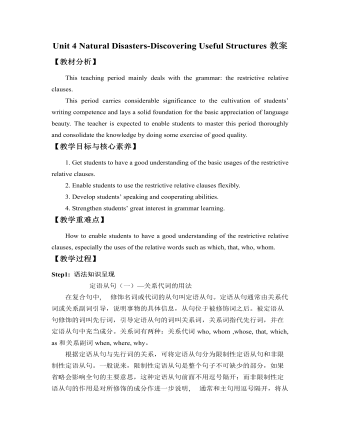
新人教版高中英语必修1Unit 4 Natural Disasters-Discovering Useful Structures教案
【教材分析】This teaching period mainly deals with the grammar: the restrictive relative clauses.This period carries considerable significance to the cultivation of students’ writing competence and lays a solid foundation for the basic appreciation of language beauty. The teacher is expected to enable students to master this period thoroughly and consolidate the knowledge by doing some exercise of good quality.【教学目标与核心素养】1. Get students to have a good understanding of the basic usages of the restrictive relative clauses.2. Enable students to use the restrictive relative clauses flexibly.3. Develop students’ speaking and cooperating abilities.4. Strengthen students’ great interest in grammar learning.【教学重难点】How to enable students to have a good understanding of the restrictive relative clauses, especially the uses of the relative words such as which, that, who, whom.【教学过程】Step1: 语法知识呈现定语从句(一)—关系代词的用法在复合句中, 修饰名词或代词的从句叫定语从句。定语从句通常由关系代词或关系副词引导,说明事物的具体信息,从句位于被修饰词之后。被定语从句修饰的词叫先行词,引导定语从句的词叫关系词,关系词指代先行词,并在定语从句中充当成分。关系词有两种:关系代词who, whom ,whose, that, which, as和关系副词when, where, why。
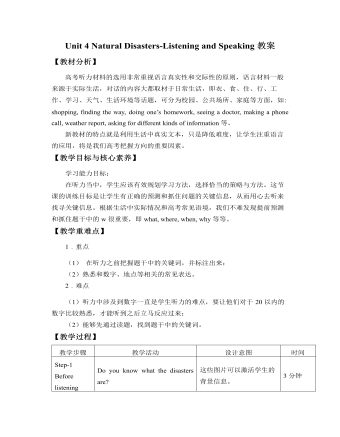
新人教版高中英语必修1Unit 4 Natural Disasters-Listening and Speaking教案
【教材分析】高考听力材料的选用非常重视语言真实性和交际性的原则,语言材料一般来源于实际生活,对话的内容大都取材于日常生活,即衣、食、住、行、工作、学习、天气、生活环境等话题,可分为校园、公共场所、家庭等方面,如: shopping, finding the way, doing one’s homework, seeing a doctor, making a phone call, weather report, asking for different kinds of information等。新教材的特点就是利用生活中真实文本,只是降低难度,让学生注重语言的应用,将是我们高考把握方向的重要因素。【教学目标与核心素养】学习能力目标:在听力当中,学生应该有效规划学习方法,选择恰当的策略与方法。这节课的训练目标是让学生有正确的预测和抓住问题的关键信息,从而用心去听来找寻关键信息。根据生活中实际情况和高考常见语境,我们不难发现提前预测和抓住题干中的w很重要,即what, where, when, why等等。
新人教版高中英语必修1Welcome Unit-Discovering Useful Structures教案
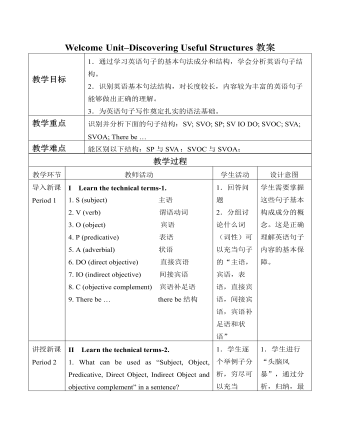
II Learn the technical terms-2.1. What can be used as “Subject, Object, Predicative, Direct Object, Indirect Object and objective complement” in a sentence?2. What can be used as “adverbial” in a sentence?3. What can be used as “verb” in a sentence?Answers to questions 1-3:1. Nouns, pronouns and appellations can be used as “Subject, Object, Predicative, Direct Object, Indirect Object and Objective Complement”. Besides, adjectives can be used as “Predicative and Objective Complement” in a sentence.2. Adverbs and prepositional phrases can be used as “Adverbial”.3. Verbs with actual meaning can be used as “Verb” in a sentence. Auxiliary verbs alone cannot be used as “Verb” in a sentence.III Learn to recognize the sentence structures.1. SV structure. For Example:(1) A bird flies.S V(2) A monkey jumps.S V(3) A fish swims.S V√ In SV structures, verbs are “intransitive verbs”.2. SVO structure. For Example:(1) A sheep eats grass.S V O(2) They like bananas.S V O(3) He wants candy.S V O√ In SVO structures, verbs are “transitive verbs”.3. SP structure. For Example:(1) This is great.S P (2) He looks well.S P (3) She became a teacher.S P √ In SP structures, Predicatives are formed by “link verbs” and “adjectives or nouns”.√ link verbs: be, become, grow, look, feel, taste, etc.4. SV IO DO structure. For Example:(1) He asked me a question.S V IO DO(2) Danny wrote me a letter.S V IO DO(3) Billy brought Sam a kite.S V IO DO√ In SV IO DO structures, the verbs are transitive and are followed by two objectives – pronouns or nouns as Indirect Objective, and nouns as Direct Objectives.
新人教版高中英语必修1Unit 4 Natural Disasters-Reading & Thinking教案
5. Read to get detailed information about Paragraph 5.Q1. What shows the revival of Tangshan?Q2. How can Tangshan revive itself and get up on its feet again?Q3. In times of disasters, how can we go through it?T: In times of disasters, we should unify, show the wisdom and stay positive.Step 4 Activity 4 Highlighting the theme and reflecting1. Make a summary of the text.2. Further understand the titleQ: After our learning, why do you think the earth didn’t sleep on that night?T: An earthquake happened. The people in the earthquake suffered a lot, and the people outside Tangshan were concerned about the people there a lot.3. Reflect through discussion on what can be learnt after reading.T: Disasters are powerful. Unpreparedness can be deadly. Life is weak, but if people work together to help each other, disasters can be defeated.There is no love from disaster, but we have love in the human heart.Step 5 Assignment How does the writer convey that the earthquake was deadly, and that people were helpless during the earthquake? Try to find some attractive and impressive expressions and note them down.
新人教版高中英语必修2Unit 1 Cultural Heritage-Discovering Useful Structure教案二
This theme of the part is “ Describe people or things in greater detail”. Students have learned the grammar(restrictive relative clauses) in Book 1, and further review and consolidate its structure “prep+relative pronouns(which/whom)” and the relative adverbs(when, where and why), besides students should understand its form, meaning and functions. In this section, students should be able to express the grammar correctly in daily communication and in the writing. 1. Review the basic usages of relative pronouns and adverbs of attributive clauses . 2. Learn to use some special cases about restrictive relative clauses.3. Learn to write sentences with restrictive relative clauses flexibly according to the context.1. Review the basic usages of relative pronouns and adverbs of attributive clauses .2. Learn to use some special cases about restrictive relative clauses.3. Learn tow rite sentences with restrictive relative clauses flexibly according to the context.Step 1. Observe the following sentences, and mark the relative pronouns and the adverbs. 1. After listening to the scientists who had studied the problems, and citizens who lived near the dam, the government turned to the United Nations for help.2. Temples and other cultural sites were taken down piece by piece, and then moved and put back together again in a place where they were safe from the water.Step 2 PracticePlease complete these sentences with relative pronouns and relative adverbs and answer the following questions.Questions: 1. What is the head noun ?2. What relative words should be used ?3. What elements do they act in these sentences ?
新人教版高中英语必修2Unit 1 Cultural Heritage-Listening&Speaking&Talking教案
Listening and Speaking introduces the topic of “Take part in a youth project”. The listening text is an interview about an international youth cultural heritage protection project. More than 20 high school students from seven countries participated in the project. The reporter interviewed two participants Stephanie and Liu Bin. By listening to the text, students can understand the significance of cultural heritage protection, and teenagers can use their knowledge, combine their own interests and advantages, etc. to participate in the action of cultural heritage protection. Listening and Talking introduces the theme of "Talk about history and culture". The listening text is a dialogue between two tourists and tour guides when they visit the Kremlin, red square and surrounding buildings. The dialogue focuses on the functional items of "starting a conversation", which is used to politely and appropriately attract the attention of the others, so as to smoothly start a conversation or start a new topic. The purpose of this section is to guide students to understand the history and current situation of Chinese and foreign cultural heritage in their own tourism experiences or from other people's tourism experiences, explore the historical and cultural values, and be able to express accurately and appropriately in oral communication.1. Guide students to understand the content of listening texts in terms of the whole and key details; 2. Cultivate students' ability to guess the meaning of words in listening; discuss with their peers how to participate in cultural heritage protection activities.3. Instruct students to use functional sentences of the dialogue such as “I beg your pardon, but…” “Forgive me for asking, but…" and so on to start the conversation more politely and appropriately.
新人教版高中英语必修2Unit 1 Cultural Heritage-Reading and Thinking教案二
1. This section focuses on "Understanding how a problem was solved”, which is aimed to guide students to analyze and discuss the challenges and problems faced by cultural heritage protection during the construction of Aswan Dam, as well as the solutions. On the basis of understanding, students should pay attention to the key role of international cooperation in solving problems, and attach importance to the balance and coordination between cultural heritage protection and social and economic development. Students are encouraged to face challenges actively, be good at cooperation, and make continuous efforts to find reasonable ways and means to solve problems.2. Enable students to understand the main information and text structure of the reading text;3. Motivate students to use the reading strategy "make a timeline" according to the appropriate text genre;4. Enable students to understand how a problem was solved;5. Enable students to understand the value of protecting cultural heritage by teamwork and global community;1. Guide students to pay attention to reading strategies, such as prediction, self-questioning and scanning.2. Help students sort out the topic language about protecting cultural relics and understand the narrative characteristics of "time-event" in illustrative style3. Lead students to understand the value of protecting cultural heritage by teamwork and global community;
新人教版高中英语必修2Unit 5 Music-Discovering Useful Structures教案二
4. When he got absorbed in his world of music, he felt as if he could “see” the beauty of the world around him, like he had in his previous life.P·P as adverbial: _________________________________________________________________.Function: _______________________________________________________________________.Step 5 Solid Complete the passage with the words in brackets in their correct forms.Well known as a successful band, the Impact members show quite a few striking qualities. They never ever give up. When _____________(question) by the media, they are not _____________(discourage) and practise even harder. They are improving themselves by attending several master training class. They are united. _____________(fill with) team spirit, they act as a whole, always aiming for glory. Step 6 Difference and similarity from -ingObserve the following examples.1. He went out, shutting the door behind him.=He went out, ________________________________________________________.2. Not knowing what to do, he went to his parents for help.=__________________________________________, he went to his parents for help.Similarity: _______________________________________________________________________________________________________________________________________________________.Difference : _______________________________________________________________________________________________________________________________________________________.Step Practice1. ________ in a hurry, this article was not so good. 因为写得匆忙, 这篇文章不是很好。2. ________ carefully, he found something he hadn’t known before. 他仔细读书时, 发现了一些从前不知道的东西。3. ________ why he did it, the monitor said it was his duty. 当被问及他为什么要这么做时, 班长说这是他的职责
人教版高中语文必修1《别了,“不列颠尼亚”》教案
(“节马”:1841年1月7日,英国侵略者义律进攻虎门,沙田炮台副将陈连升率众浴血奋战,壮烈牺牲。其马“神骏”守护主人遗体,不屈敌之羁绊,不食敌之草料,不畏敌之鞭打刀刺,终不就范。“祖逖鞭”:祖逖,东晋名将,著名爱国将领,曾率军北伐,收复许多失地。此句大意为若要扬眉吐气,意气风发,仍需祖逖的这种精神。)八、本文反映的就是香港回归这一重大历史事件本文是一篇新闻特写。特写性消息,也称新闻速写、新闻素描,要求用类似电影“特写镜头”的手法来反映事实,是作者深入新闻事件现场,采写制作的一种新闻价值高、现场感较强、篇幅短小精粹的消息文体。特写性消息侧重于“再现”,往往采用文学手法,集中、突出地描述某一重大事件的发生现场,或某些重要和精彩的场面,生动、形象地将所报道的事实再现在读者面前。
人教版高中语文必修1《烛之武退秦师》教案
四、讲读第一段(10分钟)1.抽生朗读本段,注意生字词读音。2.讲析本段译释由学生完成,师只作扼要补纠和简要分析。分析内容包括伏笔手法和语句深意,全段作用。3.让学生齐读全段。4.处理练习一之中的第1小题,要求学生试译回答,然后指导学生背诵本段。五、讲读第二段(15分钟)1.抽生朗读本段,注意生字词读音。2.讲析本段①重点讲析三个文言词“若”、“之”、“辞”的用法和人物对话。②字词句的理解仍然注意发挥学生的能动性,让他们完成为主,师纠补为辅。对要求掌握的三个文言词的用法要板书列于黑板上,对话部分要让学生试作语气练习。③小结的内容包括情节的曲折性、写法的详略和表达的特点。3.生齐读本段,然后处理相关练习。
人教版高中语文必修2《采薇》教案2篇
这两章是对战争场面的描写。写的是战车、战马、象弭、鱼服以及士兵的劳累奔波、饥渴难当,通过这些具体生动的细节描写来展现战争生活的图景。而没有写战场上的刀光剑影、厮打拼杀,但战争的残酷已可想见。4“昔我往矣,杨柳依依。今我来思,雨雪霏霏”被视为情景交融的佳句。清人王夫之在论《诗经·小雅·采薇》这两句时说:“以乐景写哀,以哀景写乐,一倍增其哀乐。”谈谈你的看法。一以往昔之虚衬眼前之实,以出征之乐衬内心之思亲之悲痛;二“杨柳依依”与“雨雪霏霏”对比,突出不胜今昔之感;三大雪交加,饥渴难当,情境实悲,以哀景写哀情。四、交流延伸1写一首诗或一段文字表达你对“乡愁”的新的体验。在全班交流。2课后搜集更多的表现乡情的诗歌散文作品,将你最感动的一篇拿到班上与同学分享感受。
人教版高中语文必修1《飞向太空的航程》教案2篇
第7~10段,我们取得了初步的成就。先写毛泽东主席的号召,激励无数的航天人去实现千年梦想;接着写我们的计划,上天毕竟是一件天大的事情,不是谁一句话就能吹上去的,需要有周密的计划,这计划的第一步是研制火箭,成功了,而从毛主席发出号召开始到火箭成功发射才用了1年零9个月;又用了不到10年的时间中国的第一颗人造卫星又上了天,“宣告中国进入了航天时代”。由号召,到计划,到成功,一步一步写来,紧张的任务,紧凑的文章,娓娓道来,条理清晰。第11~13段,人造卫星上天了,下一步就是载人飞天,圆千年梦想。我们也做了大量的准备工作,一是航天材料、食品等的准备,一是航天员的准备,已经挑选了19位优秀的飞行员,他们是航天员的预备军。看来实现中国人的航天梦已为时不远了。可是在科学上是没有坦途的,由于多方面的原因,计划搁浅了,我们的飞天梦想“只能尘封在一张张构思草图中”,这是多么遗憾的事啊!
人教版高中语文必修1《荆轲刺秦王》教案
教学目标:1、知识与能力:①了解荆轲刺秦王的历史背景和过程,整体感知课文。②掌握文言文中重要的字、词、句解释,提高翻译能力。③学会从人物的对话、动作、神态描写入手,分析主要人物形象。2、情感与态度:正确看待荆轲刺秦王这一事件,学会历史而辩证地评价人物。重点难点:评价历史事件,分析人物形象。教学方法:朗读法、提问法、讨论法课时安排:三课时教学过程:第一课时一、导入:(课前展示雕塑照片)来到正定讲课,我感到非常高兴,一进县城,就被这里浓郁的历史文化气息所感染。我们住在华阳假日酒店,外面正在兴建文化广场,刚才的照片就是在那里拍摄的。在此,我进一步了解到正定这座文化古城悠久的历史渊源,这里有南越王赵佗,常胜将军赵云,一代名家颜真卿等等,可谓物华天宝、人杰地灵。因此我相信我们正定中学的同学们一定都非常优秀。这也让我更深刻地体会到一个道理:语文的外延就是生活的外延。
人教版高中语文必修1《论语》教案2篇
【教学意图】要了解中国传统文化,必须阅读古诗文名著名篇。但在中国文化形成过程中影响最大的是什么?可以说是儒家学说,包括《论语》这部经典。《论语》等书是读书人求仕做官的必修课本,是知识分子的思想言行基础,而且影响到整个社会生活,内容包括伦理道德、教育体制、民间习俗等方面的思想。因此,要了解中国传统文化,有必要读一读《论语》。【教学设计】因《论语》的年代已久远,对学生而言,要理解透彻文句是比较深奥困难的,因此必须在充分理解文意的基础上,对《论语》进行思想上的解读。可由教师从《论语》中概括出几点与生活、现实相关的要点,要求学生分组进行透彻的学习和领会,如“小人与君子”、“学习的方法”、“教育的理念”等等。〖教学重点、难点〗读《论语》知儒家思想。〖教学方法〗讲解启发、探究梳理、拓展延伸。