-
新人教版高中英语必修2Unit 5 Music-Listening and Speaking教案
This lesson is about music. Students can classify the types of music through the instruments and its sound and can talk about their preferences about music, even join some activities and play a role in them according to their musical talents. On the basis, they are guided to use the languages to express their preferences and some plosive sounds and their rules.1. Classify the music types through the instruments and its sound.2. Listen and understand what the speakers’ preferences are and the reasons; talk about their own preferences and give their own reasons, using these sentences: “What kind of music do you like? And why? “ “Because it makes/gives me energy/peaceful.../touches my heart...”.3. Learn some plosives and the rules.4. Join some activities and play a role in them according to the talents. 1. Listen and understand what the speakers’ preferences are and the reasons;2. talk about their own preferences and give their own reasons, using these sentences: “What kind of music do you like? And why? “ “Because it makes/gives me energy/peaceful.../touches my heart...”.3. Learn some plosives and incomplete plosives and its rules.Step 1 Lead inPoint at the pictures on P50 and ask Q1: What are the people doing in the pictures below?Q2: What kind of music they are?Then play the MP3s one by oneStep 2 ListeningTask 1: A reporter from the school newspaper is interviewing students about music. Listen to the interviews. Draw lines between the words to make complete sentences. Some words will not be used.
新人教版高中英语必修2Unit 5 Music-Reading and Thinking教案一
This section focuses on "learning about experiencing music Online". This virtual choir is a new form of music performance. Members from all over the world don't need to love to come to a place. Instead, they use the new technology to model the various parts and wonderful virtual harmony group of music in the family. Students need to understand the main meaning of each paragraph. Finding topic sentences is an important way to understand the general idea of a paragraph. After the topic sentence, it is usually the detail sentence that supports and explains the topic sentence. Some paragraphs have obvious subject sentences, for example, the first sentence of the second paragraph is the subject sentence of the paragraph, and the following sentenceStudents need to pay attention to the topic sentences and key sentences, and then pay attention to how the sentences after the meaning explain, explain and support the topic sentences or key sentences before.1.Guide students to learn about experiencing music online2.Guide students to scan and circle the information in the text.3.Guide students to find the numbers and dates to fill in the timeline.4.Guide students to learn more about music by completing the sentences with the correct forms of the words and phrases. And then make a mind map about the outline of the passage.1. Guide students to pay attention to reading strategies, such as prediction, self-questioning and scanning.2. Help students sort out the main meaning of each paragraph and understand the narrative characteristics of "timeline” in illustrative style.3. Lead students to understand the changes that have been caused by the Internet.
新人教版高中英语必修3Unit 2 Morals and Virtues教学设计三
The joke set her crying.这个玩笑使她哭起来。Step 5 ReadingActivity 31. Students read the small text in activity 3. The teacher provides several small questions to check whether students understand the content of the text and the ideographic function of the -ing form in the text.*Where are those people?*Why did Dr Bethune come to China?*How did he help the Chinese people during the war?*What did Chairman Mao Zedong say about him?2. Ss try to rewrite some sentences using the -ing form. Then check the answers. When checking the answers, the teacher can ask different students to read the rewritten sentences and give comments.Answers:1. he became very interested in medicine, deciding to become a doctor.2. …after hearing that many people were dying in the war.3. Helping to organise hospitals, he taught doctors and nurses, and showed people how to give first aid./ He helped to organise hospitals, teaching doctors and nurses, and showing people how to give first aid.4. …praising Dr Bethune as a hero to be remembered in China.Step 6 PracticeActivity 4Students complete grammar activities 2 and 3 on page 69 of the workbook.Step 6 Homework1. Understand and master the functions and usage of the -ing form;2. Finish the other exercises in Using structures.1、通过本节内容学习,学生是否理解和掌握动词-ing形式作宾语补足语语和状语语的功能和意义;2、通过本节内容学习,学生能否正确使用动词-ing形式描述人物的行为、动作及其经历;3、通过本节内容学习,学生能否独立完成练习册和导学案中的相关练习。
人教版高中地理必修2城市内部空间结构教案
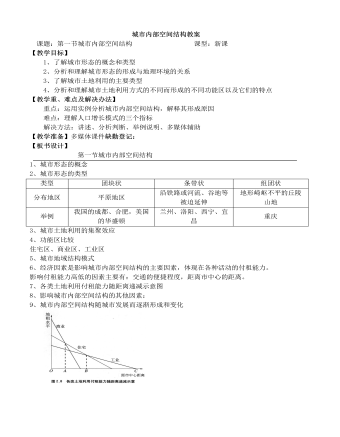
过渡:在实际生活中,城市内部空间结构并非完全按照这一经济规律呈现,而是更具复杂性。这说明除了经济因素外,还有很多其他因素在起作用,请大家结合你的认识、图2.9和案例1:纽约市的少数民族区谈谈你的看法。(2)其他因素I收入——形成不同级别住宅区的常见原因。有能力支付昂贵租金和选择最佳居住环境的人,其居住地往往形成高级住宅区。II知名度——城市内某些地区在历史、文化或经济方面具有很高的声誉,这往往会吸引更多新的住宅或商场建在该处,以提高其知名度。III种族聚居区的形成——在有些城市的某一区域内,如果某个种族或宗教团体占优势,就可能形成种族聚居区。如纽约市的唐人街、哈林区、小意大利区等。IV历史因素——城市的建筑物和街道设计可以维持久远,早期的土地利用方式对日后的功能分区有着深远的影响。
人教版高中地理必修2工业地域类型教案
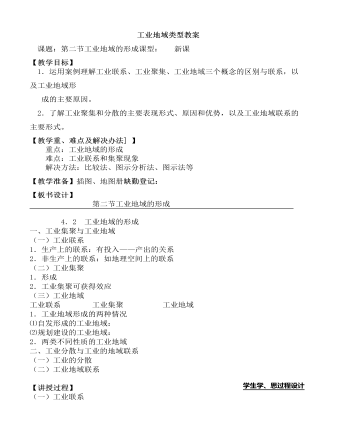
1.生产上的联系:有投入——产出的关系工业生产的过程复杂,工序繁多,往往需要经过多家工厂的加工才能完成一种产品的生产过程。因此,在这些工厂之间就存在着产品与原料的联系。一家工厂生产的产品是另一家工厂的原料,这两家工厂之间就形成了工序上的工业联系。2.非生产上的联系:如地理空间上的联系布局在同一个工业区内,共同利用工业区的道路、供水、供电、通信等基础设施以及其他生产、生活服务设施,或者共同利用当地廉价的劳动力,形成了空间利用上的工业联系。我国许多地方的经济技术开发区就是建立在这种工业联系基础上的。(二)工业集聚1.形成具有工业联系的一些工厂往往近距离地聚集起来,形成工业集聚现象。2.工业集聚可获得效应(1)工业集聚可以加强企业间的信息交流和技术协作,降低中间产品的运输费用和能源消耗,进而降低生产成本,提高生产效率和利润,取得规模效益。
人教版高中语文必修1《大卫·科波菲尔》教案2篇
(1)主人公大卫·科波菲尔:大卫·科波菲尔是《大卫·科波菲尔》中的主人公,曾经是个孤儿。作家描写了他从孤儿成长为一个具有人道主义精神的资产阶级民主主义作家的过程。他善良,诚挚,聪明,勤奋好学,有自强不息的勇气、百折不回的毅力和积极进取的精神,在逆境中满怀信心,在顺境中加倍努力,终于获得了事业上的成功和家庭的幸福。在这个人物身上寄托着狄更斯的道德理想。(2)《大卫·科波菲尔》中的女性形象:在狄更斯笔下,《大卫·科波菲尔》塑造了一个个有血有肉的人物形象,每个任务都给人留下了深刻的印象,尤其是成功塑造了不同性格、不同品德的女性形象:贝西姨婆、艾妮斯、佩葛蒂、克拉拉、朵拉、摩德斯通小姐、米考伯太太、艾米丽……贝西姨婆与摩德斯通小姐的对比,克拉拉、朵拉与艾妮斯的对比更使她们栩栩如生,对贝西姨婆、艾妮斯、佩葛蒂的爱就更深一层,对摩德斯通小姐更是恨之入骨,对朵拉、克拉拉既同情又气愤。
人教版高中语文必修3《动物游戏之迷》教案2篇
一、内容与解析内容:科普说明文《动物游戏之谜》。解析:《动物游戏之谜》是高中语文(必修)3第四单元的一篇科普说明文。科学是人类认识世界的重要工具,是人类文化的重要组成部分,是标志人类文明的尺度。阅读科普文章,可以启迪心志,激发想象,带领我们进入全新的科学天地,在科学海洋中遨游。本文思路清晰,内容生动,揭开了动物日常游戏行为的神秘面纱,摆出研究者的种种结论,既让我们扩大了视野,增长了知识,也让我们明白了科学探索永无止境。学习本文的重点是提高的科普文的阅读能力,培养学生勤于探索、勇于钻研的科学精神。二、教学目标及解析1、理清文章思路,明确本文的说明内容和顺序。2、品读文章,感受本文的语言特色。3、激发探究兴趣,培养筛选信息、提取要素及概括叙述的能力。4、挖掘人文内涵,培养学生保护动物的意识和勤于探索、勇于钻研的科学精神。
人教版高中语文必修3《马嵬(其二)》教案2篇
结合历史自古以来,江山美人历来都是引无数英雄豪杰竞折腰的,如果说英雄选择了美人却丢了江山,把所有罪名都归结于“女人是祸水”。但是,纣王无道,和有了妲己有必然的联系吗?有人说妲己坏透了,坏透了的妲己如果不是取得纣王的信任是坏不起来的,纣王听信了妲己的谗言,听与不听决定权在纣王,而不在妲己。强势永远在纣王一边。再来看看西施和杨贵妃:西施是作为越国贡献给吴国的供品来到吴王夫差的身边的,杨贵妃更是先是李隆基的儿媳妇被看中而得宠的。所以,西施和杨贵妃这两个可怜的女人根本没有自己的独立选择,没有独立的爱情,如果没有西施,就会有南施,或北施;如果没有杨贵妃,就会有李贵妃,王贵妃,总之什么施,什么妃是不能少的,因为那是吴王和李隆基的需要。
人教版高中历史必修1辛亥革命教案2篇
①从政府人员组成看,南京政府是一个以资产阶级革命派为主体的政府。②从政府颁发的法令和措施看,这些法令体现了资产阶级民主革命的要求,对于发展民族资本主义经济、资产阶级民主政治和文化教育以及改革社会风气,都起了积极作用。③从颁布的《中华民国临时约法》看,宪法体现了三权分立的政治体制,体现了资产阶级民主主义的要求,是中国历史上第一部资产阶级民主宪法,具有反封建专制制度的进步意义。(2)从南京临时政府的内外政策分析南京政府的根本弱点①未彻底地反封建。它没有采取比较彻底的反对封建主义的措施,特别是对封建统治的基础——地主阶级土地所有制没有触动,这样,南京临时政府也就不能真正地把广大人民群众动员起来,因而缺乏真正的群众基础。
人教版高中历史必修2古代商业的发展教案
中国古代商业的发展有哪些表现?综观中国古代历史,商业在不同的历史时期有不同的表现。主要表现在:(1)商业活动的场所的变化:先主要在城市中进行,后来农村集市贸易逐渐发展。唐时加快,明清时突出,出现了专业性的市集(如丝市、叶市、猪市等),以至逐渐形成了新兴的市镇(有的更是专业性的集散市集);而不是先有农村商业,而后才有城市商业的发展。(2)交易内容的变化:商业开始时以贩运、交流地区间的土特产品,经营统治者所需要的奢侈品为主要内容,以后随着商品货币经济的发展,市场商品种类增多、行业分细,为一般人民所需要的主要农副产品以及城市手工业所生产的大小商品在整个流通界地位提高。这种情况在宋代已经显现。(3)交易媒介的变化:商品交换最原始的形态是物物交换,不存在交易的媒介。随着商品交换的内容和地域的扩大,出现了以贝壳等为代表的一般等价物。
人教版高中历史必修3宋明理学教案2篇
二、程朱理学:1、宋代“理学”的产生:(1)含义:所谓“理学”,就是用“理学”一词来指明当时两宋时期所呈现出来的儒学。广义的理学,泛指以讨论天道问题为中心的整个哲学思潮,包括各种不同的学派;狭义的理学,专指程颢、程颐、朱熹为代表的,以“理”为最高范畴的学说,称为“程朱理学”。理学是北宋政治、社会、经济发展的理论表现,是中国古代哲学长期发展的结果,是批判佛、道学说的产物。他们把“理”或“天理”视作哲学的最高范畴,认为理无所不在,不生不灭,不仅是世界的本原,也是社会生活的最高准则。在穷理方法上,程颢“主静”,强调“正心诚意”;程颐“主敬”,强调“格物致知”。在人性论上,二程主张“去人欲,存天理”,并深入阐释这一观点使之更加系统化。二程学说的出现,标志着宋代“理学”思想体系的正式形成。【合作探究】宋代“理学”兴起的社会条件:
新人教版高中英语必修1Unit 2 Travelling Around-Discovering Useful Structure教案
(5)be to do (可以和具体的时间状语连用)①表示按计划、安排即将发生的动作。②用于时间、条件状语从句中,表示“如果要……,想要……”。The students are to meet at the school gate tomorrow. 明天学生们将在学校大门口集会。 If you are to succeed, you must work as hard as possible. 如果你想要成功,比必须努力工作。(6)be about to do (不与具体的时间状语连用) 表示即将要发生的动作。We are about to start. 我们就要出发了。The new school year is about to begin. 新学年开学在即。(7)一般现在时表将来①表示按时间表规定将要发生的动作。常限于表示位置移动的短暂性动词。②在时间、条件或让步状语从句中,用一般现在时表将来。Look at the timetable. Hurry up! Flight 4026 takes off at 18:20. 你看看时刻表,快点!4026次航班的起飞时间是下午6点20分。Jane is in a hurry because the train to the airport leaves in half an hour. 简很匆忙,因为去机场的火车半小时后出发。
新人教版高中英语必修1Unit 2 Travelling Around-Reading for Writing教案
Is there a clear purpose for the trip? :Does each paragraph have a clear main idea? Does the writer use the present continuous tense for future plans?Does the writer use commas, stops, and question marks correctly? Are all the words spelt correctly?Are all the proper nouns capitalized?Revise your draft according to your partner's comments.Step 5:The summary of how to write a travel plan.旅游计划是一种常见的应用文写作。旅游可分为观光游、文化游、美食游及探险游等不同类型,因此旅游计划也要根据不同的旅游目的进行设计。常规的旅游计划需要明确以下几个方面的问题:Travel planWhen will you leave for? Where is your the destination?How will you get there?What will you do there?How long will you there?Is there a clear purpose for the trip? 为了提升旅行计划的层级,还需注意以下几个方面的问题:1.每段是否有明确清晰的主题;2.用一般现在时代替一般将来时;3.用更高级的形容词词汇。例如:表达“好”时,不要总用“nice”,我们还可以用“smart, clean, excellent, exciting, beautiful, wonderful, clever, famous, grand”等表达更具有指向性的词汇;4.用更高级的动词词汇。比如:我们可以用“seem stand, lie .get stay, remain, look . sound, become . keep, grow”等代替"be";
新人教版高中英语必修2Unit 1 Cultural Heritage-Discovering Useful Structure教案二
This theme of the part is “ Describe people or things in greater detail”. Students have learned the grammar(restrictive relative clauses) in Book 1, and further review and consolidate its structure “prep+relative pronouns(which/whom)” and the relative adverbs(when, where and why), besides students should understand its form, meaning and functions. In this section, students should be able to express the grammar correctly in daily communication and in the writing. 1. Review the basic usages of relative pronouns and adverbs of attributive clauses . 2. Learn to use some special cases about restrictive relative clauses.3. Learn to write sentences with restrictive relative clauses flexibly according to the context.1. Review the basic usages of relative pronouns and adverbs of attributive clauses .2. Learn to use some special cases about restrictive relative clauses.3. Learn tow rite sentences with restrictive relative clauses flexibly according to the context.Step 1. Observe the following sentences, and mark the relative pronouns and the adverbs. 1. After listening to the scientists who had studied the problems, and citizens who lived near the dam, the government turned to the United Nations for help.2. Temples and other cultural sites were taken down piece by piece, and then moved and put back together again in a place where they were safe from the water.Step 2 PracticePlease complete these sentences with relative pronouns and relative adverbs and answer the following questions.Questions: 1. What is the head noun ?2. What relative words should be used ?3. What elements do they act in these sentences ?
新人教版高中英语必修2Unit 1 Cultural Heritage-Discovering Useful Structure教案一
This teaching period mainly deals with grammar “restrictive relative clauses.” To begin with, teachers should lead students to revise what they have learned about the relative pronouns and relative adverbs. And then, teachers move on to stress more special cases concerning this grammar, such as the “preposition+ relative pronouns which and whom” and cases where we can omit the relative pronouns. This period carries considerable significance to the cultivation of students’ writing competence and lays a solid foundation for the basic appreciation of language beauty. The teacher is expected to enable students to master this period thoroughly and consolidate the knowledge by doing some exercises. 1. Guide students to review the basic usages of relative pronouns and adverbs of attributive clauses.2. Lead students to learn to use some special cases concerning restrictive relative clauses flexibly.2. Enable students to use the basic phrases structures flexibly.3. Strengthen students’ great interest in grammar learning.1. Help students to appreciate the function of relative pronouns and adverbs of attributive clauses in a sentence2. Instruct students to write essays using the proper relative pronouns and adverbs of attributive clauses.本节语法思考:定语从句在复合句中的作用是什么? 关系词有哪些?定语从句在复合句中的作用相当于形容词,它在句中作定语修饰名词或代词。他们在先行词和定语从句之间起到联系作用,同时在意义上代表先行词并在定语从句中担任一个成分。被定语从句所修饰的词称先行词,定语从句一般放在先行词的后面。
新人教版高中英语必修2Unit 1 Cultural Heritage-Listening&Speaking&Talking教案
Listening and Speaking introduces the topic of “Take part in a youth project”. The listening text is an interview about an international youth cultural heritage protection project. More than 20 high school students from seven countries participated in the project. The reporter interviewed two participants Stephanie and Liu Bin. By listening to the text, students can understand the significance of cultural heritage protection, and teenagers can use their knowledge, combine their own interests and advantages, etc. to participate in the action of cultural heritage protection. Listening and Talking introduces the theme of "Talk about history and culture". The listening text is a dialogue between two tourists and tour guides when they visit the Kremlin, red square and surrounding buildings. The dialogue focuses on the functional items of "starting a conversation", which is used to politely and appropriately attract the attention of the others, so as to smoothly start a conversation or start a new topic. The purpose of this section is to guide students to understand the history and current situation of Chinese and foreign cultural heritage in their own tourism experiences or from other people's tourism experiences, explore the historical and cultural values, and be able to express accurately and appropriately in oral communication.1. Guide students to understand the content of listening texts in terms of the whole and key details; 2. Cultivate students' ability to guess the meaning of words in listening; discuss with their peers how to participate in cultural heritage protection activities.3. Instruct students to use functional sentences of the dialogue such as “I beg your pardon, but…” “Forgive me for asking, but…" and so on to start the conversation more politely and appropriately.
新人教版高中英语必修2Unit 1 Cultural Heritage-Reading and Thinking教案二
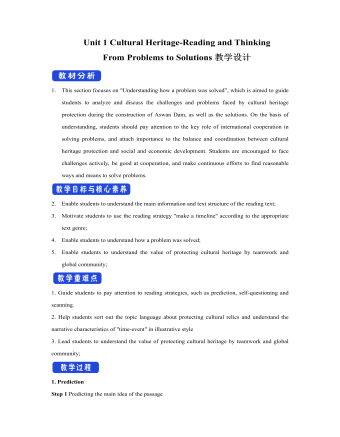
1. This section focuses on "Understanding how a problem was solved”, which is aimed to guide students to analyze and discuss the challenges and problems faced by cultural heritage protection during the construction of Aswan Dam, as well as the solutions. On the basis of understanding, students should pay attention to the key role of international cooperation in solving problems, and attach importance to the balance and coordination between cultural heritage protection and social and economic development. Students are encouraged to face challenges actively, be good at cooperation, and make continuous efforts to find reasonable ways and means to solve problems.2. Enable students to understand the main information and text structure of the reading text;3. Motivate students to use the reading strategy "make a timeline" according to the appropriate text genre;4. Enable students to understand how a problem was solved;5. Enable students to understand the value of protecting cultural heritage by teamwork and global community;1. Guide students to pay attention to reading strategies, such as prediction, self-questioning and scanning.2. Help students sort out the topic language about protecting cultural relics and understand the narrative characteristics of "time-event" in illustrative style3. Lead students to understand the value of protecting cultural heritage by teamwork and global community;
新人教版高中英语必修2Unit 1 Cultural Heritage-Reading and Thinking教案一
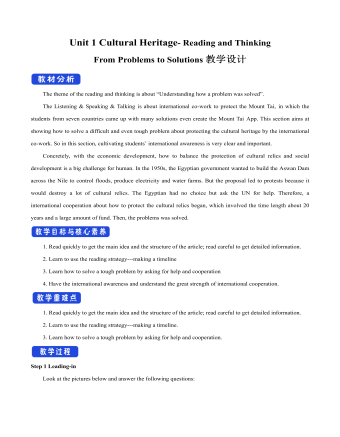
The theme of the reading and thinking is about “Understanding how a problem was solved”.The Listening & Speaking & Talking is about international co-work to protect the Mount Tai, in which the students from seven countries came up with many solutions even create the Mount Tai App. This section aims at showing how to solve a difficult and even tough problem about protecting the cultural heritage by the international co-work. So in this section, cultivating students’ international awareness is very clear and important. Concretely, with the economic development, how to balance the protection of cultural relics and social development is a big challenge for human. In the 1950s, the Egyptian government wanted to build the Aswan Dam across the Nile to control floods, produce electricity and water farms. But the proposal led to protests because it would destroy a lot of cultural relics. The Egyptian had no choice but ask the UN for help. Therefore, a international cooperation about how to protect the cultural relics began, which involved the time length about 20 years and a large amount of fund. Then, the problems was solved. 1. Read quickly to get the main idea and the structure of the article; read careful to get detailed information.2. Learn to use the reading strategy---making a timeline3. Learn how to solve a tough problem by asking for help and cooperation4. Have the international awareness and understand the great strength of international cooperation.1. Read quickly to get the main idea and the structure of the article; read careful to get detailed information.2. Learn to use the reading strategy---making a timeline.3. Learn how to solve a tough problem by asking for help and cooperation.
新人教版高中英语必修2Unit 1 Cultural Heritage-Reading For Writing教案
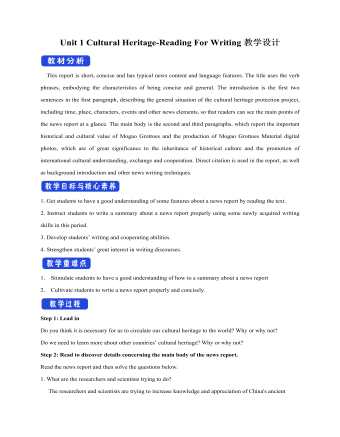
This report is short, concise and has typical news content and language features. The title uses the verb phrases, embodying the characteristics of being concise and general. The introduction is the first two sentences in the first paragraph, describing the general situation of the cultural heritage protection project, including time, place, characters, events and other news elements, so that readers can see the main points of the news report at a glance. The main body is the second and third paragraphs, which report the important historical and cultural value of Mogao Grottoes and the production of Mogao Grottoes Material digital photos, which are of great significance to the inheritance of historical culture and the promotion of international cultural understanding, exchange and cooperation. Direct citation is used in the report, as well as background introduction and other news writing techniques.1. Get students to have a good understanding of some features about a news report by reading the text.2. Instruct students to write a summary about a news report properly using some newly acquired writing skills in this period.3. Develop students’ writing and cooperating abilities.4. Strengthen students’ great interest in writing discourses.1. Stimulate students to have a good understanding of how to a summary about a news report 2. Cultivate students to write a news report properly and concisely.Step 1: Lead in Do you think it is necessary for us to circulate our cultural heritage to the world? Why or why not?Do we need to learn more about other countries’ cultural heritage? Why or why not?Step 2: Read to discover details concerning the main body of the news report.
新人教版高中英语必修2Unit 3 The Internet-Discovering Useful Structure教案二
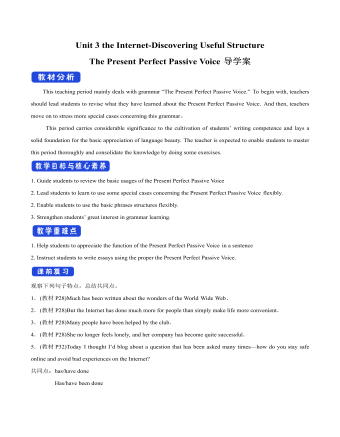
This teaching period mainly deals with grammar “The Present Perfect Passive Voice.” To begin with, teachers should lead students to revise what they have learned about the Present Perfect Passive Voice. And then, teachers move on to stress more special cases concerning this grammar。This period carries considerable significance to the cultivation of students’ writing competence and lays a solid foundation for the basic appreciation of language beauty. The teacher is expected to enable students to master this period thoroughly and consolidate the knowledge by doing some exercises. 1. Guide students to review the basic usages of the Present Perfect Passive Voice2. Lead students to learn to use some special cases concerning the Present Perfect Passive Voice flexibly.2. Enable students to use the basic phrases structures flexibly.3. Strengthen students’ great interest in grammar learning.1. Help students to appreciate the function of the Present Perfect Passive Voice in a sentence2. Instruct students to write essays using the proper the Present Perfect Passive Voice.观察下列句子特点,总结共同点。1.(教材P28)Much has been written about the wonders of the World Wide Web.2.(教材P28)But the Internet has done much more for people than simply make life more convenient.3.(教材P28)Many people have been helped by the club.4.(教材P28)She no longer feels lonely, and her company has become quite successful.5.(教材P32)Today I thought I’d blog about a question that has been asked many times—how do you stay safe online and avoid bad experiences on the Internet?