-
人教版高中政治必修3文化塑造人生教案2篇
【教学内容】人教版高中思想政治必修3文化生活第一单元第二课第二框题《文化塑造人生》。【教学目标】1.知识目标理解优秀文化如何丰富人的精神世界、增强人的精神力量及促进人的全面发展。2.能力目标(1)能赏析优秀文化产品,感悟积极向上的文化生活对于丰富人们的精神世界,增强人民的精神力量的意义,确信其促进人的全面发展的重要作用。(2)结合文化塑造人生,不断丰富自己的精神世界,促进自身的全面发展3.情感、态度、价值观目标树立正确的世界观、人生观、价值观,丰富精神世界,增强精神力量,接受优秀文化,促进自身的全面发展。【教学重点】优秀文化能丰富人的精神世界,增强人的精神力量【教学难点】文化促进人的全面发展【教学准备】资料收集、多媒体课件【课时安排】1课时【教学过程】视频导入:播放我国残疾人艺术团在春节晚会上的精美舞蹈《千手观音》。
人教版高中政治必修2我国的宗教政策教案
(1)宗教有它自身的发展规律,不能简单的用行政力量去消灭或发展宗教,实行宗教信仰自由政策是遵循宗教发展规律,科学处理宗教问题。(2)宗教信仰自由是宪法赋予公民的民主权利,实行宗教信仰自由政策有利于加强信教群众与不信教群众的团结,引导宗教与社会主义社会相适应。2、弘扬科学精神我国是在马列主义、毛泽东思想、邓小平理论、三个代表重要思想指引下的社会主义国家,要建设社会主义物质文明、政治文明,也要建设社会主义精神文明。加强对人民群众的科学世界观和无神论教育,形成文明、健康、崇尚科学的社会风尚,逐步消除宗教存在的社会根源何认识根源,在保护宗教信仰自由的同时,创造宗教消亡的条件,这是解决在教问题的根本途径。3、中学生作为中国特色社会主义事业未来的建设者,要用辩证唯物主义和历史主义以及现代科学文化知识武装自己,弘扬科学精神,树立科学世界观,承担起建设祖国、振兴中华的光荣历史使命。
人教版高中政治必修2我国的宗教政策教案
(一)知识目标识记:宗教信仰自由的含义。理解:(1)社会主义条件下宗教存在的长期性;(2)理解我国实行宗教信仰自由的内容;(3)依法加强对宗教事务管理的有关规定。(4)积极引导宗教与社会主义社会相适应。(二)能力目标能运用马克思主义关于宗教的基本观点,分析说明我国实行宗教信仰自由的正确性和必要性。(三)情感、态度与价值观目标通过学习,加强宗教的政策观念,自觉抵制和反对各种迷信活动,特别是认清法轮功的邪教本质。三、教学重点难点全面理解和贯彻宗教信仰自由政策既是重点又是难点,教学中紧紧抓住中央一再强调的三句话:(1)全面贯彻宗教政策;(2)加强对宗教事务管理:(3)引导宗教与社会主义社会相适应。四、学情分析这是本课的难点。我国是多民族的国家,也是多宗教的国家,特别是宗教对一些少数民族有广泛而深远的影响。我们东部地区的学生,很多人还存在疑惑:我们社会主义国家为什么还允许宗教存在,实行宗教信仰自由政策呢?
人教版高中历史必修3物理学的重大进展教案
B重点与难点重点:伽利略对物理学发展的重大贡献;经典力学的建立;相对论的提出;量子论的诞生。难点:物理学各阶段发展的原因;对科学发展创新性的理解。D教学过程【导入新课】1632年,伽利略撰写的《关于托勒密和哥白尼两大世界体系的对话》科学巨著出版后,立刻引起教会的恐慌,把伽利略投入监狱。教皇乌尔班八世的御用工具——宗教裁判所在1633年6月21日宣布对伽利略的判决:“我们判决你在宗教法庭监狱内服刑,刑期由我们掌握,为了有益于补赎,命令你在今后3年内,每周背诵7篇赎罪诗篇……”这一纸胡言,竟使伽利略蒙冤300多年,致死都没有撤销判决,甚至死后还被禁止举行殡礼,不准葬入圣太克罗斯墓地。那么,是什么原因导致宗教裁判所对伽利略作了如此判决?我们应如何看待伽利略在科学领域的贡献?
人教版高中政治必修1社会主义市场经济教案
教师总结:社会主义市场经济是使市场在国家宏观调控下起基础性配置作用的经济,充分发挥市场基础性调节作用,就必须主要靠经济手段、法律手段,而不是行政手段。(三)课堂总结、点评这节课我们重点学习了社会主义市场经济的有关知识,知道了社会主义市场经济的基本特征,以及国家宏观调控的含义、目标和主要手段。这对于我们在经济生活中正确地认识我国市场经济的性质和作用,理解国家宏观调控的措施及意义,增强社会主义优越感和民族自强意识,自觉投身现代化建设等将有重大指导作用。★课余作业 讨论:联系经济生活中国家宏观调控的实例,讨论应如何认识和理解国家各种宏观调控手段的综合运用,对国民经济发展的意义。★教学体会 本节内容与学生生活实际联系密切,在学习中应该多引入日常生产、生活中常见的一些宏观调控实例,让学生去深刻理解、把握宏观调控手段及其作用。
人教版高中政治必修1市场配置资源教案
教师点拨:这则材料说明,市场调节有其局限性,单纯的市场调节具有自发性、盲目性、滞后性等缺点。市场调节不是万能的。社会生活中有很多领域和产品不能用市场来调节,如国防、治安、消防等产品的供给问题,枪支弹药、麻醉品等都不能让市场来调节。市场调节具有自发性、盲目性、滞后性。自发性:由于市场调节是在价值规律自发作用下进行的,在利益驱动下会产生一些违反市场原则的行为,如制造、销售假冒伪劣商品,大量排放废水、废气破坏环境,窃取他人智力成果等等。盲目性:由于人们不可能完全掌握生产各方面信息及其变化趋势,致使决策带有一定的盲目性。如某种商品有利可图则一哄而上,反之则一哄而退,从而造成资源浪费和消费得不到充分满足。滞后性:由于市场价格的形成和传递有一个过程,一旦传递到生产经营者手中进行生产调整,就有一个时间差,致使市场调节带有滞后性,成为一种事后调节。
人教版高中语文必修1《小狗包弟》教案2篇
巴金在十年浩劫中的大致经历:放弃包弟并没有换得保全一家人,1968年8月,巴金被关进牛棚改造,随后经受了大字报、挂牌游街等形式的批斗。1970年,到农村改造,掏大粪、喂猪、背稻草、种地……1972年,妻子萧珊在饱受精神折磨后患上癌症,病逝。巴金的儿子在劳动改造的过程中也饱受精神和肉体上的折磨,性格变得内向抑郁,疾病缠身。此时,巴金69岁。巴金曾在《病中》一文写道:“当姚文元拿着棒子的时候,我给关在牛棚里除了唯唯诺诺之外,敢于做过什么事情?十年间我不过是一条含着眼泪等人宰割的牛。”小结:(幻灯片12)社会是病态的社会,政治是高压的政治,人性是扭曲的人性。十年文革,十年浩劫,给多少人留下了累累不可弥合的精神创伤。即使一条小狗,也可能摆脱不了“文革”无情的迫害,比如包弟,比如艺术家邻居的小狗。
人教版高中语文必修1《再别康桥》教案2篇
教学过程:一、交流诵读课文技巧。——节奏、韵脚、感情……(5分钟)二、再读确定自己的学习主题(15分)1、主题提示:音乐美、绘画美、建筑美简介诗歌“三美”追求闻一多先生是我国现代文学史上集诗人、学者和斗士于一身的重要诗人。他不但致力于新诗艺术美的探索,提出了音乐美、绘画美、建筑美的诗歌\"三美\"的新格律诗理论主张,还努力进行创作实践,写出了许多精美诗篇。他的新格律诗理论被后人称为现代诗学的奠基石,影响深远。《诗的格律》是闻一多先生系列诗论中最重要的一篇。在这篇论文中,他系统的提出\"诗的实力不独包括音乐的美(音节)、绘画的美(词藻),并且还有建筑的美(节的匀称和句的均齐)。\"这一关于新诗\"三美\"主张遂成为新格律诗派的理论纲领。
人教版高中语文必修2《兰亭集序》教案3篇
三、指导第一段的背诵,点拨理解句意,强调关键词语,注重文言基础知识教学。过程中要让学生反复读背。背诵线索:时间——地点——事件——人物——环境——活动——天气——感觉。时间:永和九年,岁在癸丑,暮春之初。地点:会于会稽山阴之兰亭。事件:修稧事也。人物:群贤毕至,少长咸集。环境:此地有崇山峻岭,茂林修竹;又有清流激湍,映带左右。活动:引以为流觞曲水,列坐其次。虽无丝竹管弦之盛,一觞一咏,亦足以畅叙幽情。天气:是日也,天朗气清,惠风和畅。感觉:仰观宇宙之大,俯察品类之盛,所以极视听之娱,信可乐也。四、学生自读背诵5分钟。五、抽一至二名学生试背课文,教师可作必要的线索提示。第二课时一、听名家示范朗诵,学生小声跟读。二、复习巩固第一自然段的阅读背诵。三、朗读、解析第二自然段,理解文章“由叙入感”的写作结构。
人教版高中政治必修3体味文化教案2篇
3、文化是人们的一种素养(1)人的文化素养是在社会生活、实践中形成的。每个人所具有的文化素养,不是天生的,而是通过对社会生活的体验,特别是通过参与文化生活、接受知识文化教育而逐步培养出来的。文化素养的形成,离不开生活、实践和教育。人们在社会实践中创造和发展文化,也在社会生活中获得和享用文化。(2)人的文化素养表现在日常言行中。教师活动:引导学生阅读教材7页“公交车漫画”材料,并思考所反映的问题学生活动:积极思考并讨论问题教师点评:人们的精神活动离不开物质活动,人们的文化素养总是要通过他在日常生活中的言行、在社会实践活动中的表现等表现出来。我们通过观察人们的社会行为,就可以从中透视人们的精神世界和精神生活。4、文化的传承和发展离不开物质载体。社会文化和精神产品离不开物质载体,一个时代的文化和精神产品,往往是这一时代社会发展轨迹的反映。
新人教版高中英语必修2Unit 1 Cultural Heritage-Reading and Thinking教案二
1. This section focuses on "Understanding how a problem was solved”, which is aimed to guide students to analyze and discuss the challenges and problems faced by cultural heritage protection during the construction of Aswan Dam, as well as the solutions. On the basis of understanding, students should pay attention to the key role of international cooperation in solving problems, and attach importance to the balance and coordination between cultural heritage protection and social and economic development. Students are encouraged to face challenges actively, be good at cooperation, and make continuous efforts to find reasonable ways and means to solve problems.2. Enable students to understand the main information and text structure of the reading text;3. Motivate students to use the reading strategy "make a timeline" according to the appropriate text genre;4. Enable students to understand how a problem was solved;5. Enable students to understand the value of protecting cultural heritage by teamwork and global community;1. Guide students to pay attention to reading strategies, such as prediction, self-questioning and scanning.2. Help students sort out the topic language about protecting cultural relics and understand the narrative characteristics of "time-event" in illustrative style3. Lead students to understand the value of protecting cultural heritage by teamwork and global community;
新人教版高中英语必修2Unit 1 Cultural Heritage-Reading and Thinking教案一
The theme of the reading and thinking is about “Understanding how a problem was solved”.The Listening & Speaking & Talking is about international co-work to protect the Mount Tai, in which the students from seven countries came up with many solutions even create the Mount Tai App. This section aims at showing how to solve a difficult and even tough problem about protecting the cultural heritage by the international co-work. So in this section, cultivating students’ international awareness is very clear and important. Concretely, with the economic development, how to balance the protection of cultural relics and social development is a big challenge for human. In the 1950s, the Egyptian government wanted to build the Aswan Dam across the Nile to control floods, produce electricity and water farms. But the proposal led to protests because it would destroy a lot of cultural relics. The Egyptian had no choice but ask the UN for help. Therefore, a international cooperation about how to protect the cultural relics began, which involved the time length about 20 years and a large amount of fund. Then, the problems was solved. 1. Read quickly to get the main idea and the structure of the article; read careful to get detailed information.2. Learn to use the reading strategy---making a timeline3. Learn how to solve a tough problem by asking for help and cooperation4. Have the international awareness and understand the great strength of international cooperation.1. Read quickly to get the main idea and the structure of the article; read careful to get detailed information.2. Learn to use the reading strategy---making a timeline.3. Learn how to solve a tough problem by asking for help and cooperation.
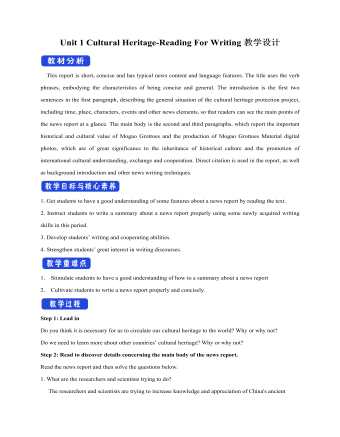
新人教版高中英语必修2Unit 1 Cultural Heritage-Reading For Writing教案
This report is short, concise and has typical news content and language features. The title uses the verb phrases, embodying the characteristics of being concise and general. The introduction is the first two sentences in the first paragraph, describing the general situation of the cultural heritage protection project, including time, place, characters, events and other news elements, so that readers can see the main points of the news report at a glance. The main body is the second and third paragraphs, which report the important historical and cultural value of Mogao Grottoes and the production of Mogao Grottoes Material digital photos, which are of great significance to the inheritance of historical culture and the promotion of international cultural understanding, exchange and cooperation. Direct citation is used in the report, as well as background introduction and other news writing techniques.1. Get students to have a good understanding of some features about a news report by reading the text.2. Instruct students to write a summary about a news report properly using some newly acquired writing skills in this period.3. Develop students’ writing and cooperating abilities.4. Strengthen students’ great interest in writing discourses.1. Stimulate students to have a good understanding of how to a summary about a news report 2. Cultivate students to write a news report properly and concisely.Step 1: Lead in Do you think it is necessary for us to circulate our cultural heritage to the world? Why or why not?Do we need to learn more about other countries’ cultural heritage? Why or why not?Step 2: Read to discover details concerning the main body of the news report.
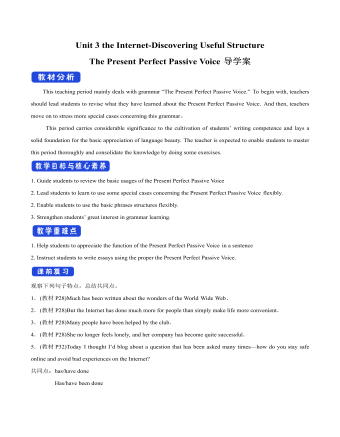
新人教版高中英语必修2Unit 3 The Internet-Discovering Useful Structure教案二
This teaching period mainly deals with grammar “The Present Perfect Passive Voice.” To begin with, teachers should lead students to revise what they have learned about the Present Perfect Passive Voice. And then, teachers move on to stress more special cases concerning this grammar。This period carries considerable significance to the cultivation of students’ writing competence and lays a solid foundation for the basic appreciation of language beauty. The teacher is expected to enable students to master this period thoroughly and consolidate the knowledge by doing some exercises. 1. Guide students to review the basic usages of the Present Perfect Passive Voice2. Lead students to learn to use some special cases concerning the Present Perfect Passive Voice flexibly.2. Enable students to use the basic phrases structures flexibly.3. Strengthen students’ great interest in grammar learning.1. Help students to appreciate the function of the Present Perfect Passive Voice in a sentence2. Instruct students to write essays using the proper the Present Perfect Passive Voice.观察下列句子特点,总结共同点。1.(教材P28)Much has been written about the wonders of the World Wide Web.2.(教材P28)But the Internet has done much more for people than simply make life more convenient.3.(教材P28)Many people have been helped by the club.4.(教材P28)She no longer feels lonely, and her company has become quite successful.5.(教材P32)Today I thought I’d blog about a question that has been asked many times—how do you stay safe online and avoid bad experiences on the Internet?
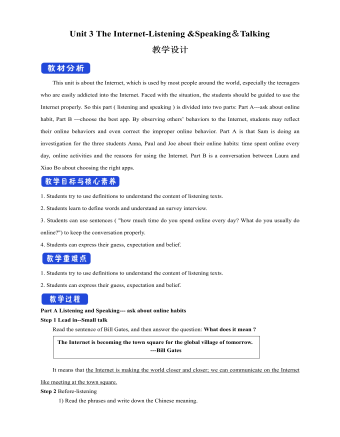
新人教版高中英语必修2Unit 3 The Internet-Listening &Speaking&Talking教案二
From the pictures in the text and the title--- choose the best app, we can know that this part is about how to save money by using apps.Step 2 While-listening1. Laura and Xiao Bo are talking about apps. Listen to their conversation and find out what apps they want.Xiao Bo is looking for a(n) exercise app to help him get in shape.Laura would like an app for getting rich and another that will make her grades better.2. Listen again. Are the sentences true T or false F?1). Both of Xiao Bo's apps keep track of the steps he takes._____2). Xiao Bo's second app can help him make a fitness plan._____3). Laura needs an app that will help her get discounts.______4). Laura needs an app that will add money to her bank account._______F T F T3. Listen once more and tick the sentence you hear. Underline the words used to express predictions, guesses, and beliefs.Predictions, Guesses, and Beliefs________It might help me walk more.________My guess is that it wouldn't work.________I imagine this app would help me get fit faster________I suppose that would be good.________I guess you could save a little with this app.________I suppose there would be some problems, too.________I believe this app could help me get thinner.
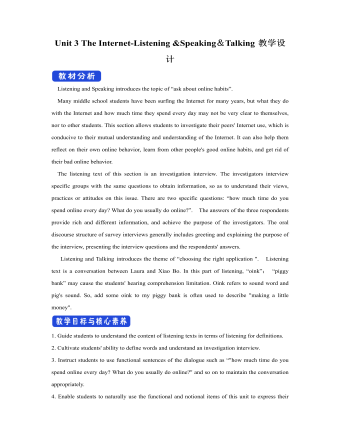
新人教版高中英语必修2Unit 3 The Internet-Listening &Speaking&Talking教案一
Listening and Speaking introduces the topic of “ask about online habits”. Many middle school students have been surfing the Internet for many years, but what they do with the Internet and how much time they spend every day may not be very clear to themselves, nor to other students. This section allows students to investigate their peers' Internet use, which is conducive to their mutual understanding and understanding of the Internet. It can also help them reflect on their own online behavior, learn from other people's good online habits, and get rid of their bad online behavior.The listening text of this section is an investigation interview. The investigators interview specific groups with the same questions to obtain information, so as to understand their views, practices or attitudes on this issue. There are two specific questions: “how much time do you spend online every day? What do you usually do online?”. The answers of the three respondents provide rich and different information, and achieve the purpose of the investigators. The oral discourse structure of survey interviews generally includes greeting and explaining the purpose of the interview, presenting the interview questions and the respondents' answers. Listening and Talking introduces the theme of “choosing the right application ". Listening text is a conversation between Laura and Xiao Bo. In this part of listening, “oink”; “piggy bank” may cause the students' hearing comprehension limitation. Oink refers to sound word and pig's sound. So, add some oink to my piggy bank is often used to describe "making a little money".1. Guide students to understand the content of listening texts in terms of listening for definitions.2. Cultivate students' ability to define words and understand an investigation interview.
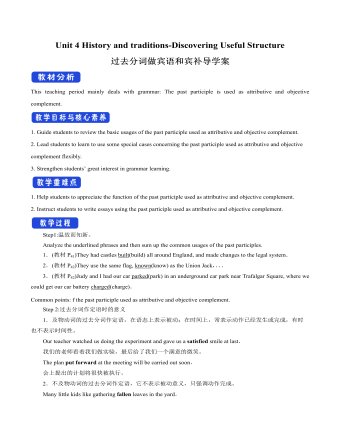
新人教版高中英语必修2Unit 4 History and Traditions-Discovering Useful Structure教案二
This teaching period mainly deals with grammar: The past participle is used as attributive and objective complement.1. Guide students to review the basic usages of the past participle used as attributive and objective complement.2. Lead students to learn to use some special cases concerning the past participle used as attributive and objective complement flexibly.3. Strengthen students’ great interest in grammar learning.1. Help students to appreciate the function of the past participle used as attributive and objective complement.2. Instruct students to write essays using the past participle used as attributive and objective complement.Step1:温故而知新。Analyze the underlined phrases and then sum up the common usages of the past participles.1.(教材P41)They had castles built(build) all around England, and made changes to the legal system.2.(教材P42)They use the same flag, known(know) as the Union Jack,...3.(教材P42)Judy and I had our car parked(park) in an underground car park near Trafalgar Square, where we could get our car battery charged(charge).Common points: f the past participle used as attributive and objective complement.Step 2:过去分词作定语时的意义1.及物动词的过去分词作定语,在语态上表示被动;在时间上,常表示动作已经发生或完成,有时也不表示时间性。Our teacher watched us doing the experiment and gave us a satisfied smile at last.我们的老师看着我们做实验,最后给了我们一个满意的微笑。The plan put forward at the meeting will be carried out soon.会上提出的计划将很快被执行。2.不及物动词的过去分词作定语,它不表示被动意义,只强调动作完成。Many little kids like gathering fallen leaves in the yard.
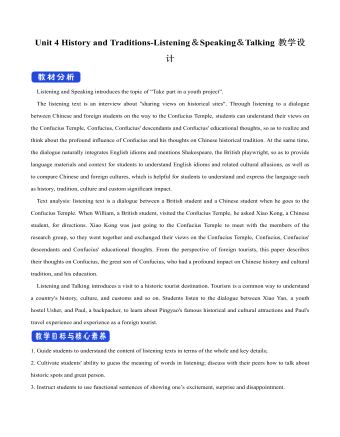
新人教版高中英语必修2Unit 4 History and Traditions-Listening&Speaking&Talking教案二
Listening and Speaking introduces the topic of “Take part in a youth project”. The listening text is an interview about "sharing views on historical sites". Through listening to a dialogue between Chinese and foreign students on the way to the Confucius Temple, students can understand their views on the Confucius Temple, Confucius, Confucius' descendants and Confucius' educational thoughts, so as to realize and think about the profound influence of Confucius and his thoughts on Chinese historical tradition. At the same time, the dialogue naturally integrates English idioms and mentions Shakespeare, the British playwright, so as to provide language materials and context for students to understand English idioms and related cultural allusions, as well as to compare Chinese and foreign cultures, which is helpful for students to understand and express the language such as history, tradition, culture and custom significant impact.Text analysis: listening text is a dialogue between a British student and a Chinese student when he goes to the Confucius Temple. When William, a British student, visited the Confucius Temple, he asked Xiao Kong, a Chinese student, for directions. Xiao Kong was just going to the Confucius Temple to meet with the members of the research group, so they went together and exchanged their views on the Confucius Temple, Confucius, Confucius' descendants and Confucius' educational thoughts. From the perspective of foreign tourists, this paper describes their thoughts on Confucius, the great son of Confucius, who had a profound impact on Chinese history and cultural tradition, and his education.Listening and Talking introduces a visit to a historic tourist destination. Tourism is a common way to understand a country's history, culture, and customs and so on. Students listen to the dialogue between Xiao Yan, a youth hostel Usher, and Paul, a backpacker, to learn about Pingyao's famous historical and cultural attractions and Paul's travel experience and experience as a foreign tourist.
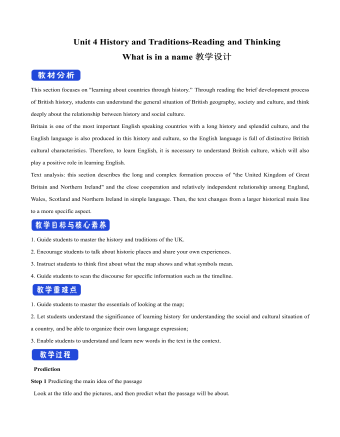
新人教版高中英语必修2Unit 4 History and Traditions-Reading and Thinking教案一
Features of languages1.Finally, in the 20th century, the southern part of Ireland broke away from the UK, which resulted in the full name we have today: the United Kingdom of Great Britain and Northern Ireland.该句是一个复合句。该句主句为:the southern part of Ireland broke away from the UK;which resulted in the full name we have today为which引导的定语从句代指前面整句话的内容,we have today为定语从句修饰先行词name。译文:最后,在20世纪,爱尔兰南部脱离英国,这导致了我们今天有的英国的全名:大不列颠及北爱尔兰联合王国。2.Almost everywhere you go in the UK, you will be surrounded by evidence of four different groups of people who took over at different times throughout history.该句是一个复合句。该句主句为:you will be surrounded by evidence of four different groups of people;其中Almost everywhere you go in the UK为让步状语从句; who took over at different times throughout history为定语从句修饰先行词people。译文:几乎无论你走到英国的任何地方,你都会发现历史上有四种不同的人在不同的时期统治过英国。3.The capital city London is a great place to start, as it is an ancient port city that has a history dating all the way back to Roman times.该句是一个复合句。该句主句为:The capital city London is a great place to start; as it is an ancient port city that has a history dating all the way back to Roman times.为原因状语从句;dating all the way back to Roman times为现在分词短语作定语修饰history。
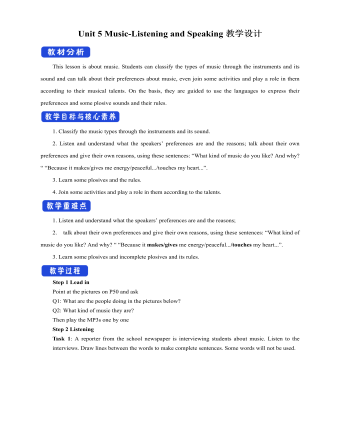
新人教版高中英语必修2Unit 5 Music-Listening and Speaking教案
This lesson is about music. Students can classify the types of music through the instruments and its sound and can talk about their preferences about music, even join some activities and play a role in them according to their musical talents. On the basis, they are guided to use the languages to express their preferences and some plosive sounds and their rules.1. Classify the music types through the instruments and its sound.2. Listen and understand what the speakers’ preferences are and the reasons; talk about their own preferences and give their own reasons, using these sentences: “What kind of music do you like? And why? “ “Because it makes/gives me energy/peaceful.../touches my heart...”.3. Learn some plosives and the rules.4. Join some activities and play a role in them according to the talents. 1. Listen and understand what the speakers’ preferences are and the reasons;2. talk about their own preferences and give their own reasons, using these sentences: “What kind of music do you like? And why? “ “Because it makes/gives me energy/peaceful.../touches my heart...”.3. Learn some plosives and incomplete plosives and its rules.Step 1 Lead inPoint at the pictures on P50 and ask Q1: What are the people doing in the pictures below?Q2: What kind of music they are?Then play the MP3s one by oneStep 2 ListeningTask 1: A reporter from the school newspaper is interviewing students about music. Listen to the interviews. Draw lines between the words to make complete sentences. Some words will not be used.