-
人教版高中语文必修4《哈姆莱特》教案
一、作者简介:威廉·莎士比亚(1564~1616),英国文艺复兴时期伟大的戏剧家和诗人。(人文主义:欧洲文艺复兴时期新兴资产阶级反封建的社会思潮。资产阶级人道主义的最初形式。它肯定人性和人的价值,要求享受人世的欢乐,要求人的个性解放和自由平等,推崇人的感性经验和理性思维。)一生共写有37部戏剧,154首14行诗,两首长诗和许多其他诗歌。主要代表作有早期的历史剧、喜剧———《亨利四世》、《仲夏夜之梦》、《威尼斯商人》和《罗密欧与朱丽叶》等;中期的悲剧———《哈姆莱特》、《奥瑟罗》、《李尔王》和《麦克白》等;后期的传奇剧———《暴风雨》等。二、莎士比亚创作《哈姆莱特》的社会背景:莎士比亚是欧洲文艺复兴时期英国伟大的戏剧家和诗人。他生活在欧洲历史上封建制度日趋没落、资本主义兴起的交替时代。哈姆莱特是丹麦古代的王子。莎士比亚故意以超越时代的误差将哈姆莱特搬到伊丽莎白统治未年的英国现实中来。
新人教版高中英语必修1Unit 1 Teenage Life-Reading and Thinking教案
【教材分析】The topic of this unit is about teenage life, which belongs to the theme context of “humans and oneself”.As teenagers who shoulder the responsibility of “Chinese great dream”, they must fully know themselves, including their strengths, weaknesses and challenges etc. They are supposed to improve themselves continuously and readily study their subjects, and thus foster their strategies and confidence in lifelong studies.This period is entitled the freshmen challenges, which mainly concerns some big challenges for new students in Senior high school. In this period, a teacher should lead students to find out what their challenges are and guide them to figure out how to crack the challenges and better themselves. More importantly, a teacher should instruct students to absorb new language points and appreciate the language. Besides, a teacher must instruct students to acquire some skills concerning reading efficiently and inspire them to talk more about their new school life, especially their new problems and solutions both at school and in life.【教学目标与核心素养】1. Enable students to acquire the basic usage of the new words and expressions concerning the freshmen challenges and learn to use them flexibly.2. Enable students to have a good understanding of the freshmen challenges in the new senior high school which is quite different from junior middle school.3. Develop students’ sense of cooperative learning and individual thinking capability. 4. Develop students’ different learning skills to solve different reading comprehensive problems.
新人教版高中英语必修1Welcome Unit-Discovering Useful Structures教案
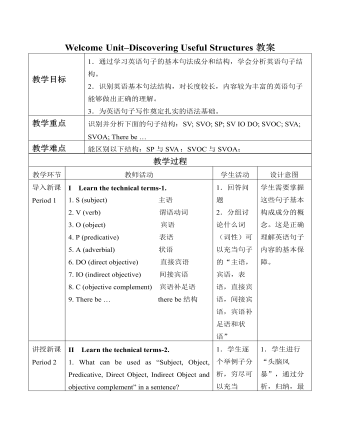
II Learn the technical terms-2.1. What can be used as “Subject, Object, Predicative, Direct Object, Indirect Object and objective complement” in a sentence?2. What can be used as “adverbial” in a sentence?3. What can be used as “verb” in a sentence?Answers to questions 1-3:1. Nouns, pronouns and appellations can be used as “Subject, Object, Predicative, Direct Object, Indirect Object and Objective Complement”. Besides, adjectives can be used as “Predicative and Objective Complement” in a sentence.2. Adverbs and prepositional phrases can be used as “Adverbial”.3. Verbs with actual meaning can be used as “Verb” in a sentence. Auxiliary verbs alone cannot be used as “Verb” in a sentence.III Learn to recognize the sentence structures.1. SV structure. For Example:(1) A bird flies.S V(2) A monkey jumps.S V(3) A fish swims.S V√ In SV structures, verbs are “intransitive verbs”.2. SVO structure. For Example:(1) A sheep eats grass.S V O(2) They like bananas.S V O(3) He wants candy.S V O√ In SVO structures, verbs are “transitive verbs”.3. SP structure. For Example:(1) This is great.S P (2) He looks well.S P (3) She became a teacher.S P √ In SP structures, Predicatives are formed by “link verbs” and “adjectives or nouns”.√ link verbs: be, become, grow, look, feel, taste, etc.4. SV IO DO structure. For Example:(1) He asked me a question.S V IO DO(2) Danny wrote me a letter.S V IO DO(3) Billy brought Sam a kite.S V IO DO√ In SV IO DO structures, the verbs are transitive and are followed by two objectives – pronouns or nouns as Indirect Objective, and nouns as Direct Objectives.
新人教版高中英语必修1Unit 4 Natural Disasters-Reading & Thinking教案
5. Read to get detailed information about Paragraph 5.Q1. What shows the revival of Tangshan?Q2. How can Tangshan revive itself and get up on its feet again?Q3. In times of disasters, how can we go through it?T: In times of disasters, we should unify, show the wisdom and stay positive.Step 4 Activity 4 Highlighting the theme and reflecting1. Make a summary of the text.2. Further understand the titleQ: After our learning, why do you think the earth didn’t sleep on that night?T: An earthquake happened. The people in the earthquake suffered a lot, and the people outside Tangshan were concerned about the people there a lot.3. Reflect through discussion on what can be learnt after reading.T: Disasters are powerful. Unpreparedness can be deadly. Life is weak, but if people work together to help each other, disasters can be defeated.There is no love from disaster, but we have love in the human heart.Step 5 Assignment How does the writer convey that the earthquake was deadly, and that people were helpless during the earthquake? Try to find some attractive and impressive expressions and note them down.
新人教版高中英语必修1Unit 5 Languages Around the World-Reading and Thinking教案
【教材分析】本节课是高中英语第一册的最后一个单元的阅读和思考部分,文章难度明显增加,体现在以下几个方面:文章题材是说明文,比较难理解;话题生疏,涉及到历史等知识;生词量增大,而且在语境中理解词汇的要求提高。面对这些,教师的难度和高度也要有所提升,通过探讨说明顺序,了解背景知识等帮助他们找到说明文阅读的方法。【教学目标与核心素养】1. 文化意识目标新课程中指出,文化意识是对中外文化的理解和对优秀文化的认同。文化意识的的培养有助于学生增加国家认同和家国情怀,成为有文明素养和社会责任感的人。我们这个单元很好体现了这一点,通过了解汉字书写的体系和发展,学生可以有一种文化自豪感,同时也能够帮助学生深入挖掘这篇文章,从而想到更多和中国文化相关的方面。2. 学习能力目标
新人教版高中英语必修1Unit 5 Languages Around the World-Reading for Writing教案
Step 3: Read to sum upRead it again and sum up the problems of the three students, and then write down the advice that was given from others.Step 4: Work in pairs. List your learning problems in English and brainstorm some useful advice.Useful expressions ? I don't know how to…... Is a big difficulty for me. I cannot ...? You might try …. It's very important to…? I have no idea how/what .My biggest problem is .... ? I (also) have trouble with. My advice is …. This worked for me.? l cannot understand the teachers’ English in class.Step 5 Homework:为提高我校学生的英语口语水平,我们将举办英语演讲比赛(English- speaking contest),请你根据下面的信息,以学生会(the Students‘ Union)的名义写一份海报,欢迎全校同学参加,届时特邀本校美籍教师史密斯先生颁奖。? 报名时间 9月30日以前(报名:signup)? 报名地点 学生会办公室? 比赛时间 10月9日晚7:00~9:00? 比赛地点 学校大会议室? 奖励 前8名
新人教版高中英语必修3Unit 1 Festivals and Celebrations教学设计二
1. Ss look at the picture and scan the passage to understand the main idea while teacher is giving the following questions to inspire Ss to think.*Where are those people?*What are they doing?*Why are they so excited?2. Ss complete the passage with the appropriate -ing form. Then discuss and check the answers with class.Answers: boring, interesting, taking, exciting, amazing3. The teacher raises questions for the students to discuss and encourages them to express their opinions.*Do you like La Tomatina? Why or why not?4. Each group representative reports the discussion result, the teacher gives feedback and the evaluation.Step 6 PracticeActivity 41. Ss complete the Ex 2 in Using structures.2. Check the answers after finishing the exercises.①The dragon boat races are the most exciting part of the Dragon Boat Festival.② The children were excited to go Easter egg hunting.③What an amazing performance! This is the best music festival I have ever been to.④We were amazed by her funny-looking hat.⑤His inspiring speech at the conference won the admiration/ favour of the audience.⑥This is a challenging game to test your memory and observation capabilities. 3. T asks Ss to finish Ex 3 and 4 in Using structures by themselves, then check the answers with class.Step 6 Homework1. Understand and master the functions and usage of the -ing form;2. Finish the other exercises in Using structures.1、通过本节内容学习,学生是否理解和掌握动词-ing形式作定语和表语的功能和意义;2、通过本节内容学习,学生能否在理解文段内容的基础上,根据上下文语境和表达逻辑,能正确运用动词-ing形式描述节日庆典。3、通过本节内容学习,学生是否归纳和积累用于表达情绪的相关词汇。
新人教版高中英语必修3Unit 3 Diverse Cultures教学设计三
The price is the same as(the price was)before the war.价格与战前相同。(4)定语从句中的“关系代词+助动词be”可以省略。The ticket(that/which was)booked by his sister has been sent to him.他妹妹订的那张票已送到了他那里。Step 5 PracticeActivity 3(1) Guide students to complete the four activities in the Using Structures part of exercise book, in which activities 1 and 2 focus on ellipsis in dialogue answers, activity 3 focus on signs and headlines, two typical situations where ellipsis is used, and activity 4 focus on ellipsis in diary, an informal style.(2) Combine the examples in the above activities, ask students to summarize the omitted situations in groups, and make their own summary into a poster, and post it on the class wall after class to share with the class.(This step should give full play to the subjectivity of students, and teachers should encourage students to conclude different ellipsis phenomena according to their own understanding, they can conclude according to the different parts omitted in the sentence.)Step 6 Homework1. Understand and master the usages of ellipsis;2. Finish the other exercises in Using structures of Workbook.1、通过本节内容学习,学生是否理解和掌握省略的用法;2、通过本节内容学习,学生能否根据上下文语境或情景恢复句子中省略的成分,体会使用省略的效果;3、通过本节内容学习,学生能否独立完成练习册和导学案中的相关练习。
新人教版高中英语必修3Unit 3 Diverse Cultures教学设计四
该板块的活动主题是“介绍一个有显著文化特征的地方”( Describe a place with distinctive cultural identity)。该板块通过介绍中国城继续聚焦中国文化。本单元主题图呈现的是旧金山中国城的典型景象, Reading and Thinking部分也提到中国城,为该板块作铺垫。介绍中国城的目的主要是体现中国文化与美国多元文化的关系,它是美国多元文化的重要组成部分。中国城也是海外华人的精神家园和传播中国文化的重要窗口,外国人在中国城能近距离体验中国文化。1. Read the text to understand the cultural characteristics of Chinatown in San Francisco and the relationship between Chinese culture and American multiculturalism;2. Through reading, learn to comb the main information of the article, understand the author's writing purpose and writing characteristics;3. Learn to give a comprehensive, accurate, and organized description of the city or town you live in;Learn to revise and evaluate your writing.Importance:1. Guide the students to read the introduction of Chinatown in San Francisco and grasp its writing characteristics;2. Guide students to introduce their city or town in a comprehensive, accurate and organized way;3. Learn to comb the main information of the article, understand the author's writing purpose, and master the core vocabulary.
高中数学人教版必修二直线的点斜式方程教案
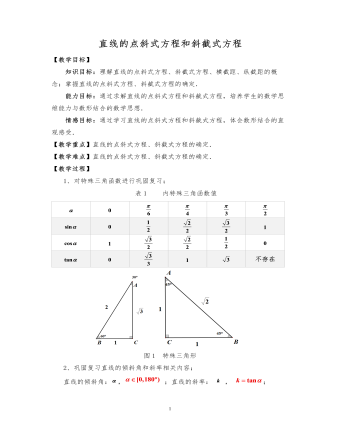
【教学重点】直线的点斜式方程、斜截式方程的确定.【教学难点】直线的点斜式方程、斜截式方程的确定.【教学过程】1、对特殊三角函数进行巩固复习;表1 内特殊三角函数值 不存在图1 特殊三角形2、巩固复习直线的倾斜角和斜率相关内容;直线的倾斜角:,;直线的斜率: , ;设点为直线l上的任意两点,当时,
人教版高中语文必修1《别了,“不列颠尼亚”》教案
(“节马”:1841年1月7日,英国侵略者义律进攻虎门,沙田炮台副将陈连升率众浴血奋战,壮烈牺牲。其马“神骏”守护主人遗体,不屈敌之羁绊,不食敌之草料,不畏敌之鞭打刀刺,终不就范。“祖逖鞭”:祖逖,东晋名将,著名爱国将领,曾率军北伐,收复许多失地。此句大意为若要扬眉吐气,意气风发,仍需祖逖的这种精神。)八、本文反映的就是香港回归这一重大历史事件本文是一篇新闻特写。特写性消息,也称新闻速写、新闻素描,要求用类似电影“特写镜头”的手法来反映事实,是作者深入新闻事件现场,采写制作的一种新闻价值高、现场感较强、篇幅短小精粹的消息文体。特写性消息侧重于“再现”,往往采用文学手法,集中、突出地描述某一重大事件的发生现场,或某些重要和精彩的场面,生动、形象地将所报道的事实再现在读者面前。
人教版高中语文必修1《烛之武退秦师》教案
四、讲读第一段(10分钟)1.抽生朗读本段,注意生字词读音。2.讲析本段译释由学生完成,师只作扼要补纠和简要分析。分析内容包括伏笔手法和语句深意,全段作用。3.让学生齐读全段。4.处理练习一之中的第1小题,要求学生试译回答,然后指导学生背诵本段。五、讲读第二段(15分钟)1.抽生朗读本段,注意生字词读音。2.讲析本段①重点讲析三个文言词“若”、“之”、“辞”的用法和人物对话。②字词句的理解仍然注意发挥学生的能动性,让他们完成为主,师纠补为辅。对要求掌握的三个文言词的用法要板书列于黑板上,对话部分要让学生试作语气练习。③小结的内容包括情节的曲折性、写法的详略和表达的特点。3.生齐读本段,然后处理相关练习。
人教版高中语文必修1《鸿门宴》教案
刘邦:先看刘邦对项伯的表白(此话也是有意让项伯转述给项羽听的):“秋毫不敢有所近”——说“不敢”而不说“不曾”,多么恭顺!“籍吏民,封府库,而待将军”——“待”,多么虔诚!“日夜望将军至”——说“望”而不说“等”,多么迫切!再看刘邦的卑词“谢罪”:他言必称“将军”,说自己与项羽“戮力而攻秦”,是战友而非敌人;将“先入关破秦”说成是不自意,以表自己的力量不如项羽;把“得复见将军于此”当作是自己莫大的荣幸以满足项羽的虚荣心;最后,他还把项羽的愤怒归咎于“小人”的挑拨,为项羽推卸责任,及时给项羽一个台阶下。小结:项羽:沽名钓誉、轻敌自大、寡谋轻信、不善用人、刚愎自用、优柔寡断的一介武夫。刘邦:狡诈多谋、遇事果断、临危不惧、能屈能伸、善于用人。
人教版高中语文必修1《荆轲刺秦王》教案
教学目标:1、知识与能力:①了解荆轲刺秦王的历史背景和过程,整体感知课文。②掌握文言文中重要的字、词、句解释,提高翻译能力。③学会从人物的对话、动作、神态描写入手,分析主要人物形象。2、情感与态度:正确看待荆轲刺秦王这一事件,学会历史而辩证地评价人物。重点难点:评价历史事件,分析人物形象。教学方法:朗读法、提问法、讨论法课时安排:三课时教学过程:第一课时一、导入:(课前展示雕塑照片)来到正定讲课,我感到非常高兴,一进县城,就被这里浓郁的历史文化气息所感染。我们住在华阳假日酒店,外面正在兴建文化广场,刚才的照片就是在那里拍摄的。在此,我进一步了解到正定这座文化古城悠久的历史渊源,这里有南越王赵佗,常胜将军赵云,一代名家颜真卿等等,可谓物华天宝、人杰地灵。因此我相信我们正定中学的同学们一定都非常优秀。这也让我更深刻地体会到一个道理:语文的外延就是生活的外延。
人教版高中语文必修3《琵琶行 并序》教案
9、在乐曲终了之后,诗人以“东船西舫悄无言,唯见江心秋月白”两句结尾,这两句作用如何?明确:诗人没有直接写听者的热烈反响以说明琵琶女技艺非凡和乐声的感人至深,否则过于直白就不含蓄,不含蓄也就显不出深沉了。用“东船西舫悄无言”的寂静无声,反衬“有声”的音乐效果,可谓“此时无声胜有声”了。人们无声地沉浸、陶醉在艺术的享受之中,那深深打动人的乐声仿佛缭绕迂回耳际,不由得使诗人想到了自己浩茫的心事,引起情绪上的波澜。在这片刻的沉寂中,只见一轮迷蒙的冷月荡漾在江心的微波之中,它提醒诗人从乐声中回到现实中来。这句景物描写点染烘托了浓重的氛围,与复杂的乐声融为一体,共同表现了琵琶女与诗人息息相通的复杂情感,是那么的忧愤、哀怨凄楚、苍凉,给整个音乐形象补足了画龙点睛之笔。
人教版高中语文必修5《作为生物的社会》教案
二、整体感知1.导入新课同学们《细胞生命的礼赞》是一个医学家、生物学家关于生命、人生、社会乃至宇宙的思考。思想博大而深邃,信息庞杂而新奇,批评文明,嘲弄愚见,开阔眼界、激发思索。而其文笔又少见的优美、清新、幽默、含蓄,无愧当今科学散文中的大家手笔。无怪乎自1974年出版后,立即引起美国读书界和评论界的巨大反响和热烈欢呼,获得当年美国国家图书奖,此后18年来由好几家出版社印了二十多版,至今畅行不衰!年过花甲的刘易斯·托马斯的名字因这一本小书而家喻户晓,有口皆碑,以至于在他接连抛出后两本书时,书商都不用再作广告,只喊声"《细胞生命的礼赞》一书作者刘易斯·托马斯的新著"就够了。今天我们就来学习选自这部书的精彩章节《作为生物的社会》(板书课题)。
人教版高中语文必修4《廉颇蔺相如列传》教案
(2)个性化的对话描写。在三个事件的描述中,大段对话占了很大篇幅,有的情节干脆由对话来表达,许多对话形象地表现了人物的思想和性格,使我们如闻其声,如见其人。先说蔺相如,他在秦廷上的慷慨陈词,有时语气平和,谦恭有礼,使对方放松警惕;有时直言斥责,有理有据,雄辩折人;有时坚决表态,分析利害,暗示对方;有时怒不可遏,咄咄逼人。总之,词锋犀利,刚柔兼施,而又轻重恰当,充分表现了他是一个热爱祖国、不畏强暴、有智有勇,长于辞令的外交家。再说廉颇,在将相交欢事件中,他先前说的这一番话,表现了他的自高自大和心胸狭窄,非常符合武将廉颇的性格特点,后来写他知过改过,负荆请罪时说:“鄙贱之人,不知将军宽之至此也!”语言不多,坦诚直率,可敬可爱。(解说:对话描写的分析,宜以学生为主,教师必要时适当点拨。)
人教版高中语文必修5《陈情表》教案
【教学目标】1.熟读全文,掌握文中出现的重要的实词、虚词、古汉语句式;2.鉴赏本文融情于事的表达和形象精粹的语言;3.深入体会文章凄切婉转的陈情技巧。【教学重点】重要的古汉语语词知识【教学难点】理解作者当时的处境和李密祖孙间真挚深厚的感情【教学方法】作为教读课,选择串讲的方式,突出朗读,以期能做到既落实知识,又能体会文章之美。课时安排为两课时。要重点做好预习工作。【教学步骤】一、以苏轼的评论导入读《出师表》不下泪者,其人必不忠;读《陈情表》不下泪者,其人必不孝;读《祭十二郎文》不下泪者,其人必不友二、预习检测1、下列红色字注音完全正确的一项()A、臣以险衅(xìn)夙遭闵(mǐn)凶终鲜(xiǎn)兄弟常在床蓐(rù)B、猥(wěi)以微贱责臣逋(bǔ)慢犹蒙衿(jīn)育宠命优渥(wò)C、岂敢盘桓(huán)有所希冀(yì)日薄(bó)西山除臣洗(xiǎn)马D、逮(dǎi)奉圣朝过蒙拔擢(zhuó)门衰祚(zuò)薄更(gēng)相为命分析:B责臣逋(bū)慢,C有所希冀(jì),D逮(dài)奉圣朝。
人教版高中语文必修5《归去来兮辞(并序)》教案
【教学目标】1.理解作者反抗黑暗,辞官归田,不与当时黑暗的上层社会同流合污而热爱田园生活的积极精神,学习其高洁的理想志趣和坚定的人生追求。2.掌握“胡、奚、曷、焉、何”五个疑问代词,归纳“行、引、乘、策”等四个词的一词多义,了解“以、而、之、兮、来”等文言虚词的用法。3.背诵全文。【教学重点】1.了解作者辞官归田的原因,深刻体味诗人鄙弃官场,热爱田园的无限欣喜之情。2.背诵全文。【教学难点】1.理解记述中渗透出的或喜或哀,或决绝或犹疑的复杂感情。2.归纳实词、虚词的用法,掌握省略句、倒装句两种句式。【教具准备】投影仪投影胶片【课时安排】2课时【教学过程】第一课时[教学要点]了解陶渊明及其作品。读课文,利用注释、工具书,初步把握文章,朗读课文,找出押韵的字,由押韵归纳各层大意,帮助学生理清背诵思路,背诵全文。[教学步骤]一、导语《桃花源记》是我们在初中接触过的陶渊明的作品。师生一同背诵。《桃花源记》中悠闲自得的田园生活正是作者精神追求的形象反映。今天我们学习的《归去来兮辞》正是作者决别官场,同上层社会分道扬镳的宣言书。
人教版高中语文必修4《长亭送别》教案
三.分析第三部分:1.夫妻赠诗表现了二人怎样的心情?提示:崔莺莺告诫张生切勿忘记她;张生则发誓永无别恋。这充分展示了二人深厚的情谊。2.怎样理解[耍孩儿]中的典故?提示:“红泪”借王嘉《拾遗记》的典故,司马青衫借白居易《琵琶行》的典故,表现主人公因离别而生的伤心之情。“伯劳飞去燕西归”则用牛郎织女的典故表现两人缠绵难舍的心情。3.[五煞]表明了主人公怎样的心情?提示:对张生的生活的关心,千叮万嘱,真情自现。4.[二煞]中所用是几个典故?这些典故的作用是什么?提示:三个典故,见课本。其作用是表明崔莺莺对张生的担心。四.分析第四部分:1.[一煞]中再写环境,其作用是否与先前所写相同?提示:稍有不同,这里是表现崔莺莺目送张生远去时那种凄怆悲苦的眷恋之情。以所见之物,写内心深藏之情。2.[收尾]中写‘残照’其含义是什么?提示:以“残照”表现内心的怅惘失意之情。