-
新人教版高中英语选修2Unit 2 Reading and thinking教学设计
Her tutor told her to acknowledge __________ other people had said if she cited their ideas, and advised her _______(read) lots of information in order to form __________wise opinion of her own.Now halfway __________ her exchange year, Xie Lei felt much more at home in the UK. She said __________ (engage) in British culture had helped and that she had been__________ (involve) in social activities. She also said while learning about business, she was acting as a cultural messenger __________(build) a bridge between the two countries. keys:Xie Lei, a 19yearold Chinese student, said goodbye to her family and friends in China and boarded (board) a plane for London six months ago in order to get a business qualification. She was ambitious(ambition) to set up a business after graduation. It was the first time that she had left (leave) home.At first, Xie Lei had to adapt to life in a different country. She chose to live with a host family, who can help with her adaptation (adapt) to the new culture. When she missed home, she felt comforted (comfort) to have a second family. Also Xie Lei had to satisfy academic requirements. Her tutor told her to acknowledge what other people had said if she cited their ideas, and advised her to read lots of information in order to form a wise opinion of her own.Now halfway through her exchange year, Xie Lei felt much more at home in the UK. She said engaging (engage) in British culture had helped and that she had been involved (involve) in social activities. She also said while learning about business, she was acting as a cultural messenger building a bridge between the two countries.
新人教版高中英语选修2Unit 3 Reading for writing教学设计
The theme of this part is to write an article about healthy diet. Through reading and writing activities, students can accumulate knowledge about healthy diet, deepen their understanding of the theme of healthy diet, and reflect on their own eating habits. This text describes the basic principles of healthy diet. The author uses data analysis, definition, comparison, examples and other methods. It also provides a demonstration of the use of conjunctions, which provides important information reference for students to complete the next collaborative task, writing skills, vivid language materials and expressions.1. Teach Ss to learn and skillfully use the new words learned from the text.2. Develop students’ ability to understand, extract and summarize information.3. Guide students to understand the theme of healthy diet and reflect on their own eating habits.4. To guide students to analyze and understand the reading discourse from the aspects of theme content, writing structure, language expression, etc., 5. Enable Ss to write in combination with relevant topics and opinions, and to talk about their eating habits.1. Guide students to analyze and understand the reading discourse from the aspects of theme content, writing structure, language expression, etc.2. Enable them to write in combination with relevant topics and opinions, and to talk about their eating habits.3. Guide the students to use the cohesive words correctly, strengthen the textual cohesion, and make the expression fluent and the thinking clear.Step1: Warming upbrainstorm some healthy eating habits.1.Eat slowly.2.Don’t eat too much fat or sugar.3.Eat healthy food.4.Have a balanced diet.Step2: Read the passage and then sum up the main idea of each paragraph.
新人教版高中英语选修2Unit 2 Reading for writing教学设计
The theme of this section is to express people's views on studying abroad. With the continuous development of Chinese economic construction, especially the general improvement of people's living standards, the number of Chinese students studying abroad at their own expense is on the rise. Many students and parents turn their attention to the world and regard studying abroad as an effective way to improve their quality, broaden their horizons and master the world's advanced scientific knowledge, which is very important for the fever of going abroad. Studying abroad is also an important decision made by a family for their children. Therefore, it is of great social significance to discuss this issue. The theme of this section is the column discussion in the newspaper: the advantages and disadvantages of studying abroad. The discourse is about two parents' contribution letters on this issue. They respectively express their own positions. One thinks that the disadvantages outweigh the advantages, and the other thinks that the advantages outweigh the disadvantages. The two parents' arguments are well founded and logical. It is worth noting that the two authors do not express their views on studying abroad from an individual point of view, but from a national or even global point of view. These two articles have the characteristics of both letters and argumentative essays1.Guide the students to read these two articles, and understand the author's point of view and argument ideas2.Help the students to summarize the structure and writing methods of argumentative writing, and guides students to correctly understand the advantages and disadvantages of studying abroad3.Cultivate students' ability to analyze problems objectively, comprehensively and deeply
新人教版高中英语选修2Unit 2 Using langauge-Listening教学设计
? B: Absolutely! Getting involved with Chinese cultural activities there definitely helped a lot. I got to practice my Chinese on a daily basis, and I could learn how native Chinese speakers spoke.? A: What do you feel is your biggest achievement?? B: Learning Chinese characters! I have learnt about 1,500 so far. When I first started, I didn't think it was even going to be possible to learn so many, but now I find that I can read signs, menus, and even some easy newspaper articles.? A: What are you most keen on?? B: I've really become keen on learning more about the Chinese culture, in particular Chinese calligraphy. As I have learnt Chinese characters, I have developed a great appreciation for their meaning. I want to explore Chinese characters by learning how to write them in a more beautiful way. ? A: Finally, what do you want to say to anyone interested in learning Chinese?? I have really become keen on learning more about the Chinese culture, in particular Chinese Calligraphy. As I have learnt Chinese character, I have developed a great appreciation for their meaning. I want to explore Chinese characters by learning how to write them in a more beautiful way.? A: Finally, what do you want to say to anyone interested in learning Chinese?? B: I'd say, give it a shot! While some aspects may be difficult, it is quite rewarding and you will be happy that you tried.? A: Thanks for your time. ? B:You're welcome.
新人教版高中英语选修2Unit 3 Using langauge-Listening教学设计
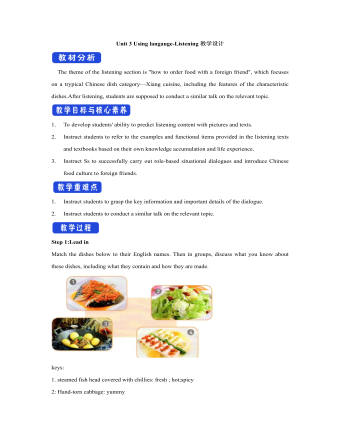
1. How is Hunan cuisine somewhat different from Sichuan cuisine?The heat in Sichuan cuisine comes from chilies and Sichuan peppercorns. Human cuisine is often hotter and the heat comes from just chilies.2.What are the reasons why Hunan people like spicy food?Because they are a bold people. But many Chinese people think that hot food helps them overcome the effects of rainy or wet weather.3.Why do so many people love steamed fish head covered with chilies?People love it because the meat is quite tender and there are very few small bones.4.Why does Tingting recommend bridge tofu instead of dry pot duck with golden buns?Because bridge tofu has a lighter taste.5 .Why is red braised pork the most famous dish?Because Chairman Mao was from Hunan, and this was his favorite food.Step 5: Instruct students to make a short presentation to the class about your choice. Use the example and useful phrases below to help them.? In groups of three, discuss what types of restaurant you would like to take a foreign visitor to, and why. Then take turns role-playing taking your foreign guest to the restaurant you have chosen. One of you should act as the foreign guest, one as the Chinese host, and one as the waiter or waitress. You may start like this:? EXAMPLE? A: I really love spicy food, so what dish would you recommend?? B: I suggest Mapo tofu.? A: Really ? what's that?
新人教版高中英语选修2Unit 4 Learning about Language教学设计
This section guides students to pay attention to the typical context of vocabulary use, helps students accumulate vocabulary around the key vocabulary of this unit, and uses the learned words and word chunks in different contexts to deeply understand their meaning and usage, so as to achieve the purpose of review and consolidation.The teaching design activities aim to guide students to pay attention to the typical context in which the target vocabulary is used, as well as the common vocabulary used in collocation, so that students can complete the sentence with correct words. In terms of vocabulary learning strategies, this unit focuses on cultivating students' ability to pay attention to collocation of words and to use word blocks to express meaning.For vocabulary learning, it is not enough just to know the meaning of a single word, but the most important thing is to master the common collocations of words, namely word blocks.Teachers should timely guide students to summarize common vocabulary collocation, such as verb and noun collocation, verb and preposition collocation, preposition and noun collocation, and so on.1. Guide students to understand and consolidate the meaning and usage of the vocabulary in the context, 2. Guide the students to use the unit topic vocabulary in a richer context3. Let the students sort out and accumulate the accumulated vocabulary, establishes the semantic connection between the vocabulary,4. Enable students to understand and master the vocabulary more effectivelyGuiding the Ss to use unit topic words and the sentence patterns in a richer context.
新人教版高中英语选修2Unit 4 Reading for writing教学设计
假定你是英国的Jack,打算来中国旅行,请你给你的中国笔友李华写一封信,要点如下:1.你的旅行计划:北京→泰山→杭州;2.征求建议并询问他是否愿意充当你的导游。注意:1.词数80左右(开头和结尾已给出,不计入总词数);2.可以适当增加细节,以使行文连贯。参考词汇:故宫 the Forbidden City;泰山 Mount TaiDear Li Hua,I'm glad to tell you that 'm going to visit China.First,I am planning to visit Beijing,the capitalof China,where I am looking forward to enjoying the Great Wall,the Forbidden City and somebeautiful parks.Then I intend to go to visit Mount Tai in Shandong Province.I've heard that it is one ofthe most famous mountains in China and I can't wait to enjoy the amazing sunrise there.After that,I amalso going to Hangzhou.It is said that it is a beautiful modern city with breathtaking natural sights,among which the West Lake is a well- known tourist attraction.What do you think of my travel plan? Will you act as my guide? Hope to hear from you soon.
新人教版高中英语选修2Unit 4 Using langauge-Listening教学设计
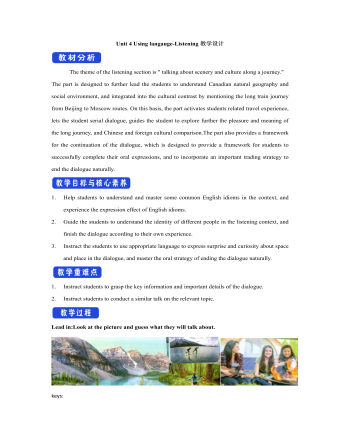
The theme of the listening section is " talking about scenery and culture along a journey."The part is designed to further lead the students to understand Canadian natural geography and social environment, and integrated into the cultural contrast by mentioning the long train journey from Beijing to Moscow routes. On this basis, the part activates students related travel experience, lets the student serial dialogue, guides the student to explore further the pleasure and meaning of the long journey, and Chinese and foreign cultural comparison.The part also provides a framework for the continuation of the dialogue, which is designed to provide a framework for students to successfully complete their oral expressions, and to incorporate an important trading strategy to end the dialogue naturally.1. Help students to understand and master some common English idioms in the context, and experience the expression effect of English idioms.2. Guide the students to understand the identity of different people in the listening context, and finish the dialogue according to their own experience.3. Instruct the students to use appropriate language to express surprise and curiosity about space and place in the dialogue, and master the oral strategy of ending the dialogue naturally.1. Instruct students to grasp the key information and important details of the dialogue.2. Instruct students to conduct a similar talk on the relevant topic.
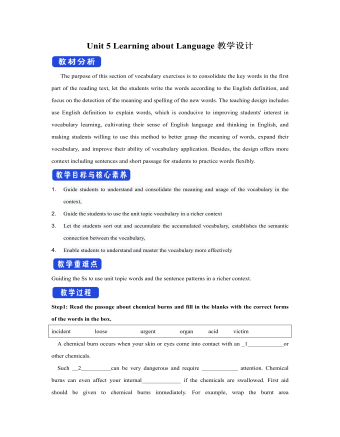
新人教版高中英语选修2Unit 5 Learning about Language教学设计
The purpose of this section of vocabulary exercises is to consolidate the key words in the first part of the reading text, let the students write the words according to the English definition, and focus on the detection of the meaning and spelling of the new words. The teaching design includes use English definition to explain words, which is conducive to improving students' interest in vocabulary learning, cultivating their sense of English language and thinking in English, and making students willing to use this method to better grasp the meaning of words, expand their vocabulary, and improve their ability of vocabulary application. Besides, the design offers more context including sentences and short passage for students to practice words flexibly.1. Guide students to understand and consolidate the meaning and usage of the vocabulary in the context, 2. Guide the students to use the unit topic vocabulary in a richer context3. Let the students sort out and accumulate the accumulated vocabulary, establishes the semantic connection between the vocabulary,4. Enable students to understand and master the vocabulary more effectivelyGuiding the Ss to use unit topic words and the sentence patterns in a richer context.Step1: Read the passage about chemical burns and fill in the blanks with the correct forms of the words in the box.
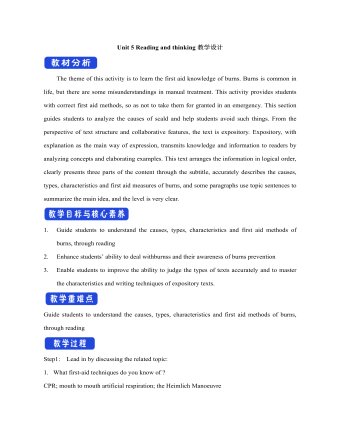
新人教版高中英语选修2Unit 5 Reading and thinking教学设计
The theme of this activity is to learn the first aid knowledge of burns. Burns is common in life, but there are some misunderstandings in manual treatment. This activity provides students with correct first aid methods, so as not to take them for granted in an emergency. This section guides students to analyze the causes of scald and help students avoid such things. From the perspective of text structure and collaborative features, the text is expository. Expository, with explanation as the main way of expression, transmits knowledge and information to readers by analyzing concepts and elaborating examples. This text arranges the information in logical order, clearly presents three parts of the content through the subtitle, accurately describes the causes, types, characteristics and first aid measures of burns, and some paragraphs use topic sentences to summarize the main idea, and the level is very clear.1. Guide students to understand the causes, types, characteristics and first aid methods of burns, through reading2. Enhance students’ ability to deal withburnss and their awareness of burns prevention3. Enable students to improve the ability to judge the types of texts accurately and to master the characteristics and writing techniques of expository texts.Guide students to understand the causes, types, characteristics and first aid methods of burns, through readingStep1: Lead in by discussing the related topic:1. What first-aid techniques do you know of ?CPR; mouth to mouth artificial respiration; the Heimlich Manoeuvre
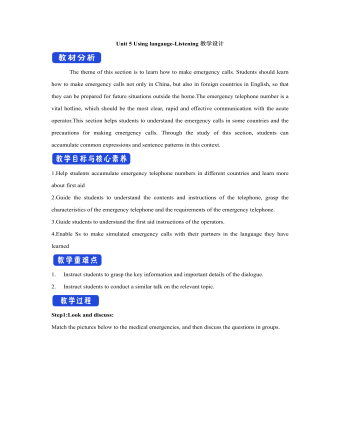
新人教版高中英语选修2Unit 5 Using langauge-Listening教学设计
The theme of this section is to learn how to make emergency calls. Students should learn how to make emergency calls not only in China, but also in foreign countries in English, so that they can be prepared for future situations outside the home.The emergency telephone number is a vital hotline, which should be the most clear, rapid and effective communication with the acute operator.This section helps students to understand the emergency calls in some countries and the precautions for making emergency calls. Through the study of this section, students can accumulate common expressions and sentence patterns in this context. 1.Help students accumulate emergency telephone numbers in different countries and learn more about first aid2.Guide the students to understand the contents and instructions of the telephone, grasp the characteristics of the emergency telephone and the requirements of the emergency telephone.3.Guide students to understand the first aid instructions of the operators.4.Enable Ss to make simulated emergency calls with their partners in the language they have learned1. Instruct students to grasp the key information and important details of the dialogue.2. Instruct students to conduct a similar talk on the relevant topic.Step1:Look and discuss:Match the pictures below to the medical emergencies, and then discuss the questions in groups.
英文简历+中文简历
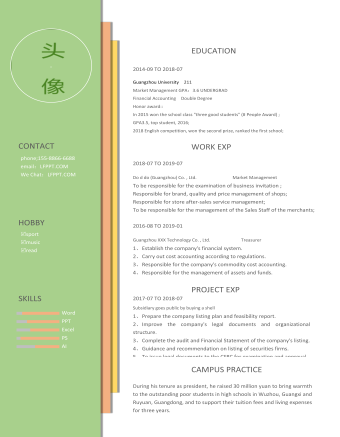
GuangzhouUniversity 211Market Management GPA:3.6 UNDERGRADFinancial Accounting Double DegreeHonor award::In 2015 won the school class"three good students" (# People Award) ;GPA3.5, top student, 2016;2018 English competition, won thesecond prize, ranked the first school;
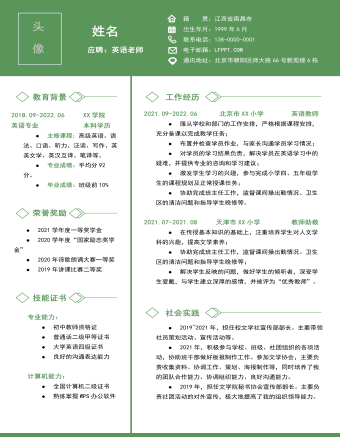
小学英语老师应聘学校教师简历
l 服从学校和部门的工作安排,严格根据课程安排,充分备课以完成教学任务;l 布置并检查学员作业,与家长沟通学员学习情况;l 对学员的学习结果负责,解决学员在英语学习中的疑难,并提供专业的咨询和学习建议;l 激发学生学习的兴趣,参与完成小学四、五年级学生的课程规划及正常授课任务;l 协助完成班主任工作,监督课间操出勤情况、卫生区的清洁问题和指导学生晚修等。l 在传授基本知识的基础上,注重培养学生对人文学科的兴趣,提高文学素养;l 协助完成班主任工作,监督课间操出勤情况、卫生区的清洁问题和指导学生晚修等;
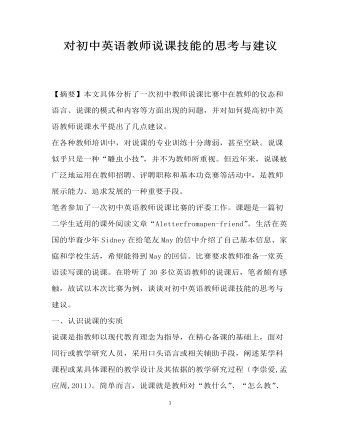
对初中英语教师说课技能的思考与建议
一、认识说课的实质说课是指教师以现代教育理念为指导,在精心备课的基础上,面对同行或教学研究人员,采用口头语言或相关辅助手段,阐述某学科课程或某具体课程的教学设计及其依据的教学研究过程(李崇爱,孟应周,2011)。简单而言,说课就是教师对“教什么”、“怎么教”、“为什么这么教”等问题进行阐述。这样做的目的,一方面可以展现一个教师的教育理论修养、教学组织能力和口头表达能力,另一方面可以帮助教师优化教学设计,反思教学行为,分享教学经验。
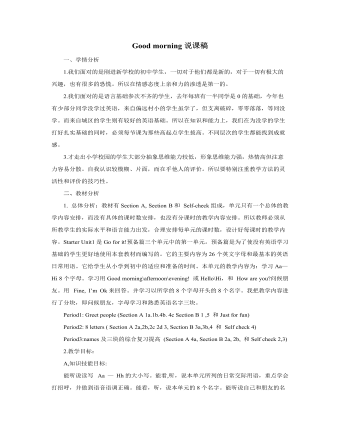
人教版新目标初中英语七年级上册Good morning说课稿
1.课堂活动中的竞赛制:以记奖评优的形式无声的评价每一个活动,包括个体和小群体。在第一课时评最佳演员和导演奖,第二课时评最佳团体奖,既节约时间又明确有效。使学生能提高语言质量,增强参与意识,提高学习兴趣。2. 教师课堂上语言、表情激励制:在课堂活动中教师要乐于 、善于用激励性语言。从good, super, smart, excellent , great ,wonderful等,用微笑,皱眉,摇头、点头等身体语言对于学生的评价是方便又有效的途径。3.课后作业评价:口头作业在第二天课堂上表演,接受全体同学的评价。笔头作业有教师批阅,以评语的方式出现。优秀作业予以展出或交流。积极地肯定和鼓励学生是我们评价的重要目的之一。4.单元结束后综合性评价:除了笔试以外,也可以根据学生实际开展丰富的活动,如:调查报告、小品表演、专题演讲等。
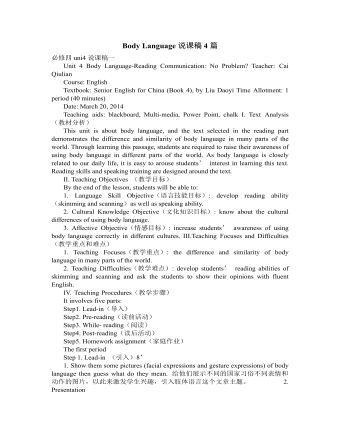
人教版高中英语必修4Body Language说课稿4篇
Textbook: Senior English for China (Book 4), by Liu Daoyi Time Allotment: 1 period (40 minutes)Date: March 20, 2014Teaching aids: blackboard, Multi-media, Power Point, chalk I. Text Analysis (教材分析)This unit is about body language, and the text selected in the reading part demonstrates the difference and similarity of body language in many parts of the world. Through learning this passage, students are required to raise their awareness of using body language in different parts of the world. As body language is closely related to our daily life, it is easy to arouse students’ interest in learning this text. Reading skills and speaking training are designed around the text.II. Teaching Objectives (教学目标)By the end of the lesson, students will be able to:1. Language Skill Objective(语言技能目标): develop reading ability (skimming and scanning)as well as speaking ability.2. Cultural Knowledge Objective(文化知识目标): know about the cultural differences of using body language.3. Affective Objective(情感目标): increase students’ awareness of using body language correctly in different cultures. III.Teaching Focuses and Difficulties(教学重点和难点)1. Teaching Focuses(教学重点): the difference and similarity of body language in many parts of the world.2. Teaching Difficulties(教学难点): develop students’ reading abilities of skimming and scanning and ask the students to show their opinions with fluent English.
人教版高中英语必修1English around the world说课稿
(3)v. 给:提出;展现,显现present sb. with sth. ; present sth. to sb. 把. . 交给;颁发;授予present sth. (for sth. )/present sth. to sb. e. g. Om his birthday, his friends presented him a collection of stamps. 在他生日时,他的朋友们送给他一套邮票作为礼物。The sword was presented by the family to the museum. 这家人把宝剑捐赠给了博物馆。The committee will present the final report to Parliament in June. 委员会将在六月向议会提交最后的报告。You need to present yourself better. 你需要更善于展现自己。It is essential that we present a united front. 至关重要的是我们要表现得更加团结。Step 4 ConsolidationT:Now that we have got a general idea of these words and phrases. Lets make up some sentences using them to master them. Suggested sentences:1. Your duties include typing letters and answering the telephone. 2. It is one of the greatest roles that she has played. 3. A large number of people have applied for the job. 4. The number of the panda is declining. 5. I'11 go there, even if I have to walk. 6. He came up to me to ask for a light. 7. The novel is about a family who can't communicate with each other. 8. He based his plan on interests of most people. 9. Why doesn't he make use of his singing talent?Step 5 Summary and homeworkT:Today we dealt with several new words and phrases. After class I hope that youcan read them again and again to keep them in mind. That's all for today. You aredismissed.
人教版高中英语必修1Nelson Mandela--A Modern Hero说课稿
In this step, give students a few minutes to read the passage . While they are reading, I will write some key words of the text on the blackboard. Then ask students to retell the passage according to the key words.By retelling, students can improve their ability of language organization and have an overall understanding of the article.Step 4 Group discussionIn this step, students will be divided into groups of 4 to discussion the following question: What qualities make a great person?After their discussion, invite a few groups to make a report to the class.This group discussion can practice students’ oral English and cultivate their abilities of cooperation and communication.Step 5. HomeworkLet students write a short passage to introduce a great person he or she admires.The homework can consolidate the knowledge the students have learned and cultivate their writing ability. Part 6 Blackboard Design(板书设计)That’s all my teaching procedures. Finally, I’d like to say sth about part 6 blackboard design. On the top is the title. On the left, there will be some new words and expressions. In the middle of the blackboard, I will write some useful sentence structures so that the students can know clearly what they’ve learned and then try to master the knowledge.OK. That’s all for my presentation. Thank you for your attention.
人教版高中英语必修2The Olympic Games说课稿2篇
Purpose of my design:To ask the students to do these two tasks will make the Ss predict the story of this passage. As a result, it will deepen Ss’ memory of this story because they will have their own understanding of this story.Step 3. While-readingTask 1. (Individual work _____min)Skimming: ask students to skim the text and the main ideas of each paragraph in this passage. Please read it quickly and then match the sentences with the letters.Task 2. (Individual work _____min)Scanning: read the text quickly and decide the whether the following statements are true or false and give reasons.Task 3. (Pair work _____min)Listen to the tape and fill in the banks. Then read the paragraph with expression to your partner.Task4 (individual work min)Listen to the tape again and write down the main idea in one sentence.Purpose of my design: Enable students to understand the given material better by using different reading skills. And proper competition can arouse the Ss’ interest in English learning. “Task-based” teaching method is used here todevelop the Ss’ ability of communication and also their ability of co-operation will be well trainedStep 4. Post-readingTask 1. (Individual work, pair work, group work, class work; _____min)Discussion (group of 4):1. If you were Hippomenes, would you run against Atlanta?2. Do you think Hippomenes deserved to win the race? Why or why not?Step 5. HomeworkPlease read the story again carefully after class and imagine: What will happen during the race between Hippomenes and Atlanta? Who do you think will win the race? Do you think Atlanta would marry Hippomenes? Write an end for the story with thses questions.Purpose of my design: Homework is so important and necessary for to master the knowledge they learned after class. It will check whether the Ss achieve the teaching aims.Part 5 Blackboard design
人教版高中英语必修4A taste of English Humor说课稿3篇
Then I would ask them to think of a funny English or Chinese and tell it to partners. While telling stories, they can use expressions and some acting to help make the story funny. 5 minutes would be given to do this.Those stories they told there will be the material for their writing. Soletting them tell it at first is helpful. And they can make a difference between telling a funny story and writing it down. Generally speaking, it is difficult forstudents to write well because they don’t know what to write and how to write. Asking them to tell their own stories at first can help them come up with what to write.After their telling, I would invite someone to share his/her story with all of us and I would write it down on the blackboard.This example story would be used as a sample to illustrate the format of funny story. Different from a story from teacher or textbook, a story from students can obviously become a interesting material to draw students’ attention.Then I would ask the whole class to put this story into several parts. It might be a little bit difficult for them. So I would ask them to find out whether all the sentences are necessary. After delete some sentences, there are 6 sentences left behind. Then they can easily put them into three parts. After interaction with students, I would teach them the right terms for each part and conclude the format of funny story.This step is the key and difficult point in my lesson. So I mainly usetask-based teaching method in this part and the task for students was divided into several stages. With the separated difficult level, students can find there are usually three parts in writing. They can also learn to write without the unnecessary parts in the process of analyzing. And then I wouldn’t rush to tell them the right terms to them directly. Instead, I would ask them to name them by their own. A confused mind is better for acquiring knowledge.While-writing:Then I would give students 7 minutes to write down this story, without other requirements.With all the preparations in pre-writing, students’ difficulties were cleared. So it would be much easier for them to write down the story within 7 minutes. There are no other requirements because students’ first writing is actually a drafting. It would be revise and edit several times later. Writing, as a skill