-
小学美术人教版一年级下册《第3课花地毯》教学设计
2学情分析一年级的学生,虽然经过了一学期学习但好习惯还没养成,课上易失去注意力等。因此我在教学中要关注学生的注意力,抓住学生的兴趣点加以引导、启发,说易懂的语言,练学生易学的方法,让学生在宽松融洽的气氛快乐的学习。a教学重点教学重点:以最简单的方式让学生了解图案的基本构成特点。学时难点把握个人创作与集体合作的关系。
小学美术人教版六年级下册《第10课宇宙之旅》教学设计
2重点难点教学重点:1.了解中国航天知识和掌握飞船的主要结构。2.利用各种废弃物制作各种宇宙飞船。教学难点:学习利用各种废弃物制作宇宙飞船,培养学生养成收集有关宇宙飞船的信息与资料的习惯教学活动活动1【导入】导入新课.师:今年11月1日5时58分10秒神舟八号的发射成功,再一次圆了中国人民的千年飞天梦。真让人振奋啊!好,现在让我们一起回到那激动人心的时刻吧。教师播放在段有关“神州八号”载人飞船上天的影片,在播放过程中讲解有关“神州八号”的发射情况。
小学美术人教版六年级下册《第12课二十年后的学校》教学设计
2重点难点教学重点用各种方法、材料制作未来的学校模型。第一课时:设计制作学校的平面图第二课时:设计制作学校的立体模型。教学难点大胆想象,小组协作,创想出与众不同的学校创意。第一课时:学校建筑的布局。第二课时:设计与众不同的未来的建筑。3教学过程3.1 第一学时
小学美术人教版一年级上册《第5课五彩的烟花》教学设计模板说课稿
2学情分析一年级学生对美术的兴趣很高,对五颜六色的物体特别感兴趣,孩子们课前做的准备很好。3重点难点1.节日里烟花的画法。2.油画棒和水彩颜料相结合的涂色技巧。教学活动活动1【活动】教案第5课五彩的烟花
统编版二年级语文上识字2树之歌教学设计教案
《树之歌》是统编版二年级上册第二单元的一篇识字课文。介绍树木特征的归类识字歌,描写了杨树、榕树、梧桐树……等11种树木,表现了大自然树木种类的丰富。课文安排了一组“木”字旁归类识字。把树木的名称集中在一首诗歌中,让学生在感受美丽景色、感受美好生活的同时,认识事物,认识表示树木的汉字,感知不同树木的名称。教学的过程中可引导学生在诵读文本的同时,体现多样的识字形式,要将识字教学与阅读文本有机融合, 在反复的读书体会中,引导学生发现汉字规律,运用形声字形旁表义、声旁表音的特点归类识字,并鼓励学生运用已经掌握的方法自主识字。 1.认识“梧、桐”等15个生字,会写“杨、壮”等10个生字。学会运用形声字的特点自主识字。2.正确、流利地朗读儿歌,并背诵全文。3.通过看图和读儿歌,初步了解11种树木的基本特点。积累与树木有关的语句。4.引导学生学会观察身边的事物,树立爱护花草树木的意识。 1.教学重点:学会本课生字,利用形声字特点掌握木字旁的8个生字。朗读课文,背诵课文。了解不同树木的特点。2.教学难点:能按掌握形声字的构字特点,了解11种树木的基本特点。积累与树木有关的语句。能背诵课文。 2课时
统编版三年级语文上第12课总也倒不了的老屋教学设计教案
《总也倒不了的老屋》是三年级上册第四单元的第一篇课文。课文主要描写了老屋帮助了很多人,为他们遮风挡雨的故事,赞扬了老屋的爱心和他的善良品质。本课的重点是通过感情朗读,理解课文内容,引导学生联系上下文,体会老屋善良、富有同情心的美好品质。本课的难点是学习预测故事,续编故事。课文用反复的手法推进情节的发展,各部分情节具有相似性,教学过程中可引导学生关注相关内容,这也可以为学生预测故事的发展提供方法上的引领,尤其是对老屋和小动物的语言、动作和心理等细节描写的相似为学生提供预测的依据。 1.会认“暴、凑”等6个生字,会写“准、备”13个生字,理解“准备、偶尔”等词语。2.能试着一边读一边预测故事的情节发展。3.能根据题目、插图和故事内容中的线索,结合生活经验和常识进行故事情节的预测,培养阅读兴趣。4.初步体会预测的好处和乐趣,学习老屋善良的品质。 1.教学重点:培养学生抓住重点词句理解课文内容的能力,能试着一边读一边预测故事的情节发展。2.教学难点:引导学生初步掌握通过故事情节的发展方向,预测故事结局的方法。 2课时
统编版三年级语文上第16课金色的草地教学设计教案
《金色的草地》是第五单元的第二篇课文,是一篇精读写作课文,本单元的语文元素是 “留心观察周围的事物”。本组单元只有两课,第二课明确了本课主要的学习内容,学会观察并运用作者的观察方法写出自己的观察。课文先讲兄弟两个在住处窗前一大片草地上自由自在、无拘无束、尽情玩耍的情景,使我们真切地感受到了大自然带给他们的快乐。课文接着写了“我”无意中发现草地的颜色在不同的时间是不一样的;再仔细观察,又发现了草地颜色变化的原因。最后作者总结全文,可爱的草地和有趣的蒲公英给他们生活带来了快乐,还给他们带来了探索发现的喜悦。 1.正确、流利地朗读课文,会认“蒲、英”6个生字,会写“盛、耍等13个生字。会写“窗前、蒲公英”等13个词语。2.理解课文内容,了解草地颜色的变化情况及原因。3.品读感悟,体会“我”观察的细致,引导学生体会文中“我”对蒲公英的感情变化。4.能自己观察某一种动物、植物或一处场景的变化情况并和同学们交流。 1.教学重点:理解课文内容,了解草地颜色的变化情况及原因。品读感悟,体会“我”观察的细致,引导学生体会文中“我”对蒲公英的感情变化。2.教学难点:能自己观察某一种动物、植物或一处场景的变化情况并和同学们交流。 2课时
统编版三年级语文上第22课读不完的大书教学设计教案
《读不完的大书》这篇课文以儿童的视角描写了野外与自家房前屋后的自然环境,并且融入了丰富的想象,展现出一幅幅生动有趣的大自然画面。学习这篇课文,学生可以借助课文优美的句子走进大自然,体会作者对大自然的喜爱之情。本课重点是借助第二题的学习,了解课文的主要内容,并且通过朗读、想象画面、联系生活等方式,感受课文中生动的语言并积累摘抄,结合课后第三题写一写从这篇课文中读到了什么。本课教学可注意两点内容:一要帮助学生理清文章的思路。熟读课文之后,引导学生说说课文都写了哪些好玩的东西。二要引导学生抓住重点语句讨论、交流。除了课后思考题二所列的4个句子外,还可以鼓励学生根据自己的理解再提出几个句子。讨论、交流时,可在引导学生理解语句含义的基础上,启发学生联系实际。 1.会认“妙、奏”等11个生字,会写“读、虾”等13个生字。掌握“高远、沉思”等词语。2.正确、流利、有感情地朗读课文,联系生活体验,感悟课文内容,感受大自然的乐趣。3.能找出作者具体描写了哪些有趣的事物,积累喜欢的语句。 1.教学重点:能找出作者具体描写了哪些有趣的事物,感受课文生动的语言,感受大自然的乐趣。2.教学难点:能简单地写出自己感受到的大自然的乐趣,并和同学交流。 2课时
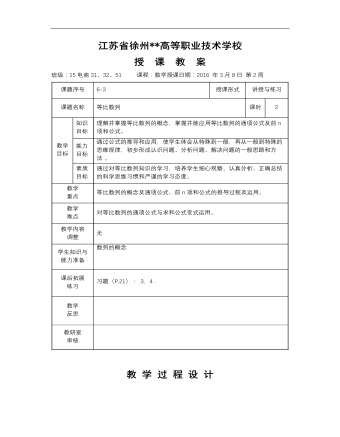
高教版中职数学基础模块下册:6.3《等比数列》教学设计
课题序号6-3授课形式讲授与练习课题名称等比数列课时2教学 目标知识 目标理解并掌握等比数列的概念,掌握并能应用等比数列的通项公式及前n项和公式。能力 目标通过公式的推导和应用,使学生体会从特殊到一般,再从一般到特殊的思维规律,初步形成认识问题、分析问题、解决问题的一般思路和方法 。素质 目标通过对等比数列知识的学习,培养学生细心观察、认真分析、正确总结的科学思维习惯和严谨的学习态度。教学 重点等比数列的概念及通项公式、前n项和公式的推导过程及运用。教学 难点对等比数列的通项公式与求和公式变式运用。教学内容 调整无学生知识与 能力准备数列的概念课后拓展 练习 习题(P.21): 3,4.教学 反思 教研室 审核
【高教版】中职数学基础模块上册:3.3《函数的实际应用举例》教学设计
课程分析中专数学课程教学是专业建设与专业课程体系改革的一部分,应与专业课教学融为一体,立足于为专业课服务,解决实际生活中常见问题,结合中专学生的实际,强调数学的应用性,以满足学生在今后的工作岗位上的实际应用为主,这也体现了新课标中突出应用性的理念。分段函数的实际应用在本课程中的地位:(1) 函数是中专数学学习的重点和难点,函数的思想贯穿于整个中专数学之中,分段函数在科技和生活的各个领域有着十分广泛的应用。(2) 本节所探讨学习分段函数在生活生产中的实际问题上应用,培养学生分析与解决问题的能力,养成正确的数学化理性思维的同时,形成一种意识,即数学“源于生活、寓于生活、用于生活”。教材分析 教材使用的是中等职业教育课程改革国家规划教材,依照13级教学计划,函数的实际应用举例内容安排在第三章函数的最后一部分讲解。本节内容是在学生熟知函数的概念,表示方法和对函数性质有一定了解的基础上研究分段函数,同时深化学生对函数概念的理解和认识,也为接下来学习指数函数和对数函数作了良好铺垫。根据13级学生实际情况,由生活生产中的实际问题入手,求得分段函数此部分知识以学生生活常识为背景,可以引导学生分析得出。
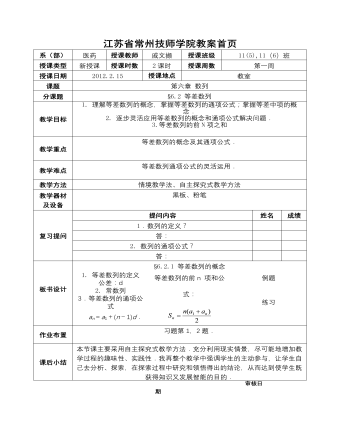
高教版中职数学基础模块下册:6.2《等差数列》教学设计
系(部)医药授课教师戚文撷授课班级11(5),11(6)班授课类型新授课授课时数2课时授课周数第一周授课日期2012.2.15授课地点 教室课题第六章数列分课题§6.2 等差数列教学目标1. 理解等差数列的概念,掌握等差数列的通项公式;掌握等差中项的概念. 2. 逐步灵活应用等差数列的概念和通项公式解决问题. 3.等差数列的前N项之和 . 4.培养学生分析、比较、归纳的逻辑思维能力. . 2. 3.教学重点等差数列的概念及其通项公式. 教学难点等差数列通项公式的灵活运用. 教学方法情境教学法、自主探究式教学方法教学器材及设备黑板、粉笔复习提问提问内容姓名成绩1.数列的定义? 答: 2. 数列的通项公式? 答: 板书设计 §6.2.1等差数列的概念 1. 1.等差数列的定义 公差:d 2.常数列 3.等差数列的通项公式 an=a1+(n-1)d. 等差数列的前n 项和公式: 例题 练习作业布置习题第1,2题.课后小结本节课主要采用自主探究式教学方法.充分利用现实情景,尽可能地增加教学过程的趣味性、实践性.我再整个教学中强调学生的主动参与,让学生自己去分析、探索,在探索过程中研究和领悟得出的结论,从而达到使学生既获得知识又发展智能的目的.
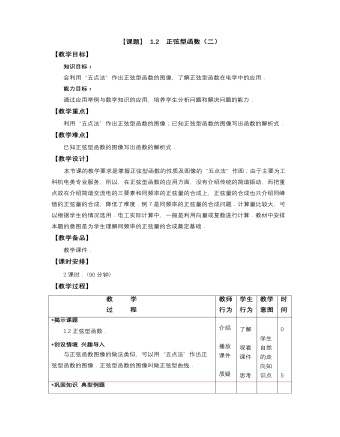
【高教版】中职数学拓展模块:1.2《正弦型函数》教学设计
教 学 过 程教师 行为学生 行为教学 意图时间 *揭示课题 1.2正弦型函数. *创设情境 兴趣导入 与正弦函数图像的做法类似,可以用“五点法”作出正弦型函数的图像.正弦型函数的图像叫做正弦型曲线. 介绍 播放 课件 质疑 了解 观看 课件 思考 学生自然的走向知识点 0 5*巩固知识 典型例题 例3 作出函数在一个周期内的简图. 分析 函数与函数的周期都是,最大值都是2,最小值都是-2. 解 为求出图像上五个关键点的横坐标,分别令,,,,,求出对应的值与函数的值,列表1-1如下: 表 001000200 以表中每组的值为坐标,描出对应五个关键点(,0)、(,2)、(,0)、(,?2)、(,0).用光滑的曲线联结各点,得到函数在一个周期内的图像(如图). 图 引领 讲解 说明 引领 观察 思考 主动 求解 观察 通过 例题 进一 步领 会 注意 观察 学生 是否 理解 知识 点 15
【高教版】中职数学拓展模块:3.2《二项式定理》教学设计
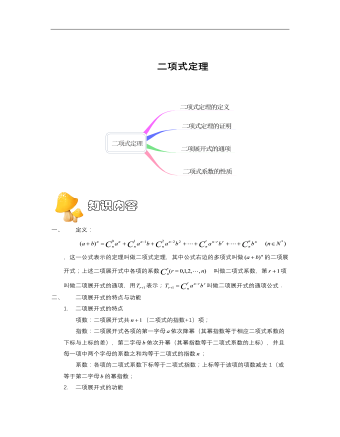
一、定义: ,这一公式表示的定理叫做二项式定理,其中公式右边的多项式叫做的二项展开式;上述二项展开式中各项的系数 叫做二项式系数,第项叫做二项展开式的通项,用表示;叫做二项展开式的通项公式.二、二项展开式的特点与功能1. 二项展开式的特点项数:二项展开式共(二项式的指数+1)项;指数:二项展开式各项的第一字母依次降幂(其幂指数等于相应二项式系数的下标与上标的差),第二字母依次升幂(其幂指数等于二项式系数的上标),并且每一项中两个字母的系数之和均等于二项式的指数;系数:各项的二项式系数下标等于二项式指数;上标等于该项的项数减去1(或等于第二字母的幂指数;2. 二项展开式的功能注意到二项展开式的各项均含有不同的组合数,若赋予a,b不同的取值,则二项式展开式演变成一个组合恒等式.因此,揭示二项式定理的恒等式为组合恒等式的“母函数”,它是解决组合多项式问题的原始依据.又注意到在的二项展开式中,若将各项中组合数以外的因子视为这一组合数的系数,则易见展开式中各组合数的系数依次成等比数列.因此,解决组合数的系数依次成等比数列的求值或证明问题,二项式公式也是不可或缺的理论依据.
高教版中职数学基础模块下册:10.3《总体、样本与抽样方法》教学设计
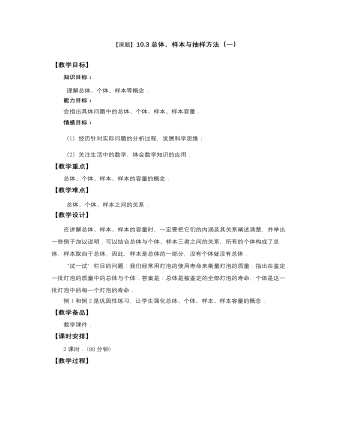
教 学 过 程教师 行为学生 行为教学 意图时间 *揭示课题 10.3总体、样本与抽样方法(一) *创设情境 兴趣导入 【实验】 商店进了一批苹果,小王从中任意选取了10个苹果,编上号并称出质量.得到下面的数据(如表10-6所示): 苹果编号12345678910质量(kg)0.210.170.190.160.200.220.210.180.190.17 利用这些数据,就可以估计出这批苹果的平均质量及苹果的大小是否均匀. 介绍 质疑 讲解 说明 了解 思考 启发 学生思考 0 10*动脑思考 探索新知 【新知识】 在统计中,所研究对象的全体叫做总体,组成总体的每个对象叫做个体. 上面的实验中,这批苹果的质量是研究对象的总体,每个苹果的质量是研究的个体. 讲解 说明 引领 分析 理解 记忆 带领 学生 分析 20*巩固知识 典型例题 【知识巩固】 例1 研究某班学生上学期数学期末考试成绩,指出其中的总体与个体. 解 该班所有学生的数学期末考试成绩是总体,每一个学生的数学期末考试成绩是个体. 【试一试】 我们经常用灯泡的使用寿命来衡量灯炮的质量.指出在鉴定一批灯泡的质量中的总体与个体. 说明 强调 引领 观察 思考 主动 求解 通过例题进一步领会 35
第四单元《教学设计》 说课稿 2021—2022学年统编版高中语文必修下册
(六)说教学策略1.专题性海量的媒介信息必须加以选择或者整合,以项目为依据,进行信息筛选,形成专题性阅读与交流;培养学生对文本信息“化零为整”的能力,提升跨媒介阅读与交流学习的充实感。2.情境化情境教学应指向学生的应用,建构富有符合时代气息的内容,与生活经验更加贴合,对学生的语言建构与运用有所提升,在情境中能够有效地进行交流。3.任务化以任务为导向的序列化学习,可以为学生构建学习路线图、学习框架等具体任务引导;或以跨媒介的认识与应用为任务的设置引导;甚至以阅读和交流作为序列化安排的实践引导。4.整合性跨媒介阅读与交流是结合线上线下的资源,形成新的“超媒介”,也能实现对信息进行“深加工”,多种媒介的信息整合只为一个核心教学内容服务。5.互文性语言文字是语文之生命,我们是立足于语言文字的探讨,音乐、图像、视频等文本与传统语言文字文本形成互文,触发学生对学习内容立体化和具体化的感悟,提升学生的审美能力。
新人教版高中英语必修3Unit 1 Festivals and Celebrations-Reading and Thinking教学设计
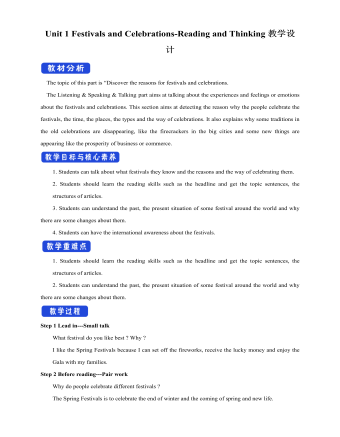
The topic of this part is “Discover the reasons for festivals and celebrations.The Listening & Speaking & Talking part aims at talking about the experiences and feelings or emotions about the festivals and celebrations. This section aims at detecting the reason why the people celebrate the festivals, the time, the places, the types and the way of celebrations. It also explains why some traditions in the old celebrations are disappearing, like the firecrackers in the big cities and some new things are appearing like the prosperity of business or commerce. 1. Students can talk about what festivals they know and the reasons and the way of celebrating them.2. Students should learn the reading skills such as the headline and get the topic sentences, the structures of articles.3. Students can understand the past, the present situation of some festival around the world and why there are some changes about them. 4. Students can have the international awareness about the festivals.1. Students should learn the reading skills such as the headline and get the topic sentences, the structures of articles.2. Students can understand the past, the present situation of some festival around the world and why there are some changes about them.Step 1 Lead in---Small talkWhat festival do you like best ? Why ?I like the Spring Festivals because I can set off the fireworks, receive the lucky money and enjoy the Gala with my families.Step 2 Before reading---Pair workWhy do people celebrate different festivals ?The Spring Festivals is to celebrate the end of winter and the coming of spring and new life.The Mid-autumn Day is to celebrate the harvest and admire the moon.
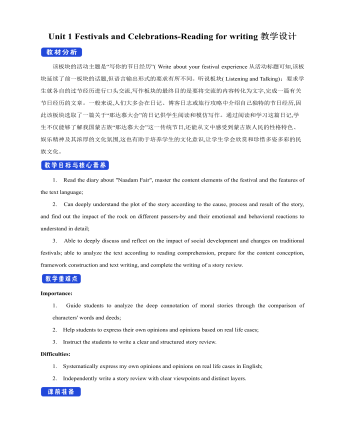
新人教版高中英语必修3Unit 1 Festivals and Celebrations-Reading for writing教学设计二
Step 3 Analyzing article structureActivity 31. Teachers raise questions to guide students to analyze the chapter structure of this diary and think about how to describe the festival experience. (1)What should be included in the opening/body/closing paragraph(s)?(2)How did the writer arrange his/her ideas?(3)What kind of interesting details did the writer describe?(4)How did the writer describe his/her feelings/emotions during the event?2. Students read and compare the three sentence patterns in activity 2. Try to rewrite the first paragraph of the diary with these three sentence patterns. After that, students exchange corrections with their partners. Such as:●This was my first time spending three days experiencing the Naadam Festival in China’s Inner Mongolia Autonomous Region and it was an enjoyable and exciting experience. ●I'll never forget my experience at the Naadam Festival because it was my first time to watch the exciting Mongolian games of horse racing, wrestling, and archery so closely. ●I'll always remember my first experience at the Naadam Festival in China’s Inner Mongolia Autonomous Region because it was so amazing to spend three days witnessing a grand Mongolian ceremony. Step 4 Accumulation of statementsActivity 41. Ask the students to read the diary again. Look for sentences that express feelings and emotions, especially those with the -ing form and the past participle. Such as:● …horse racing, wrestling, and archery, which are all so exciting to watch. ● some amazing performances● I was surprised to see…● I was a little worried about. . . ● feeling really tiredOther emotional statements:●I absolutely enjoyed the archery, too, but the horse races were my favourite part. ●I'm finally back home now, feeling really tired, but celebrating Naadam with my friend was totally worth it. ●He invited me back for the winter to stay in a traditional Mongolian tent and cat hot pot. I can’t wait!2. In addition to the use of the -ing form and the past participle, the teacher should guide the students in the appreciation of these statements, ask them to memorize them, and encourage them to use them reasonably in writing practice.
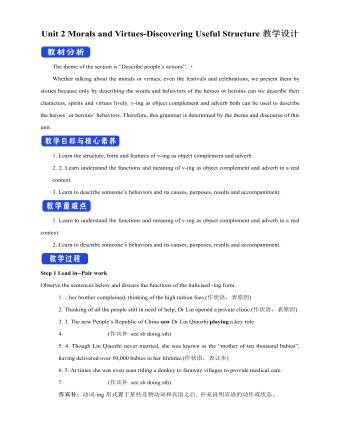
新人教版高中英语必修3Unit 2 Morals and Virtues-Discovering Useful Structure教学设计
1. 表示时间。Hearing these stories, I’m skeptical about the place. = When I heard these stories. . . 2. 表示原因。Not knowing his address, I can’t send this book to him. = Because/Since/As I don’t know his address. . . 3. 表示结果。His father died, leaving him a lot of money. =. . . and left him a lot of money4. 表示条件。Going straight down the road, you will find the department store. = If you go straight down the road. . . 5. 表示让步。Being tired, they went on working. =Although they were tired. . . 6. 表示行为方式、伴随情况或补充说明。He lay on the grass, staring at the sky for a long time. =. . . and stared at the sky for a long time注意:非谓语动词作状语时, 如所提供的动词不能和句子中的主语保持一致, 动词-ing形式必须有自己的逻辑主语, 通常由名词或代词来担任, 这就是独立主格结构。The last bus having gone, we had to walk home. (having gone的逻辑主语是the last bus, 而不是we)Weather permitting, the football match will be played on Friday. (permitting的逻辑主语是time, 而不是the football match)Step 7 Practice1. ________(study) hard, you are sure to get first prize. 2. People use plastic in their daily life, _______(leave) large amounts of waste. 3. ________(work) hard at your lessons, you are to succeed. 4. The old man, ____________(work) abroad for twenty years, is on the way back to his motherland. 5. ______________(finish) his homework, he was playing on the playground. Answers: 1. Studying 2. leaving 3. Working 4.having worked 5. Having finishedStep 8 HomeworkFinish the homework on Page 22.
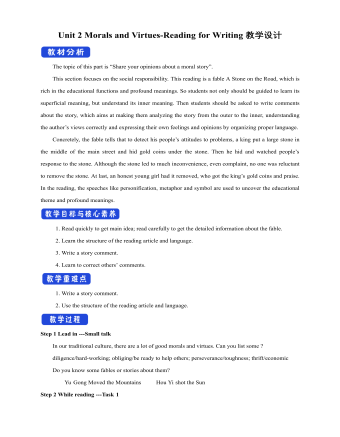
新人教版高中英语必修3Unit 2 Morals and Virtues-Reading for Writing教学设计
1. 这个寓言是一个关于一位国王古寓言。 The fable is an old fable about a king.2.作者用这个故事让读者对于社区的问题负有个人责任的必要印象深刻。The author used the story to impress upon readers with the need to take personal responsibility for problems in the community.3. 这个故事十分成功的实现了它的目的。The story was quite successful in achieving its purpose.Step 7 WritingPlease write a review of the story according the outline above.The fable is an old fable about a king who thought his people are lazy, so he put a large stone in the middle of the road and hides and waited to see if anyone will try to move it.The author used this story to impress upon readers with the need to take personal responsibility for problems in the community. The story was quite successful in achieving its purpose, and I liked it because it had a clear moral.However, while the moral of the story is clear, the actions of the king seemed pointless to me, because none of the characters in the story learnt anything. For this reason, I think there are better stories that can be used to impress upon people with the need for personal responsibility.Step 8 Pair workExchange drafts with a partner. Use this checklist to help your partner revise his/her draft.1. Does the writer give a short description of the story ?2. Does the description include the most important details of the story ?3. Does the writer give his or her opinion about the character or their actions ?4. Is the review well-organised ? 5. Does the writer use the -ing form as the adverbial correctly in the writing ?6. Are there any grammar, spelling, or punctuation errors ?Step 9 HomeworkPut up your revised draft in the classroom or read it to your class.
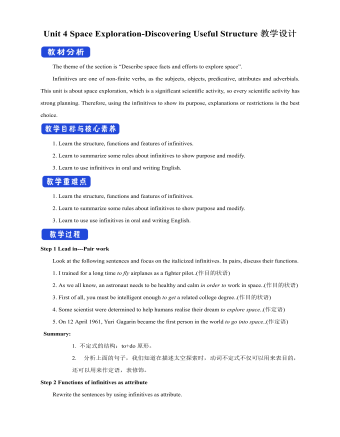
新人教版高中英语必修3Unit 4 Space Exploration-Discovering Useful Structure教学设计
The theme of the section is “Describe space facts and efforts to explore space”. Infinitives are one of non-finite verbs, as the subjects, objects, predicative, attributes and adverbials. This unit is about space exploration, which is a significant scientific activity, so every scientific activity has strong planning. Therefore, using the infinitives to show its purpose, explanations or restrictions is the best choice.1. Learn the structure, functions and features of infinitives.2. Learn to summarize some rules about infinitives to show purpose and modify.3. Learn to use infinitives in oral and writing English. 1. Learn the structure, functions and features of infinitives.2. Learn to summarize some rules about infinitives to show purpose and modify.3. Learn to use use infinitives in oral and writing English.Step 1 Lead in---Pair workLook at the following sentences and focus on the italicized infinitives. In pairs, discuss their functions. 1. I trained for a long time to fly airplanes as a fighter pilot..(作目的状语)2. As we all know, an astronaut needs to be healthy and calm in order to work in space..(作目的状语)3. First of all, you must be intelligent enough to get a related college degree..(作目的状语)4. Some scientist were determined to help humans realise their dream to explore space..(作定语)5. On 12 April 1961, Yuri Gagarin became the first person in the world to go into space..(作定语)Summary:1. 不定式的结构:to+do原形。2. 分析上面的句子,我们知道在描述太空探索时,动词不定式不仅可以用来表目的,还可以用来作定语,表修饰。