-
人教版高中政治必修4社会发展的规律说课稿(二)
“最佳实践者”活动凸显了“尊重劳动”的理念。运用历史唯物主义有关原理。说明为什么药“尊重劳动”。(10分)参考答案:①生产方式是社会存在和发展的基础,生产力是社会发展的最终决定力量,尊重劳动是尊重社会发展规律的必然要求;(3分)③人民群众是历史的创造者,尊重劳动是尊重人民群众社会实践主体地位的要求;(2分)④尊重劳动是以人民群众利益为最高价值标准的必然要求;(2分)⑤劳动者的价值通过劳动实现,尊重劳动是尊重实践、提高劳动者积极性和创造性的必然要求。(3分)七、教学反思本节课教学目标明确,教学重点、难点设置恰当,教学过程详略得当,教学过程流畅。教师充分利用时政热点和生活故事,创设情景,使学生融入教学活动过程之中,充分发挥了学生的主体作用,在体验中提高了认识能力和知识水平,促进了学生的理解能力、思维能力和解决问题的能力,促进了学生的发展。
人教版高中政治必修4社会发展的规律说课稿(一)
学生回答:推动社会发展的矛盾是:生产力和生产关系的矛盾,经济基础和上层建筑的矛盾。问题:你知道人类社会存在和发展的基础吗?学生回答,步步深入。社会发展的规律是生产关系一定要适合生产力发展的规律,上层建筑一定要适合经济基础状况的规律。你是如何理解这两个规律的?请举例说明。那么你是如何理解这一规律的,请举例说明学生阅读教材第二目,并举例说明。培养学生自我学习能力。教师归纳:总结生产力和生产关系、经济基础和上层建筑的辩证关系原理。过渡:我们掌握了社会发展的规律,那么同学们来说一下,社会发展呈什么趋势?这一趋势怎么实现的?社会矛盾的解决方式有几种,为什么会有这么的区别,我们国家的矛盾解决靠什么方式来完成?学生阅读教材第三目,学生分组合作探究,交流发言。设计意图:提升推导能力,引导深化认识。教师归纳总结:社会历史发展的总趋势是前进的、上升的,发展的过程是曲折的。
人教版高中地理必修2第二章第三节城市化说课稿
投影上海市的卫星城镇建设、交通改善图以及住房图等,探讨上海为解决城市化的问题做了哪些方面的工作?进一步引导思考总结对于城市化带来的问题,除了上海市的做法,你还有什么想法?◆设计意图:借上海的例子一方面引导学生解决问题的思路,让学生自己掌握城市化问题及措施,活跃思维;另一方面帮助学生树立学习优秀的意识;4.活动设计.未来展望——生态城市课本38页的活动,结合合肥市环城公园,解释生态城市。◆设计意图:进一步让学生认识到人地协调的重要性,牢固树立可持续发展的观念。5.活动设计分析南京的城市化过程中存在哪些问题,除了共性外,还有没有自己的个性问题?对于问题展开讨论,并提出相应的解决措施。◆设计意图:结合身边的地理,落实乡土地理的教育,激发学生热爱家乡,从身边的环境小事做起,落实环境教育。
人教版高中地理必修3地理环境对区域发展的影响说课稿
本节课我分成两个课时A首先我会在在ppt上放几张关于区域的图,让学生思考什么是区域,区域有什么特征。其次我会在在书上画出区域的定义,在给与解释说明,再在书上画出区域的四个特征,让同学小组讨论哪些区域是有界的,哪些区域是无界的,从而加深同学们对区域的理解。B在ppt上放出长江三角洲和松嫩平原,不同风土人情由此导入下一个知识点:不同区域由于地理环境的差异,人们的生产特点有许多的不同,发展方式也存在差异,然后让学生思考长江三角洲和松嫩平原有什么差异,各自给区域环境发展带来什么影响,启发学生从气候等方向思考,然后用表格的方式给不同因素归类(归位自然和社会经济两大类)再启发同学们从两大类分别讨论对农业与工业发展的影响,最后再用表格的形式分类表达C然后给同学们几个问题,巩固同学课堂所学,最后留下一个问题课后解决:除了今天讲的因素外还有哪些因素对区域发展产生影响?
人教版高中地理必修2第二章第一节城市内部空间结构说课稿
提问:结合课本找出城市地域结构模式的类型及各自特点,模式形成的因素又有哪些?学生回答,使其掌握基本模式及特点,通过对比,分析把握每一模式各自的特征,学会把握事物本质。◆设计意图:阅读课本,总结归纳,同时引导,通过原因规律的探究,大胆设想,总结规律掌握人文地理学习思路。4.活动设计:内部空间结构变化,结合实例,分析说明。提问:结合江宁区的变化,分析江宁区城市结构发生了哪些变化?结合课本24页活动题,提出功能结构布局方案?通过理论联系实际,让学生更好理解理论,掌握城市结构布局的变化及其影响因素,通过活动题方案的提出,学生能够掌握布局的规律性,解决问题。设计意图:理论联系实际,知识的不枯燥性,提高学生学习兴趣。同时,能够通过总结,深层次认识城市结构布局,活学活用。
人教版高中地理必修2第三章第一节农业的区位选择说课稿
◆设计意图:培养学生独立思考、合作学习的能力。分别说明市场、交通、劳动力、机械和政策对农业生产的影响,让学生切实地考虑,拓展学生思路。教师激发和维持学生学习动机、引导学生、帮助学生自主发现、探索知识,达到巩固所学知识,检验学生的实践应用能力。D.分析教材,识别图片,理解农业地域阅读、分析教材,看图识别,研究案例《澳大利亚地混合农业生产》、思考问题、解决问题◆设计意图:图片展示能清楚直观地说明问题,通过案例分析,了解澳大利亚的混合农业生产,培养学生独立思考问题、解决问题的能力,开拓学生思路。3.课堂小结:◆设计意图:帮助学生回顾课堂、巩固所学知识。4.反馈练习:◆设计意图:知识与能力强化训练,巩固本课所学知识,提高应用能力。
人教版高中地理必修2第四章第二节工业地域的形成说课稿
下面要针对工业地域内部的工业联系进行讲解,这里主要涉及到的是工序上的工业联系。在这段文字的处理上,我会将钢铁、石化、机械加工等工业部门分散成一步一步的工序,便于学生理解这种工业上的联系方式与构造,进而对于工业的发育程度这一概念的理解也就相对简单了。紧接着需要讲述的是工业分散的内容。工业分散是建立在现代的交通运输方式和通信技术与手段上的。它主要针对的是体积小、重量轻、价格昂贵的电子产品生产领域,目的是根据原件的不同性质选择不同的生产地域,利用其各异的优势条件以节省开支。由于案例都是针对高科技产品的生产而提出的,因此在这段教材的教学中我会注意避免将工业分散这一现象描述得更为高级。要让学生明白,无论是工业集聚还是工业分散,它们之间是没有好坏之分的。最后将进行课堂小结,由于本节内容较少且相对简单,可以在最后适当添加部分练习题,重点考察一二两节的相关知识点。
人教版高中地理必修2如何看待农民工现象说课稿
b.基于对农民工现象的认识以及资料2的分析,请同学辨证的分析出这一现象的利弊——分析问题,当然,这一部分内容还是要以学生自主学习、合作学习为主,但教师要给予一定的引导。c.最后,请同学讨论,提出自己的意见和建议,应该怎样解决农民工所面临的问题——解决问题。这一部分要求学生提出自己的见解,不局限于书本,发挥自身的创造性思维。3.课堂小结:本节课作为问题研究课程,探讨了我国现阶段的农民工现象,了解了农民工生存的环境,以及体会了解决农民工问题的必要性和重要性,并通过合作探讨,得出了一些列解决的方案。着重培养大家对于问题的综合分析能力。增加大家对农民工现象的感性认识,希望大家运用所学知识关心现实社会中的问题,增强社会责任感,学以致用。
人教版高中地理必修3产业转移—以东亚为例说课稿
【情感态度及价值观】 通过创设探究情境,展示典型显示案例激发思考,与学生共同感受当前区域经济一体化与经济全球化浪潮的冲击,以及当前我国、我省发展的机遇、成就和危机,培养学生的时代感和使命感。五、重点难点【重点】1、产业转移的影响因素2、产业转移对区域地理环境的影响【难点】1、如何从图文材料中分析出影响产业转移的主要因素2、产业转移对产业迁出区和移入区的不同影响六、教学方法1、材料分析法。提供分层次的问题与材料,并进行方法指导,学生通过思考和讨论自行分析发现知识、构建知识。使不同层次的学生均有发展。这是本节设计主要采用的教学方法。2、合作探究法3、多媒体教学法七、 教学过程(一) 引入 :假如某同学买彩票中大奖,想投资生产面临几项选择1、投资高端智能手机制造还是普通服装厂?2、厂址选择在濮阳市还是南乐县?
人教版高中地理必修3河流的综合开发—以美国田纳西河流域说课稿
师我国河流众多,长江流域、黄河流域、珠江流域等正在继续开发,出示“长江流域示意图”,请同学们借鉴今天所学的分析方法,分析长江流域发展的自然地理条件。(学生相互交流、讨论)生略。师长江干流全长6300余千米,发源于青藏高原,流经青、藏、滇、川、渝、鄂、湘、赣、皖、苏、沪,奔入东海。水域辽阔,总面积达180万平方千米,流经我国半壁河山。水量汪洋壮阔,多年平均入海近10000亿立方米。流域内总人口、耕地各约占全国的35%,工农业总产值占全国的40%~50%,历来是中华民族繁衍的沃土。流域经过我国三大阶梯,流经青藏高原、横断山脉、四川盆地、云贵高原、长江中下游平原等地形区。流域内水系发达、众多,以亚热带季风气候为主,气候温暖湿润,降水量丰富,河流水量大,水能资源、森林资源、矿产资源丰富,长江干流自古以来就是我国东西航运的大动脉,沟通内地和沿海的广大地区,干支流通航里程约占全国内河航道总里程的2/3,形成了一个纵横广阔的水运网,被誉为“黄金水道”。
人教版高中地理必修3能源资源的开发—以我国山西省为例说课稿
指导学生阅读图3.8,让同学们讨论山西省三类工业发展变化的情况。可以看出,采掘业占工业增加值的比重在1985~1995年间有所上升,但在1995~2000年下降,且下降速度很快。原料工业始终在增加,且有越来越快的趋势。加工工业1985~1995年间比重下降,到2000年几乎停滞不前。这说明山西省虽然实现了产业结构的升级,但还是限于初级加工阶段,工业发展水平还不高。山西省只是一个能源大省,并不是一个工业大省,更不是经济强省,山西省的改革还有很长的路要走。(参考资料)《急需调整产业结构的山西经济》(山西日报1999年11月25日)山西能源的综合利用是一个正在发展完善的过程,教学中教师可以结合目前存在的一些问题和困境展开讨论,引导学生深入探究。(例如屡屡发生的矿难,以及背后隐藏的“官煤勾结”问题,这些都是目前各种媒体关注的焦点,相关的新闻报道,教师在课前应该专门搜集一些,或者让有条件上网的学生自己去搜集,使得课堂教学更加贴近现实生活。)
人教版高中地理必修2第四章第三节传统工业区与新工业区说课稿
下面是对以高技术产业为主的新工业区的内容进行讲解,教材以美国“硅谷”为例,首先谈的是高技术工业的特点,然后讲述的是“硅谷”的发展条件,由于教学模式与意大利新工业区的内容基本一致,这里就不再赘述了。接下来教材中提到的与之对照的案例同样是以高技术产业而闻名的中关村,由于中关村在国内的知名度较高,一般学生都有所了解,因此不妨让学生谈谈自己的看法:对于高新技术产业的发展有何建议,相对于发展较为成功的“硅谷”我们需要学习的方面又是哪些?案例中最后一个问题很值得深省,我国的新工业区到底怎样做才能够获得成功,简单的模仿下我们缺少的又是什么?这个问题可以作为拓展,让学生写一篇简短的论文作为课后作业。最后做以简单的课堂小结。本节内容的教学可能会相对繁杂,而案例之间的分析过程又过于雷同,所以难免枯燥。在处理这个问题上,我将尽量做到详略得当,主要培养学生的自主学习能力。
人教版高中地理必修2城市化教案
读《环境污染组图》思考:造成交通拥挤的原因是什么?有什么危害?(原因:汽车的增加、汽车数量与道路状况的比值越来越大造成的。危害:交通阻塞,导致时间和能源的严重浪费,影响城市环境质量。)3.增加就业困难,失业人数增多思考:产生这个问题的原因是什么?(随着城市化发展,城市科学技术提高,机器化大生产使劳动者数量要求降低,城市人口本来就未充分就业,再加上乡村人口大量涌入,导致失业人数增多。)二、解决办法:(以上海市为例,讲解解决的办法。)1.改善城市环境:治理河流、控制大气污染物、大力加强绿化建设为改善城市环境,上海市全面展开对大气、河流、噪声等多方面的治理工作。如苏州河的治理、降低城市污染物浓度、加强绿化建设,截止1990年,市区绿化覆盖率达到20.3%。
人教版高中语文必修1《新词新语与流行文化》教案2篇
【教学设计】一、教学目的:1、引导学生关注生活,向生活学习语言。2、了解新词新语,能正确评价和运用新词新语。二、教学重难点:1、重点:认识并评价新词新语。2、难点:如何评价新词新语三、教学用时:一课时四、教学过程预设(一)导入新课以前如果有人说我可爱,我会很高兴:我还是有优点的哦。现在如果有人说我可爱,我就会心里嘀咕了:这是什么意思呀?同学们知道这有什么意思吗?(可爱=可怜没人爱)如果大家留心就会发现,类似这样的词语很多,在网上是特别流行,很新颖、独特,谁来列举几个?(点评学生所列举出的词语)网络上有新词新语,其它媒体(如报刊、电视等)都有新词新语。关于新词新语的概念,一般认为,新近创造出来的词语,或是旧词新用,这样的词语就叫新词新语。
新人教版高中英语必修3Unit 2 Morals and Virtues-Listening &Speaking&Talking教学设计
Example:One day, a poor boy who was trying to pay his way through school by sending newspapers door to door found that he only had one dime(一角)left. He was so hungry that he decided to beg for a meal at the next house.However, he lost his nerve when a lovely young woman opened the door. Instead of a meal he asked for a drink of water. She thought he looked hungry so she brought him a large glass of milk. He drank it slowly, and then asked, “How much do I owe you?” “You don’t owe me anything,” she replied, “Mother has taught me never to accept pay for a kindness.” “Then I thank you from the bottom of my heart.” With these words, Howard Kelly left that house.Years later the woman became badly ill and was finally sent to the hospital in a big city. Dr. Howard Kelly, now famous, was called in. When he heard the name of the town she came from, a strange light filled his eyes. Dressed in his doctor’s clothes, Dr. Kelly went into her room and recognized her at once. From that day on, he gave special attention to her, and decided to do his best to save her life.At last the woman was saved. Dr. Kelly asked the business office to pass the final bill to him. He looked at it and then wrote something on the side. The bill was sent to the woman’s room. She was afraid to open it because she was sure that it would take the rest of her life to pay for it off. Finally she looked, and the note on the side of the bill caught her attention. She read these words: “Paid in full with a glass of milk, Dr. Howard Kelly.” Tear of joy flooded her eyes.
新人教版高中英语必修3Unit 2 Morals and Virtues-Reading and Thinking教学设计
The topic of this part is “Learn to make choices in life”.The Listening & Speaking & Talking part aims at the moral dilemmas, and this part is about making choices in life. The heroin is Lin Qiaozhi, a famous medical scientist, made a great contribution to our country’s medical care. Most importantly, her life experience can inspire our students whether in studying or the development of career. she had moral dilemmas and life choices, which are similar to the students who will step into society. Besides, Lin has quite good virtues like kindness, self-improvement, insistence, job-loving , generosity and responsibility, which is worth being learned.Concretely, this article is a biography about Lin Qiaozhi. The article tells her whole life according the timeline, among which the life choices is emphasized. For example, whether married or chased her dream, returned home or stayed abroad, family or public, her choices all reflected her faith, spirit, responsibility and devotion.1. Fast reading to get the detailed information about Lin Qiaozhi; careful reading to do the deductive information.2. Learn the reading skills--deductive judgement according the context.3. Study the structure features and language features. 4. Communicate about Lin’s life choices and reflect their own life choices.1. Learn the reading skills--deductive judgement according the context.2. Study the structure features and language features.3. Communicate about Lin’s life choices and reflect their own life choices.Step 1 Lead in---Small talkWhat are some important life choices?Importance choices: university study, jobs and marriage partners. Because they can determine our future.
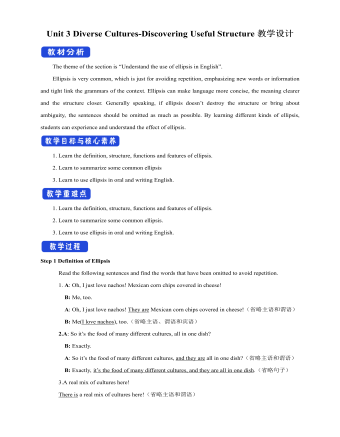
新人教版高中英语必修3Unit 3 Diverse Cultures-Discovering Useful Structure教学设计
Step 4 PracticeRead the conversation. Find out which words have been left out.Justin: Linlin, I’m going to Guizhou Province next month. I’m super excited! Any recommendations for places to visit?Linlin: Wow, cool! Guizhou is a province with a lot of cultural diversity. Places to visit...well, definitely the Huangguoshu Waterfall first.Justin: What’s special about the waterfall?Linlin: Well, have you ever heard of the Chinese novel Journey to the West ?Justin: Yes, I have. Why ?Linlin: In the back of the waterfall, you will find a cave, which is the home of the Monkey King.Justin: Really? Cool! I’ll definitely check it out.Linlin:And I strongly recommend the ethnic minority villages. You’ll find Chinese culture is much more diverse than you thought.Justin:Sounds great, thanks.Answers:Justin: Linlin, I’m going to Guizhou Province next month. I’m super excited! Do you have any recommendations for places to visit?Linlin: Wow, that’s cool! Guizhou is a province with a lot of cultural diversity. What are some places to visit in Guizhou ? Well, definitely the Huangguoshu Waterfall is the first place to visit in Guizhou Province.Justin: What’s special about the waterfall?Linlin: Well, have you ever heard of the Chinese novel Journey to the West ?Justin: Yes, I have heard of the Chinese novel Journey to the West . Why do you ask if I have heard of the Chinese novel Journey to the West?Linlin: In the back of the waterfall, you will find a cave, which is the home of the Monkey King from Journey to the West.Justin: That’s really true? It’s Cool! I’ll definitely check it out.Linlin:And I strongly recommend the ethnic minority villages on your trip to Guizhou Province. You’ll find Chinese culture is much more diverse than you thought it was.Justin:This all sounds great, thanks.
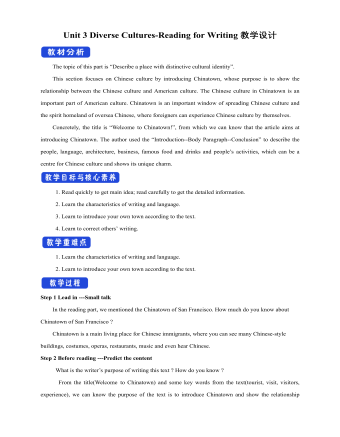
新人教版高中英语必修3Unit 3 Diverse Cultures-Reading for Writing教学设计
The topic of this part is “Describe a place with distinctive cultural identity”.This section focuses on Chinese culture by introducing Chinatown, whose purpose is to show the relationship between the Chinese culture and American culture. The Chinese culture in Chinatown is an important part of American culture. Chinatown is an important window of spreading Chinese culture and the spirit homeland of oversea Chinese, where foreigners can experience Chinese culture by themselves.Concretely, the title is “Welcome to Chinatown!”, from which we can know that the article aims at introducing Chinatown. The author used the “Introduction--Body Paragraph--Conclusion” to describe the people, language, architecture, business, famous food and drinks and people’s activities, which can be a centre for Chinese culture and shows its unique charm.1. Read quickly to get main idea; read carefully to get the detailed information.2. Learn the characteristics of writing and language.3. Learn to introduce your own town according to the text.4. Learn to correct others’ writing.1. Learn the characteristics of writing and language.2. Learn to introduce your own town according to the text.Step 1 Lead in ---Small talkIn the reading part, we mentioned the Chinatown of San Francisco. How much do you know about Chinatown of San Francisco ?Chinatown is a main living place for Chinese immigrants, where you can see many Chinese-style buildings, costumes, operas, restaurants, music and even hear Chinese.Step 2 Before reading ---Predict the contentWhat is the writer’s purpose of writing this text ? How do you know ?From the title(Welcome to Chinatown) and some key words from the text(tourist, visit, visitors, experience), we can know the purpose of the text is to introduce Chinatown and show the relationship between Chinese culture and American culture.
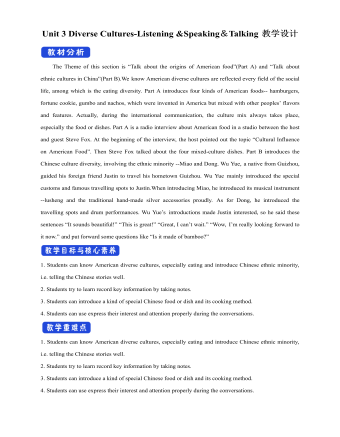
新人教版高中英语必修3Unit 3 Diverse Cultures-Listening &Speaking&Talking教学设计
1. In Picture 1 and Picture 2, where do you think they are from? How do you know?From their wearings, we can know they are from ethnic minority of China--- Miao and Dong.Picture 1, they are playing their traditional instrument lusheng in their traditional costumes.Picture 2. the girls are Miao because they wear their traditional costumes and silver accessory.2. In Picture 3, can you find which village it is? What time is it in the picture?It is Dong village. It is at night. Step 2 While-listeningJustin met a new friend while traveling in Guizhou. Listen to their conversation and complete the summaries below.Part 1Justin and Wu Yue watched some Miao people play the lusheng. The instrument has a history of over 3,000 years and it is even mentioned in the oldest collection of Chinese poetry. Then they watched the lusheng dance. Justin wanted to buy some hand-made silver/traditional accessories as souvenirs. He was told that the price will depend on the percentage of silver. Part 2They will go to a pretty Dong minority village called Zhaoxing. they will see the drum towers and the wind and rain bridges. They may also see a performance of the Grand Song of the Dong people.Step 3 Post-listening---TalkingWork in groups. Imagine Justin is telling some friends about his trip to Guizhou. One of you is Justin and the rest of you are his friends. Ask Justin questions about his trip and experience. The following expressions may help you.
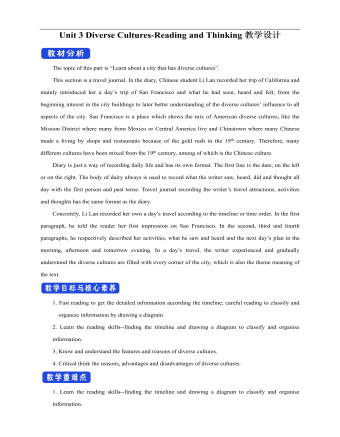
新人教版高中英语必修3Unit 3 Diverse Cultures-Reading and Thinking教学设计
Discuss these questions in groups.Q1: Have you ever been to a place that has a diverse culture ? What do you think about the culture diversity ?One culturally diverse place that I have been to is Harbin, the capital city of Heilongjiang Province. I went there last year with my family to see the Ice and Snow Festival, and I was amazed at how the culture as different to most other Chinese cities. There is a big Russian influence there, with beautiful Russian architecture and lots of interesting restaurants. I learnt that Harbin is called “the Oriental Moscow” and that many Russians settled there to help build the railway over 100 years ago.Q2: What are the benefits and challenges of cultural diversity ?The benefits: People are able to experience a wide variety of cultures, making their lives more interesting, and it can deepen the feelings for our national culture, it is also helpful for us to learn about other outstanding culture, which helps improve the ability to respect others. The challenges: People may have trouble communicating or understanding each other, and it may lead to disappearance of some civilizations and even make some people think “The western moon is rounder than his own.”Step 7 Post reading---RetellComplete the passage according to the text.Today, I arrived back in San Francisco, and it feels good (1) _____(be) back in the city again. The city succeeded in (2)_________ (rebuild) itself after the earthquake that (3)________ (occur) in 1906, and I stayed in the Mission District, enjoying some delicious noodles mixed with cultures. In the afternoon, I headed to a local museum (4)____ showed the historical changes in California. During the gold rush, many Chinese arrived, and some opened up shops and restaurants in Chinatown to earn a (5)_____ (live). Many others worked on (6)______ (farm), joined the gold rush, or went to build the railway that connected California to the east. The museum showed us (7)____ America was built by immigrants from (8)________ (difference) countries and cultures. In the evening, I went to Chinatown, and ate in a Cantonese restaurant that served food on (9)________(beauty) china plates. Tomorrow evening, I’m going to (10)__ jazz bar in the Richmond District. 答案:1. to be 2. rebuilding 3. occurred 4. that 5.living6. farms 7.how 8. different 9. beautiful 10. a