-
数据的收集与整理 3 数据的表示教案教学设计
创设情境,导入新课:你对母亲知多少师问1:我们5月份刚过了一个重要的节日,你知道是什么吗?----母亲节。师问2:那你知道妈妈的生日吗?(举手示意),每个妈妈都知道自己孩子的生日,请不知道的同学回家了解一下,多关心一下自己的父母。师问3:那你知道妈妈最爱吃的菜吗?你可以选择知道、不知道或者是没有爱吃的(拖动白板上相对应的表情符号)。请大家用不同的手势表示出来。我找3名同学统计各组的数据,写在黑板上(随机找3名学生数人数)。下面我来随机采访一下:你妈妈最喜欢吃的菜是什么?(教师随机采访,结合营养搭配和感恩教育)
三角形的有关证明 3 直角三角形教案教学设计
从课程内容来看,本节课属于“图形与几何”中“图形的性质”部分。依据课标的要求,我从以下四个方面设定了课程目标,分别是:1。知识技能:(1)掌握判定直角三角形全等的“斜边、直角边”定理。(2)已知一直角边和斜边,能用尺规作出直角三角形。2。数学思考:(1)经历探索、猜想、证明的过程,进一步体会证明的必要性,发展推理能力和有条理的表达能力。(2)在探究过程中,渗透由特殊到一般的数学思想方法。3。问题解决:能利用直角三角形的全等解决有关问题。4。情感态度:通过学习,让学生感受数学证明的严谨性,发展勇于质疑、严谨求实的科学态度。
人教版新课标PEP小学英语三年级上册Look at me教案(全英文版)
3、Practicea. Nice to meet you. Nice to meet you,too.b. Perform the dialogue.c. Arrange the dialogue according to the pictures or sentence cards.d. Let’s play.A: Good afternoon,B. This is C. Hello, C! Nice to meet you.C: Nice to meet you, too.A,B: Goodbye!C: Bye!4、Assessment Workbook page 10Add-activitiesa. Listen to the recording and repeat.b. Make a dialogue according to "Let’s talk".Second Period一、Teaching contents1. Let’s learn Words:body, leg, arm, hand, finger, foot.1. Let’s do二、Preparation1、a puppet2、Cards of body, leg, arm, hand, finger and foot.3、headgear of a captain三、Teaching steps1、Warm-up/ Revisiona. Captain says to review "let’s do" of Part A.b. Perform the students their own dialogues.2、Presentationa. Learn to say "body, leg, arm, hand, finger and foot."b. Listen to the recording and repeat.c. Let’s do. Clap your hands. Snap your fingers. Wave your arms. Cross your legs. Shake your body. Stamp your foot.3、Practicea. Let’s draw a person.b. Let’s do. Point out which picture.c. Let’s do. Who responses faster.4、Assessment Workbook page 115、Add-activitiesa. Listen to the recording, repeat and act out.b. Say all the names of the body to your parents.Third Period一、Teaching contents1. Let’s check2. Let’s chant二、Preparation1、stationeries1、pictures of parts of Zoom
人教版新课标PEP小学英语三年级上册Happy Birthday(全英文版)说课稿
1. Do some exercise on the paper. There are four kinds of exercise here. The exercise 1 is to develop Ss’ ability of listening. Exercise 2 is to practice Ss’ ability of knowing the words. Exercise 3 is to develop Ss’ ability of speaking numbers and letters. Exercise 4 is to make Ss know the words and letters well. These exercises can consolidate the new knowledge from different styles of problems.2. Then tell Ss that we can sing the numbers like “ Do, re, mi, fa, so, la, ti, do” and let them listen to a song named “Do, Re, Mi”. Add some extra knowledge so that Ss will be glad to see that the numbers can be used in another way.Step 4 Homework1.Read the numbers from 1 to 7 and 7 to 1 five times.2.Read the letters “u, v, w” five times follow the tape.Reading is a useful way for the Ss of Grade One to practice the knowledge. Ask Ss to imitate reading from the tape in order to make Ss have a good habit of listening and let them have a better pronunciation.Step 5 Board writingI ‘ll put the seven numbers like a scale(音阶)as I’ll let Ss know that we can sing out the numbers. When it comes to listen to the song, I ‘ll draw a musical note on Bb. Unit 9 Happy birthday!sevensixfivefourthree U u V v W wtwo pupil five windowoneThat’s all for my class designing. Thank you for listening!
【高教版】中职数学拓展模块:2.3《抛物线》教学设计
一、教学目标(一)知识教育点使学生掌握抛物线的定义、抛物线的标准方程及其推导过程.(二)能力训练点要求学生进一步熟练掌握解析几何的基本思想方法,提高分析、对比、概括、转化等方面的能力.(三)学科渗透点通过一个简单实验引入抛物线的定义,可以对学生进行理论来源于实践的辩证唯物主义思想教育.二、教材分析1.重点:抛物线的定义和标准方程.2.难点:抛物线的标准方程的推导.三、活动设计提问、回顾、实验、讲解、板演、归纳表格.四、教学过程(一)导出课题我们已学习了圆、椭圆、双曲线三种圆锥曲线.今天我们将学习第四种圆锥曲线——抛物线,以及它的定义和标准方程.课题是“抛物线及其标准方程”.首先,利用篮球和排球的运动轨迹给出抛物线的实际意义,再利用太阳灶和抛物线型的桥说明抛物线的实际用途。
【高教版】中职数学拓展模块:3.5《正态分布》教学设计
教学目的:理解并熟练掌握正态分布的密度函数、分布函数、数字特征及线性性质。教学重点:正态分布的密度函数和分布函数。教学难点:正态分布密度曲线的特征及正态分布的线性性质。教学学时:2学时教学过程:第四章 正态分布§4.1 正态分布的概率密度与分布函数在讨论正态分布之前,我们先计算积分。首先计算。因为(利用极坐标计算)所以。记,则利用定积分的换元法有因为,所以它可以作为某个连续随机变量的概率密度函数。定义 如果连续随机变量的概率密度为则称随机变量服从正态分布,记作,其中是正态分布的参数。正态分布也称为高斯(Gauss)分布。
高教版中职数学基础模块下册:8.4《圆》教学设计
教 学 过 程教师 行为学生 行为教学 意图时间 *揭示课题 8.4 圆(二) *创设情境 兴趣导入 【知识回顾】 我们知道,平面内直线与圆的位置关系有三种(如图8-21): (1)相离:无交点; (2)相切:仅有一个交点; (3)相交:有两个交点. 并且知道,直线与圆的位置关系,可以由圆心到直线的距离d与半径r的关系来判别(如图8-22): (1):直线与圆相离; (2):直线与圆相切; (3):直线与圆相交. 介绍 讲解 说明 质疑 引导 分析 了解 思考 思考 带领 学生 分析 启发 学生思考 0 15*动脑思考 探索新知 【新知识】 设圆的标准方程为 , 则圆心C(a,b)到直线的距离为 . 比较d与r的大小,就可以判断直线与圆的位置关系. 讲解 说明 引领 分析 思考 理解 带领 学生 分析 30*巩固知识 典型例题 【知识巩固】 例6 判断下列各直线与圆的位置关系: ⑴直线, 圆; ⑵直线,圆. 解 ⑴ 由方程知,圆C的半径,圆心为. 圆心C到直线的距离为 , 由于,故直线与圆相交. ⑵ 将方程化成圆的标准方程,得 . 因此,圆心为,半径.圆心C到直线的距离为 , 即由于,所以直线与圆相交. 【想一想】 你是否可以找到判断直线与圆的位置关系的其他方法? *例7 过点作圆的切线,试求切线方程. 分析 求切线方程的关键是求出切线的斜率.可以利用原点到切线的距离等于半径的条件来确定. 解 设所求切线的斜率为,则切线方程为 , 即 . 圆的标准方程为 , 所以圆心,半径. 图8-23 圆心到切线的距离为 , 由于圆心到切线的距离与半径相等,所以 , 解得 . 故所求切线方程(如图8-23)为 , 即 或. 说明 例题7中所使用的方法是待定系数法,在利用代数方法研究几何问题中有着广泛的应用. 【想一想】 能否利用“切线垂直于过切点的半径”的几何性质求出切线方程? 说明 强调 引领 讲解 说明 引领 讲解 说明 观察 思考 主动 求解 思考 主动 求解 通过例题进一步领会 注意 观察 学生 是否 理解 知识 点 50
【高教版】中职数学拓展模块:2.1《椭圆》优秀教学设计
本人所教的两个班级学生普遍存在着数学科基础知识较为薄弱,计算能力较差,综合能力不强,对数学学习有一定的困难。在课堂上的主体作用的体现不是太充分,但是他们能意识到自己的不足,对数学课的学习兴趣高,积极性强。 学生在学习交往上表现为个别化学习,课堂上较为依赖老师的引导。学生的群体性小组交流能力与协同讨论学习的能力不强,对学习资源和知识信息的获取、加工、处理和综合的能力较低。在教学中尽量分析细致,减少跨度较大的环节,对重要的推导过程采用板书方式逐步进行,力求让绝大多数学生接受。 1.理解椭圆标准方程的推导;掌握椭圆的标准方程;会根据条件求椭圆的标准方程,会根据椭圆的标准方程求焦点坐标. 2.通过椭圆图形的研究和标准方程的讨论,使学生掌握椭圆的几何性质,能正确地画出椭圆的图形,并了解椭圆的一些实际应用。 1.让学生经历椭圆标准方程的推导过程,进一步掌握求曲线方程的一般方法,体会数形结合等数学思想;培养学生运用类比、联想等方法提出问题. 2.培养学生运用数形结合的思想,进一步掌握利用方程研究曲线的基本方法,通过与椭圆几何性质的对比来提高学生联想、类比、归纳的能力,解决一些实际问题。 1.通过具体的情境感知研究椭圆标准方程的必要性和实际意义;体会数学的对称美、简洁美,培养学生的审美情趣,形成学习数学知识的积极态度. 2.进一步理解并掌握代数知识在解析几何运算中的作用,提高解方程组和计算能力,通过“数”研究“形”,说明“数”与“形”存在矛盾的统一体中,通过“数”的变化研究“形”的本质。帮助学生建立勇于探索创新的精神和克服困难的信心。
【高教版】中职数学拓展模块:2.2《双曲线》教学设计
教学准备 1. 教学目标 知识与技能掌握双曲线的定义,掌握双曲线的四种标准方程形式及其对应的焦点、准线.过程与方法掌握对双曲线标准方程的推导,进一步理解求曲线方程的方法——坐标法.通过本节课的学习,提高学生观察、类比、分析和概括的能力.情感、态度与价值观通过本节的学习,体验研究解析几何的基本思想,感受圆锥曲线在刻画现实和解决实际问题中的作用,进一步体会数形结合的思想.2. 教学重点/难点 教学重点双曲线的定义及焦点及双曲线标准方程.教学难点在推导双曲线标准方程的过程中,如何选择适当的坐标系. 3. 教学用具 多媒体4. 标签
统编版三年级语文上第25课灰雀教学设计教案
《秋天的雨》是统编版教材三年级语文上册第八单元的一篇精读课文,课文讲述了列宁、灰雀和一个孩子之间的故事。这个故事表达了列宁善解人意,对男孩的敬重、保护以及男孩的老实和天真。通过语言和行动来揭示人物的内心世界,展现事件的开展进程,是本篇课文在表达上的主要特点。在学习时,可以对话为重点,研读课文,通过阅读人物对话,揣摩体会人物不同的心情,感受列宁爱鸟更爱孩子的情感,懂得知错就改是诚实的表现,同时产生保护鸟类等动物的环保意识。 1.会认“宁、胸”等10个生字,会写“郊、养”等13个生字。2.分角色朗读课文,读出对话的语气。3.带着问题,边默读边推敲人物的内心想法,体会列宁对男孩的尊重和呵护、男孩的诚实与天真。4.体会列宁的善解人意、循循善诱和对儿童的爱护,懂得做错事情应该改正的道理,同时教育学生要爱护动物。 1.教学重点:通过朗读对话体会列宁、小男孩心理变化的过程。2.教学难点:能带着问题,边默读边揣摩人物内心的想法。能体会列宁对男孩的尊重与呵护、男孩的诚实与天真。 2课时
初中语文常考常见的别词、别字教案教学设计
1、三年的汗水,终于有了回报。站在领奖台上,她兴奋得不能自己,泪水刷刷地流了下来。误:不能自己 正:不能自已[bù néng zì yǐ] 2、灯光下面,人头攒动。这条街上陈列的,其实大都是膺品,但还是热闹非凡。误:膺品 正:赝品[yàn pǐn]3、待学生从农村基地回来时,校舍已修茸一新,三幢大楼披上了节日的盛装。误:修茸 正:修葺[xiū qì] 4、埋伏在左侧的三连,听到冲锋号响,尤如猛虎下山,直扑敌人阵地。误:尤如猛虎下山 正:犹如猛虎下山[yóu rú] 5、粗制滥造,哄抬市价,这种竭泽而鱼的做法,最后必然会让自己受到惩罚。误:竭泽而鱼 正:竭泽而渔[jié zé ér yú] 6、自从钢琴热掀起后,钢琴教师身价倍增,一批“三脚猫”也混迹其中,滥芋充数。误:滥芋充数 正:滥竽充数[làn yú chōng shù] 7、阳光穿射而入,配着店堂排列得整整齐齐的书架,真是一个书香花香阳光普照的世外桃园。误:世外桃园 正:世外桃源[shì wài táo yuán]8、在调查过程中,陈又将大批赃款转移至岳父处,专案组找他谈话时,他依旧装得若无其事。误:脏款 正:赃款[zāng kuǎn]
新人教版高中英语必修1Unit 3 Sports and Fitness-Listening and Speaking & Listening and Talking教案
Finally, after finishing the task above, the teacher is expected to instruct students to work in groups to finish the following project:Speaking ProjectWhat event or activity would you like to invite your friend to? Make a conversation with a partner.Ski Race: Zhangjiakou, a beautiful city in northern China, will host the Youth Ski Race in December.Track Meet: a great event for track –and –field lovers on 26 October.Gym Class: come and work out at a gym! You can make it.Part 2: Listening and Talking:The teacher is advised to talk with their new students about the related topic: Boys and girls , what do you think of sportsmanship? Let’s listen and find out:Play the listening and match each opinion with the right speaker. Who do you agree with? Why?Cao Jing _____________ Lily _____________ Max _____________A. An athlete should do his/her best to win.B. The girl should stop and help the other girl. Good sportsmanship is more important than wining!C. An athlete should think about honor and his/her fans if he/she is competing for his/her country.Listen again and circle the expressions that you hear in the conversation.
新人教版高中英语必修1Unit 3 Sports and Fitness- Discovering Useful Structures—tag questions教案
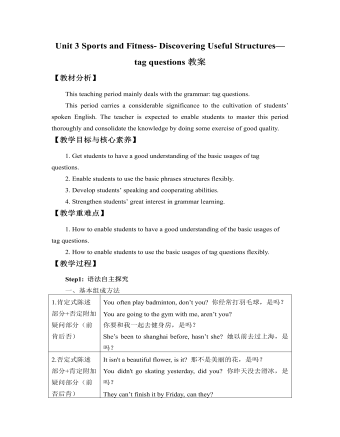
【教材分析】This teaching period mainly deals with the grammar: tag questions.This period carries a considerable significance to the cultivation of students’ spoken English. The teacher is expected to enable students to master this period thoroughly and consolidate the knowledge by doing some exercise of good quality.【教学目标与核心素养】1. Get students to have a good understanding of the basic usages of tag questions.2. Enable students to use the basic phrases structures flexibly.3. Develop students’ speaking and cooperating abilities.4. Strengthen students’ great interest in grammar learning.【教学重难点】1. How to enable students to have a good understanding of the basic usages of tag questions.2. How to enable students to use the basic usages of tag questions flexibly.【教学过程】Step1: 语法自主探究一、基本组成方法1.肯定式陈述部分+否定附加疑问部分(前肯后否) You often play badminton, don’t you? 你经常打羽毛球,是吗?You are going to the gym with me, aren’t you?你要和我一起去健身房,是吗?She’s been to shanghai before, hasn’t she? 她以前去过上海,是吗?2.否定式陈述部分+肯定附加疑问部分(前否后肯) It isn't a beautiful flower, is it? 那不是美丽的花,是吗?You didn't go skating yesterday, did you? 你昨天没去滑冰,是吗?They can’t finish it by Friday, can they?他们不能在星期五之前完成,是吗?
新人教版高中英语必修2Unit 1 Cultural Heritage-Reading and Thinking教案一
The theme of the reading and thinking is about “Understanding how a problem was solved”.The Listening & Speaking & Talking is about international co-work to protect the Mount Tai, in which the students from seven countries came up with many solutions even create the Mount Tai App. This section aims at showing how to solve a difficult and even tough problem about protecting the cultural heritage by the international co-work. So in this section, cultivating students’ international awareness is very clear and important. Concretely, with the economic development, how to balance the protection of cultural relics and social development is a big challenge for human. In the 1950s, the Egyptian government wanted to build the Aswan Dam across the Nile to control floods, produce electricity and water farms. But the proposal led to protests because it would destroy a lot of cultural relics. The Egyptian had no choice but ask the UN for help. Therefore, a international cooperation about how to protect the cultural relics began, which involved the time length about 20 years and a large amount of fund. Then, the problems was solved. 1. Read quickly to get the main idea and the structure of the article; read careful to get detailed information.2. Learn to use the reading strategy---making a timeline3. Learn how to solve a tough problem by asking for help and cooperation4. Have the international awareness and understand the great strength of international cooperation.1. Read quickly to get the main idea and the structure of the article; read careful to get detailed information.2. Learn to use the reading strategy---making a timeline.3. Learn how to solve a tough problem by asking for help and cooperation.
新人教版高中英语必修1Welcome Unit-Discovering Useful Structures教案
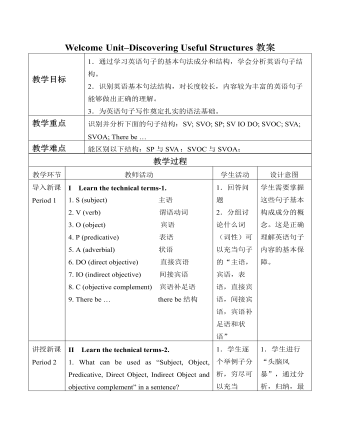
II Learn the technical terms-2.1. What can be used as “Subject, Object, Predicative, Direct Object, Indirect Object and objective complement” in a sentence?2. What can be used as “adverbial” in a sentence?3. What can be used as “verb” in a sentence?Answers to questions 1-3:1. Nouns, pronouns and appellations can be used as “Subject, Object, Predicative, Direct Object, Indirect Object and Objective Complement”. Besides, adjectives can be used as “Predicative and Objective Complement” in a sentence.2. Adverbs and prepositional phrases can be used as “Adverbial”.3. Verbs with actual meaning can be used as “Verb” in a sentence. Auxiliary verbs alone cannot be used as “Verb” in a sentence.III Learn to recognize the sentence structures.1. SV structure. For Example:(1) A bird flies.S V(2) A monkey jumps.S V(3) A fish swims.S V√ In SV structures, verbs are “intransitive verbs”.2. SVO structure. For Example:(1) A sheep eats grass.S V O(2) They like bananas.S V O(3) He wants candy.S V O√ In SVO structures, verbs are “transitive verbs”.3. SP structure. For Example:(1) This is great.S P (2) He looks well.S P (3) She became a teacher.S P √ In SP structures, Predicatives are formed by “link verbs” and “adjectives or nouns”.√ link verbs: be, become, grow, look, feel, taste, etc.4. SV IO DO structure. For Example:(1) He asked me a question.S V IO DO(2) Danny wrote me a letter.S V IO DO(3) Billy brought Sam a kite.S V IO DO√ In SV IO DO structures, the verbs are transitive and are followed by two objectives – pronouns or nouns as Indirect Objective, and nouns as Direct Objectives.
新人教版高中英语必修1Unit 4 Natural Disasters-Reading & Thinking教案
5. Read to get detailed information about Paragraph 5.Q1. What shows the revival of Tangshan?Q2. How can Tangshan revive itself and get up on its feet again?Q3. In times of disasters, how can we go through it?T: In times of disasters, we should unify, show the wisdom and stay positive.Step 4 Activity 4 Highlighting the theme and reflecting1. Make a summary of the text.2. Further understand the titleQ: After our learning, why do you think the earth didn’t sleep on that night?T: An earthquake happened. The people in the earthquake suffered a lot, and the people outside Tangshan were concerned about the people there a lot.3. Reflect through discussion on what can be learnt after reading.T: Disasters are powerful. Unpreparedness can be deadly. Life is weak, but if people work together to help each other, disasters can be defeated.There is no love from disaster, but we have love in the human heart.Step 5 Assignment How does the writer convey that the earthquake was deadly, and that people were helpless during the earthquake? Try to find some attractive and impressive expressions and note them down.
新人教版高中英语必修1Unit 5 Languages Around the World-Reading and Thinking教案
【教材分析】本节课是高中英语第一册的最后一个单元的阅读和思考部分,文章难度明显增加,体现在以下几个方面:文章题材是说明文,比较难理解;话题生疏,涉及到历史等知识;生词量增大,而且在语境中理解词汇的要求提高。面对这些,教师的难度和高度也要有所提升,通过探讨说明顺序,了解背景知识等帮助他们找到说明文阅读的方法。【教学目标与核心素养】1. 文化意识目标新课程中指出,文化意识是对中外文化的理解和对优秀文化的认同。文化意识的的培养有助于学生增加国家认同和家国情怀,成为有文明素养和社会责任感的人。我们这个单元很好体现了这一点,通过了解汉字书写的体系和发展,学生可以有一种文化自豪感,同时也能够帮助学生深入挖掘这篇文章,从而想到更多和中国文化相关的方面。2. 学习能力目标
新人教版高中英语必修1Welcome Unit-Reading for Writing教案
教学目标知识目标:让学生更好理解如何恰当地写一个人的信息介绍,并能让学生熟练地使用一些写作技能。能力目标:培养学生的写作能力和团队协作能力。情感目标:提升学生对写作的兴趣。教学重难点 教学重点:如何能让学生更好地理解个人信息介绍。教学难点:如何能让学生通过适当地使用一些写作技能来写一篇较好的个人信息介绍。教学准备 多媒体、黑板、粉笔一、Pre-class1. Greetings2. Leading-inAsk students how to write a profile. What kinds of aspects should be included? The teacher asks students to discuss the topic with each other and put forward to much more ideas about the answer.二、While-class1. The teacher lets students to read the student profiles on Page 8 silently and then asks students to discuss the questions below.1. What is Ann like? How do you know?2. What are Thando’s hobbies?3. Where does Thando come from?4. What is Thando’s dream?5. What does “You will never see me without a book or a pen” mean?
新人教版高中英语必修2Unit 1 Cultural Heritage-Discovering Useful Structure教案二
This theme of the part is “ Describe people or things in greater detail”. Students have learned the grammar(restrictive relative clauses) in Book 1, and further review and consolidate its structure “prep+relative pronouns(which/whom)” and the relative adverbs(when, where and why), besides students should understand its form, meaning and functions. In this section, students should be able to express the grammar correctly in daily communication and in the writing. 1. Review the basic usages of relative pronouns and adverbs of attributive clauses . 2. Learn to use some special cases about restrictive relative clauses.3. Learn to write sentences with restrictive relative clauses flexibly according to the context.1. Review the basic usages of relative pronouns and adverbs of attributive clauses .2. Learn to use some special cases about restrictive relative clauses.3. Learn tow rite sentences with restrictive relative clauses flexibly according to the context.Step 1. Observe the following sentences, and mark the relative pronouns and the adverbs. 1. After listening to the scientists who had studied the problems, and citizens who lived near the dam, the government turned to the United Nations for help.2. Temples and other cultural sites were taken down piece by piece, and then moved and put back together again in a place where they were safe from the water.Step 2 PracticePlease complete these sentences with relative pronouns and relative adverbs and answer the following questions.Questions: 1. What is the head noun ?2. What relative words should be used ?3. What elements do they act in these sentences ?
新人教版高中英语必修2Unit 1 Cultural Heritage-Listening&Speaking&Talking教案
Listening and Speaking introduces the topic of “Take part in a youth project”. The listening text is an interview about an international youth cultural heritage protection project. More than 20 high school students from seven countries participated in the project. The reporter interviewed two participants Stephanie and Liu Bin. By listening to the text, students can understand the significance of cultural heritage protection, and teenagers can use their knowledge, combine their own interests and advantages, etc. to participate in the action of cultural heritage protection. Listening and Talking introduces the theme of "Talk about history and culture". The listening text is a dialogue between two tourists and tour guides when they visit the Kremlin, red square and surrounding buildings. The dialogue focuses on the functional items of "starting a conversation", which is used to politely and appropriately attract the attention of the others, so as to smoothly start a conversation or start a new topic. The purpose of this section is to guide students to understand the history and current situation of Chinese and foreign cultural heritage in their own tourism experiences or from other people's tourism experiences, explore the historical and cultural values, and be able to express accurately and appropriately in oral communication.1. Guide students to understand the content of listening texts in terms of the whole and key details; 2. Cultivate students' ability to guess the meaning of words in listening; discuss with their peers how to participate in cultural heritage protection activities.3. Instruct students to use functional sentences of the dialogue such as “I beg your pardon, but…” “Forgive me for asking, but…" and so on to start the conversation more politely and appropriately.