-
人教版高中地理必修2城市内部空间结构教案
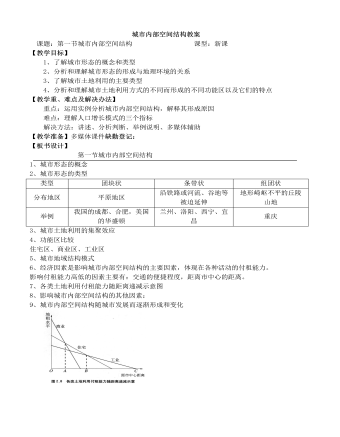
过渡:在实际生活中,城市内部空间结构并非完全按照这一经济规律呈现,而是更具复杂性。这说明除了经济因素外,还有很多其他因素在起作用,请大家结合你的认识、图2.9和案例1:纽约市的少数民族区谈谈你的看法。(2)其他因素I收入——形成不同级别住宅区的常见原因。有能力支付昂贵租金和选择最佳居住环境的人,其居住地往往形成高级住宅区。II知名度——城市内某些地区在历史、文化或经济方面具有很高的声誉,这往往会吸引更多新的住宅或商场建在该处,以提高其知名度。III种族聚居区的形成——在有些城市的某一区域内,如果某个种族或宗教团体占优势,就可能形成种族聚居区。如纽约市的唐人街、哈林区、小意大利区等。IV历史因素——城市的建筑物和街道设计可以维持久远,早期的土地利用方式对日后的功能分区有着深远的影响。
新人教版高中英语必修1Unit 2 Travelling Around–Listening and Speaking教案
无论她说什么都不会对我们的安排有影响。Answers: for, arrangement3) Parents arrange everything for their children and spare no effort to pave the way for their success.父母为孩子安排好一切,不遗余力地为他们的成功铺路。4. extremely adv 极其,非常extreme adj 非常的1) Mary found it extremely difficult to get a job.2) I’m extremely sorry to have troubled you.Answers:玛丽发现找工作极其困难。给你添了麻烦,我十分抱歉。3) It had white-painted tunnels and bright red carriages, and proved _________ (extreme) popular with the public.它有白色的隧道和明亮的红色车厢,结果证明它非常受大众的欢迎。Answers: extremelyExercises1. I am continuing to apply_______ jobs though I have failed several times.2. All this had an _______ (extremely) bad effect on the criminal justice system.3. The invention would have wide ______ (apply) in industry.4. She’s happy with her unusual living _________ (arrange).5. I was banging so loudly that I’m ___________ (amaze) that they didn’t hear me.6. You haven’t changed at all you still look ___________ (exact) the same.7. “Was it what you expected?” “Yes, _________ (definite).”8. He was looking forward to______ (work) with the newPrime Minister. Answers: for extreme application arrangement amazed exactly definitely looking单句写作:1. _______________ (你要说些什么) when you get on the platform to accept the reward?2. Since_____________________(我们为这些事情做好了准备), we have nothing to worry about.
新人教版高中英语必修1Unit 2 Travelling Around-Reading and Thinking教案
Good expressions that students can choose to use: help the travelers choose which tour to take1. In my opinion, you could/might choose…, because you prefer to…2. …could be a perfect choice for you, for…3. As far as I am concerned, you would enjoy…, for…4. …would probably suit you, because you enjoy/love/hate doing…Step 5 Passage ConsolidationLanguage appreciation:1. You can then spend three days exploring the rainforest with a local guide and enjoying the plants and animals unique to the rainforest. 在接下来的三天里,您可以在当地导游的陪同下,深入雨林进行探索,欣赏雨林特有的动植物。本句主体结构为spend some time doing sth. 2. Inca builders cut stones to exact sizes so that nothing was needed to hold walls together other than the perfect fit of the stones. 印加的建筑工人将石头切割成精确的尺寸,仅仅凭着石头间的完美契合,即可稳固墙体。本句为so that引导的结果状语从句。nothing与the perfect fit为并列成分; other than在句中意为“除了”。Step 6 HomeworkSuppose you will travel to Peru, write a short essay about your three-day tour plan.
新人教版高中英语必修2Unit 1 Cultural Heritage-Listening&Speaking&Talking教案
Listening and Speaking introduces the topic of “Take part in a youth project”. The listening text is an interview about an international youth cultural heritage protection project. More than 20 high school students from seven countries participated in the project. The reporter interviewed two participants Stephanie and Liu Bin. By listening to the text, students can understand the significance of cultural heritage protection, and teenagers can use their knowledge, combine their own interests and advantages, etc. to participate in the action of cultural heritage protection. Listening and Talking introduces the theme of "Talk about history and culture". The listening text is a dialogue between two tourists and tour guides when they visit the Kremlin, red square and surrounding buildings. The dialogue focuses on the functional items of "starting a conversation", which is used to politely and appropriately attract the attention of the others, so as to smoothly start a conversation or start a new topic. The purpose of this section is to guide students to understand the history and current situation of Chinese and foreign cultural heritage in their own tourism experiences or from other people's tourism experiences, explore the historical and cultural values, and be able to express accurately and appropriately in oral communication.1. Guide students to understand the content of listening texts in terms of the whole and key details; 2. Cultivate students' ability to guess the meaning of words in listening; discuss with their peers how to participate in cultural heritage protection activities.3. Instruct students to use functional sentences of the dialogue such as “I beg your pardon, but…” “Forgive me for asking, but…" and so on to start the conversation more politely and appropriately.
新人教版高中英语必修2Unit 4 History and Traditions-Listening&Speaking&Talking教案一
This unit is about history and traditions. From the opening page, we can know that this unit will introduce the history and traditions around the world. As Marcus Garvey says “A people without the knowledge of their past history, origin and culture is like a tree without roots”, it is important for students to realize the importance and value of knowing the history and traditions and their further meanings. And this part ( listening and speaking ) is divided into two parts: Part A---share views on historic sites, Part B ---talk about a visit to a historic tourist destination. By talking with a foreigner, the speakers introduce the historic attractions and their cultures. Part A is that William, a British student, who was going to visit the Confucius Temple and a Chinese student, Xiao Kong, who was going to the Confucius Temple to meet with the members of the research group, went together and exchanged their views on the Confucius Temple, Confucius, Confucius' descendants and Confucius' educational thoughts. Part B is a conversation between Xiao Yan, a youth hostel receptionist and Paul, a backpacker about the feelings and experience after visiting the Chinese famous tourist attraction Pingyao.1. Guide students to understand the content of listening texts in terms of the whole and key details; 2. Cultivate students' ability to guess the meaning of words in listening; discuss with their peers how to talk about historic spots and great person.3. Instruct students to use functional sentences of showing one’s excitement, surprise and disappointment.1. Guide students to understand the content of listening texts in terms of the whole and key details; 2. Cultivate students' ability to discuss with their peers the related topics.3. Enable students to use the functional items of showing one’s excitement, surprise and disappointment.
新人教版高中英语必修2Unit 4 History and Traditions-Discovering Useful Structure教案二
This teaching period mainly deals with grammar: The past participle is used as attributive and objective complement.1. Guide students to review the basic usages of the past participle used as attributive and objective complement.2. Lead students to learn to use some special cases concerning the past participle used as attributive and objective complement flexibly.3. Strengthen students’ great interest in grammar learning.1. Help students to appreciate the function of the past participle used as attributive and objective complement.2. Instruct students to write essays using the past participle used as attributive and objective complement.Step1:温故而知新。Analyze the underlined phrases and then sum up the common usages of the past participles.1.(教材P41)They had castles built(build) all around England, and made changes to the legal system.2.(教材P42)They use the same flag, known(know) as the Union Jack,...3.(教材P42)Judy and I had our car parked(park) in an underground car park near Trafalgar Square, where we could get our car battery charged(charge).Common points: f the past participle used as attributive and objective complement.Step 2:过去分词作定语时的意义1.及物动词的过去分词作定语,在语态上表示被动;在时间上,常表示动作已经发生或完成,有时也不表示时间性。Our teacher watched us doing the experiment and gave us a satisfied smile at last.我们的老师看着我们做实验,最后给了我们一个满意的微笑。The plan put forward at the meeting will be carried out soon.会上提出的计划将很快被执行。2.不及物动词的过去分词作定语,它不表示被动意义,只强调动作完成。Many little kids like gathering fallen leaves in the yard.
新人教版高中英语必修2Unit 4 History and Traditions-Listening&Speaking&Talking教案二
Listening and Speaking introduces the topic of “Take part in a youth project”. The listening text is an interview about "sharing views on historical sites". Through listening to a dialogue between Chinese and foreign students on the way to the Confucius Temple, students can understand their views on the Confucius Temple, Confucius, Confucius' descendants and Confucius' educational thoughts, so as to realize and think about the profound influence of Confucius and his thoughts on Chinese historical tradition. At the same time, the dialogue naturally integrates English idioms and mentions Shakespeare, the British playwright, so as to provide language materials and context for students to understand English idioms and related cultural allusions, as well as to compare Chinese and foreign cultures, which is helpful for students to understand and express the language such as history, tradition, culture and custom significant impact.Text analysis: listening text is a dialogue between a British student and a Chinese student when he goes to the Confucius Temple. When William, a British student, visited the Confucius Temple, he asked Xiao Kong, a Chinese student, for directions. Xiao Kong was just going to the Confucius Temple to meet with the members of the research group, so they went together and exchanged their views on the Confucius Temple, Confucius, Confucius' descendants and Confucius' educational thoughts. From the perspective of foreign tourists, this paper describes their thoughts on Confucius, the great son of Confucius, who had a profound impact on Chinese history and cultural tradition, and his education.Listening and Talking introduces a visit to a historic tourist destination. Tourism is a common way to understand a country's history, culture, and customs and so on. Students listen to the dialogue between Xiao Yan, a youth hostel Usher, and Paul, a backpacker, to learn about Pingyao's famous historical and cultural attractions and Paul's travel experience and experience as a foreign tourist.
新人教版高中英语必修2Unit 5 Music-Discovering Useful Structures教案二
4. When he got absorbed in his world of music, he felt as if he could “see” the beauty of the world around him, like he had in his previous life.P·P as adverbial: _________________________________________________________________.Function: _______________________________________________________________________.Step 5 Solid Complete the passage with the words in brackets in their correct forms.Well known as a successful band, the Impact members show quite a few striking qualities. They never ever give up. When _____________(question) by the media, they are not _____________(discourage) and practise even harder. They are improving themselves by attending several master training class. They are united. _____________(fill with) team spirit, they act as a whole, always aiming for glory. Step 6 Difference and similarity from -ingObserve the following examples.1. He went out, shutting the door behind him.=He went out, ________________________________________________________.2. Not knowing what to do, he went to his parents for help.=__________________________________________, he went to his parents for help.Similarity: _______________________________________________________________________________________________________________________________________________________.Difference : _______________________________________________________________________________________________________________________________________________________.Step Practice1. ________ in a hurry, this article was not so good. 因为写得匆忙, 这篇文章不是很好。2. ________ carefully, he found something he hadn’t known before. 他仔细读书时, 发现了一些从前不知道的东西。3. ________ why he did it, the monitor said it was his duty. 当被问及他为什么要这么做时, 班长说这是他的职责
新人教版高中英语必修2Unit 5 Music-Listening&Speaking&Talking教案
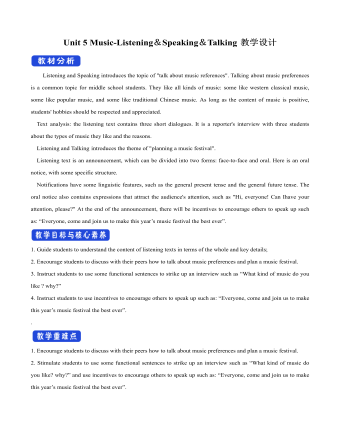
choir memberspeople to run food stands people to sell festival ticketspeople to sell music CDspeople to set up equipmentmusical performersStep 2: Listen to the announcement again and answer the questions. ? 1. What kind of songs will Grace Davis sing at the festival?? 2. Who can try out as a performer?? 3. What can those who think they do not have musical talent do?? 4. How can students volunteer to take part?? Talking about preferences:? Would you prefer doing ..?? What would you prefer to do?? Would you rather do .... or ….?? What would you rather do?? I'd prefer .... to ..? I'd rather have ... than .. Step 3: Speaking ProjectWork in groups. Role-play the conversation or make a new one.? Debbie: Where have you been? You missed the announcement about the music festival.? John: I was at the doctor's office. Music festival?? Frank: Yes, it's going to be next month on the school sports field. John, you can play the piano. How about playing it at the festival?? John: Well, I'd rather play the violin. I can play Liang Zhu.? Frank: Wow! Sounds good. What about you, Debbie? ? Debbie: Actually, I don't have much musical ability. I'd prefer just to help out with the crowds.? Frank: You can sell tickets or work at a food stand.? John: So can I assume that the aim of the festival is to raise money?? Debbie: Yes. All of the money will go to charity.
新人教版高中英语必修2Unit 5 Music-Listening and Speaking教案
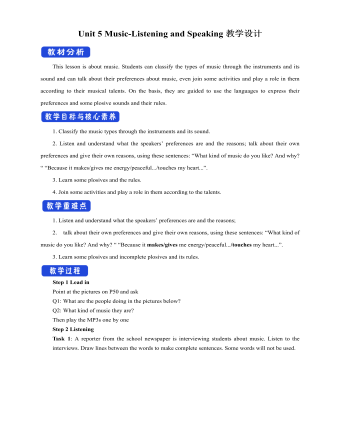
This lesson is about music. Students can classify the types of music through the instruments and its sound and can talk about their preferences about music, even join some activities and play a role in them according to their musical talents. On the basis, they are guided to use the languages to express their preferences and some plosive sounds and their rules.1. Classify the music types through the instruments and its sound.2. Listen and understand what the speakers’ preferences are and the reasons; talk about their own preferences and give their own reasons, using these sentences: “What kind of music do you like? And why? “ “Because it makes/gives me energy/peaceful.../touches my heart...”.3. Learn some plosives and the rules.4. Join some activities and play a role in them according to the talents. 1. Listen and understand what the speakers’ preferences are and the reasons;2. talk about their own preferences and give their own reasons, using these sentences: “What kind of music do you like? And why? “ “Because it makes/gives me energy/peaceful.../touches my heart...”.3. Learn some plosives and incomplete plosives and its rules.Step 1 Lead inPoint at the pictures on P50 and ask Q1: What are the people doing in the pictures below?Q2: What kind of music they are?Then play the MP3s one by oneStep 2 ListeningTask 1: A reporter from the school newspaper is interviewing students about music. Listen to the interviews. Draw lines between the words to make complete sentences. Some words will not be used.
新人教版高中英语必修2Unit 5 Music-Reading and Thinking教案一
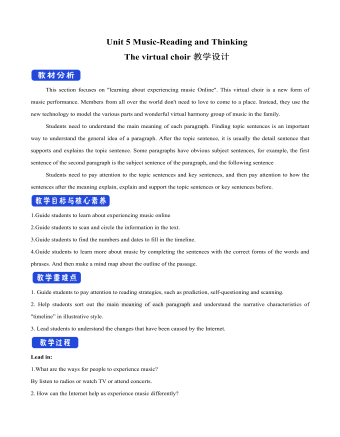
This section focuses on "learning about experiencing music Online". This virtual choir is a new form of music performance. Members from all over the world don't need to love to come to a place. Instead, they use the new technology to model the various parts and wonderful virtual harmony group of music in the family. Students need to understand the main meaning of each paragraph. Finding topic sentences is an important way to understand the general idea of a paragraph. After the topic sentence, it is usually the detail sentence that supports and explains the topic sentence. Some paragraphs have obvious subject sentences, for example, the first sentence of the second paragraph is the subject sentence of the paragraph, and the following sentenceStudents need to pay attention to the topic sentences and key sentences, and then pay attention to how the sentences after the meaning explain, explain and support the topic sentences or key sentences before.1.Guide students to learn about experiencing music online2.Guide students to scan and circle the information in the text.3.Guide students to find the numbers and dates to fill in the timeline.4.Guide students to learn more about music by completing the sentences with the correct forms of the words and phrases. And then make a mind map about the outline of the passage.1. Guide students to pay attention to reading strategies, such as prediction, self-questioning and scanning.2. Help students sort out the main meaning of each paragraph and understand the narrative characteristics of "timeline” in illustrative style.3. Lead students to understand the changes that have been caused by the Internet.
人教版高中地理必修2工业地域类型教案
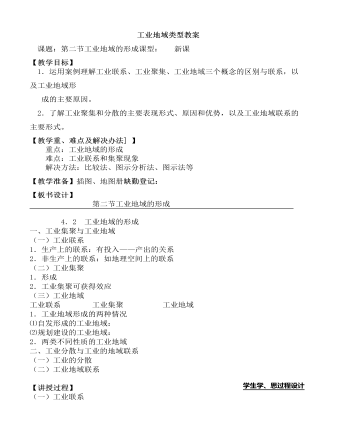
1.生产上的联系:有投入——产出的关系工业生产的过程复杂,工序繁多,往往需要经过多家工厂的加工才能完成一种产品的生产过程。因此,在这些工厂之间就存在着产品与原料的联系。一家工厂生产的产品是另一家工厂的原料,这两家工厂之间就形成了工序上的工业联系。2.非生产上的联系:如地理空间上的联系布局在同一个工业区内,共同利用工业区的道路、供水、供电、通信等基础设施以及其他生产、生活服务设施,或者共同利用当地廉价的劳动力,形成了空间利用上的工业联系。我国许多地方的经济技术开发区就是建立在这种工业联系基础上的。(二)工业集聚1.形成具有工业联系的一些工厂往往近距离地聚集起来,形成工业集聚现象。2.工业集聚可获得效应(1)工业集聚可以加强企业间的信息交流和技术协作,降低中间产品的运输费用和能源消耗,进而降低生产成本,提高生产效率和利润,取得规模效益。
人教版高中语文必修4《短文三篇》教案
③于是,大自然出现了惊人的奇迹,不毛的石缝间丛生出倔强的生命。④或者就只是一簇一簇无名的野草,春绿秋黄。岁岁枯荣。它们只有三两片长长的细瘦的薄叶,那细微的叶脉,告知你生存该是多么艰难;更有的。它们就在一簇一簇瘦叶下自己生长出根须,只为了少向母体吮吸一点乳汁,便自去寻找那不易被觉察到的石缝。这就是生命,如果这是一种本能,那么它正说明生命的本能是多么尊贵,生命有权自认为辉煌壮丽,生机竟是这样地不可扼制。⑤或者就是一团一团小小的山花,大多又都是那苦苦的蒲公英。它们不似田野上的同宗长得那样茁壮,它们的茎显得坚韧而苍老。它们的叶因枯萎而失却光泽。它们已经不能再去为人们作佐餐的鲜嫩的野菜,却默默地为攀登山路的人准备了一个可靠的抓手。生命就这样地被环境规定着,又被环境改变着,适者生存的规律尽管无情。但一切适者就是战胜环境的强者。生命现象告诉你,生命就是拼搏。
人教版高中政治必修1第二课多变的价格教案
(四)反思总结,当堂检测。本节内容讲述了价格变动对人们生活、生产的影响作用,主要知识框架如下:(1)、价格变动会影响人们的消费需求,商品价格上涨,人需求就减少,反之,则增大。价格变动对不同商品需求影响程度是不一样的,对生活必需品的需求量影响较小,对高档耐用品的需求量影响较大。相关商品价格变动对消费需求的影响不同,某种商品价格上涨,就会减少需求量,其替代品需求量增加,其互补品需求量则减少。(2)、价格变化也会影响生产经营,价格变动会调节生产,刺激生产者改进技术,提高劳动生产率,促使生产者生产适销对路的高 质量产品。(五)发导学案、布置预习。预习第三课第一框《消费及其类型》,完成预习导学案练习题九、板书设计《价格变动的影响》1、对人们生活的影响(1)商品价格变动与消费需求量之间的关系(2)不同商品的需求量对价格变动的反应程度不同
人教版高中政治必修1第三课多彩的消费教案
二、做理智的消费者1、量入为出,适度消费2、避免盲从,理性消费3、保护环境,绿色消费4、勤俭节约,艰苦奋斗十、教学反思本课的设计采用了课前下发预习学案,学生预习本节内容,找出自己迷惑的地方。课堂上师生主要解决重点、难点、疑点、考点、探究点以及学生学习过程中易忘、易混点等,最后进行当堂检测,课后进行延伸拓展,以达到提高课堂效率的目的。这节课我们主要学习了影响人们消费的几种消费心理和几种科学的消费观。本节课与学生生活十分贴近所以这节课充分的调动了学生学习的兴趣和积极性,并且让学生针对案例进行充分的分组讨论分析,通过学生的展示分析和补充可以知道学生们不但深层次分析了教学原理也透彻理解了教学重难点大大提高了课堂效率.。通过案例的分析进一步领会了教材原理突破了本节课的难点——树立正确的消费观。整堂课学生求知旺盛,复杂的知识变得简单化,从阅读教材到独立思考分析再到合作讨论最后的展示质疑答疑,加深了印象,提高了能力。
人教版高中政治必修1第一课神奇的货币教案
1、外汇与外币的关系:(1)外汇包括外币,但外汇不等于就是外币。外币是指外国的货币,包括外国的纸币、铸币;外汇通常是以外国货币表示的用于国际间结算的支付手段,具体包括外币、外币有价证券、外币支付凭证等。(2)外币属于外汇的范围,但不能把二者等同起来。通常情况下,只有可以自由兑换的外币才是外汇,因为外汇的实质是国际支付手段,如果某种货币不能自由兑换,它就不能成为国际支付手段。外汇执行的 主要是货币的支付手段的职能。(3)持有外汇意味着对外汇发行国拥有债权。持有外汇过多,一方面意味着国际支付能力强和有可能对外汇发行国施加影响;另一方面则意味着大量该由本国享受的资源,被借给外国利用,并要承担外汇贬值的风险。2、关于币值变化的分析:(1)对货币升值的具体分析:一个国家的货币升值(上浮)后,同量的这种货币能比以前换 取更多的他国货币,买到更多的他国商品。
人教版高中生物必修3第六章第一节《人口增长对生态环境的影响》说课稿
3、讨论问题二:我国、我市人口增长对环境有那些影响?教师:让第三、第四组学生分别介绍、展示课前调查到的资料,说明人口增长对我国环境的影响、对三亚市环境的影响。学生:第三组学生派代表介绍人口增长过快对我国生态环境的影响。第四小组由学生自己主持“我市人口增长过快对三亚市生态环境的影响”讨论会,汇报课前调查到的资料和讨论,其它小组参与发言。教师:投影:课本图6-2组织学生讨论、补充和完善。学生:观察老师投影图片并进行讨论,对图片问题进行补充和完善。教学意图:通过让学生汇报、观察、主持,能让学生亲身体验,更深刻地理解人口增长对生态环境的影响,培养和提高学生的表达能力、观察能力、主持会议的能力。4、讨论问题三:怎样协调人与环境的关系?教师:组织第五组学生进行汇报课前调查到的资料,交流、讨论、发表意见和见解。学生:展示课件、图片,汇报调查到的情况,提出合理建议。
人教版高中地理必修3地理信息技术在区域地理环境研究中的应用说课稿
通过列表对比法、归纳法、、多媒体辅助法等教学方法,突破理论性强、不宜理解的“3S”原理与区别的知识难点。学生更是学会运用图表方法、高效记忆法、合作学习法等方法学习地理知识,增加学习能力。[幻灯片] “3S技术”的应用:地理信息技术的应用十分广泛,从实际身旁的社会生产生活,到地理学的区域地理环境研究。学生的年龄和认知范围决定,此部分的案例教学的运用,前者容易接触到、简单直观、易区分掌握“3S”技术特点和具体应用。而后者涉及地理学科的综合性和区域性的特点,难度较大。针对学情特点,我多以前者案例入手学习,以后者案例加以补充。案例:遥感:(1)视频 专家解说卫星遥感受灾影象(2)教材 图1.6 1998年8月28日洞庭湖及荆江地区卫星遥感图像(3)视频 2008年5月13日“北京一号”卫星提供汶川的灾区遥感图像(4)教材 阅读 遥感在农业方面的应用
人教版高中政治必修2国际社会的主要成员-主权国家和国际组织说课稿
【教师总结:联合国的会徽的世界地图象征着联合国是一个世界性的国际组织;图案中得橄榄枝象征着和平。联合国采取了很多措施以实现它的宗旨,如对于朝鲜违反国际法规进行核试验,联合国给予警告和制裁,充分体现了它维护国际和平与安全,促进国际合作与发展的宗旨。】对于中国与联合国的关系这部分内容,我将请阅读教材92页几幅图片及材料内容,设置活动探究课中国在联合国的声音和身影,请合作讨论思考以下两个问题,中国与联合国的关系;列举事实说明中国在国际社会中的重要作用。 教师通过剖析中国在联合国的地位和作用,引导学生理解中国在国际社会中发挥着重要作用,是负责任的国家;同时培养学生综合运用知识分析说明问题的能力,使学生感受作为中国人的自豪。【教师总结:中国是联合国的创始国之一,中国作为联合国的创始国和安理会常任理事国之一,一贯遵循联合国宪章的宗旨和原则,积极参与联合国及其专门机构有利于世界和平和发展的活动。】
人教版新课标高中物理必修1匀变速直线运动的速度与时间的关系说课稿2篇
设计意图:几道例题及练习题,其中例1小车由静止启动开始行驶,以加速度 做匀加速运动,求2s后的速度大小?进而变式到:小车遇到红灯刹车……,充分体现了“从生活到物理,从物理到社会”的物理教学理念;例题及练习题由浅入深、由易到难、各有侧重,体现新课标提出的让不同的学生在物理上得到不同发展的教学理念。这一环节总的设计意图是反馈教学,内化知识。(6) 小结归纳,拓展深化我的理解是,小结归纳不应该仅仅是知识的简单罗列,而应该是优化认知结构,完善知识体系的一种有效手段,为充分发挥学生的主题作用,从学习的知识、方法、体验是那个方面进行归纳,我设计了这么三个问题:① 通过本节课的学习,你学会了哪些知识;② 通过本节课的学习,你最大的体验是什么;③ 通过本节课的学习,你掌握了哪些学习物理的方法?