-
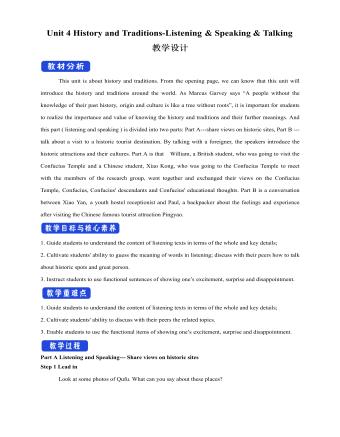
新人教版高中英语必修2Unit 4 History and Traditions-Listening&Speaking&Talking教案一
This unit is about history and traditions. From the opening page, we can know that this unit will introduce the history and traditions around the world. As Marcus Garvey says “A people without the knowledge of their past history, origin and culture is like a tree without roots”, it is important for students to realize the importance and value of knowing the history and traditions and their further meanings. And this part ( listening and speaking ) is divided into two parts: Part A---share views on historic sites, Part B ---talk about a visit to a historic tourist destination. By talking with a foreigner, the speakers introduce the historic attractions and their cultures. Part A is that William, a British student, who was going to visit the Confucius Temple and a Chinese student, Xiao Kong, who was going to the Confucius Temple to meet with the members of the research group, went together and exchanged their views on the Confucius Temple, Confucius, Confucius' descendants and Confucius' educational thoughts. Part B is a conversation between Xiao Yan, a youth hostel receptionist and Paul, a backpacker about the feelings and experience after visiting the Chinese famous tourist attraction Pingyao.1. Guide students to understand the content of listening texts in terms of the whole and key details; 2. Cultivate students' ability to guess the meaning of words in listening; discuss with their peers how to talk about historic spots and great person.3. Instruct students to use functional sentences of showing one’s excitement, surprise and disappointment.1. Guide students to understand the content of listening texts in terms of the whole and key details; 2. Cultivate students' ability to discuss with their peers the related topics.3. Enable students to use the functional items of showing one’s excitement, surprise and disappointment.
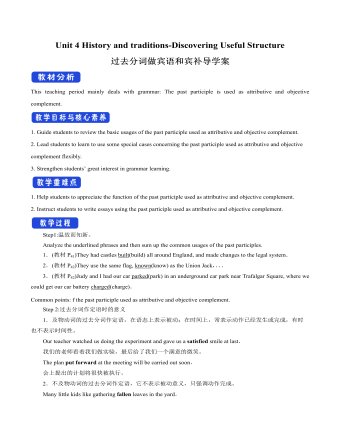
新人教版高中英语必修2Unit 4 History and Traditions-Discovering Useful Structure教案二
This teaching period mainly deals with grammar: The past participle is used as attributive and objective complement.1. Guide students to review the basic usages of the past participle used as attributive and objective complement.2. Lead students to learn to use some special cases concerning the past participle used as attributive and objective complement flexibly.3. Strengthen students’ great interest in grammar learning.1. Help students to appreciate the function of the past participle used as attributive and objective complement.2. Instruct students to write essays using the past participle used as attributive and objective complement.Step1:温故而知新。Analyze the underlined phrases and then sum up the common usages of the past participles.1.(教材P41)They had castles built(build) all around England, and made changes to the legal system.2.(教材P42)They use the same flag, known(know) as the Union Jack,...3.(教材P42)Judy and I had our car parked(park) in an underground car park near Trafalgar Square, where we could get our car battery charged(charge).Common points: f the past participle used as attributive and objective complement.Step 2:过去分词作定语时的意义1.及物动词的过去分词作定语,在语态上表示被动;在时间上,常表示动作已经发生或完成,有时也不表示时间性。Our teacher watched us doing the experiment and gave us a satisfied smile at last.我们的老师看着我们做实验,最后给了我们一个满意的微笑。The plan put forward at the meeting will be carried out soon.会上提出的计划将很快被执行。2.不及物动词的过去分词作定语,它不表示被动意义,只强调动作完成。Many little kids like gathering fallen leaves in the yard.
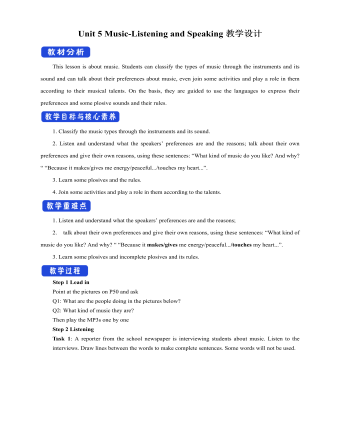
新人教版高中英语必修2Unit 5 Music-Listening and Speaking教案
This lesson is about music. Students can classify the types of music through the instruments and its sound and can talk about their preferences about music, even join some activities and play a role in them according to their musical talents. On the basis, they are guided to use the languages to express their preferences and some plosive sounds and their rules.1. Classify the music types through the instruments and its sound.2. Listen and understand what the speakers’ preferences are and the reasons; talk about their own preferences and give their own reasons, using these sentences: “What kind of music do you like? And why? “ “Because it makes/gives me energy/peaceful.../touches my heart...”.3. Learn some plosives and the rules.4. Join some activities and play a role in them according to the talents. 1. Listen and understand what the speakers’ preferences are and the reasons;2. talk about their own preferences and give their own reasons, using these sentences: “What kind of music do you like? And why? “ “Because it makes/gives me energy/peaceful.../touches my heart...”.3. Learn some plosives and incomplete plosives and its rules.Step 1 Lead inPoint at the pictures on P50 and ask Q1: What are the people doing in the pictures below?Q2: What kind of music they are?Then play the MP3s one by oneStep 2 ListeningTask 1: A reporter from the school newspaper is interviewing students about music. Listen to the interviews. Draw lines between the words to make complete sentences. Some words will not be used.
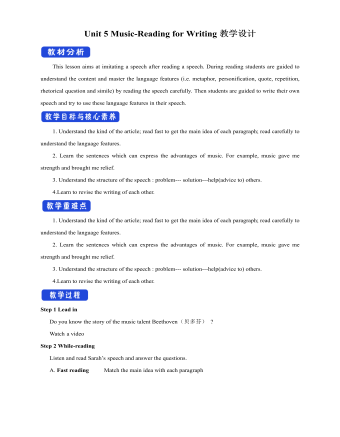
新人教版高中英语必修2Unit 5 Music-Reading for Writing教案二
The Internet celebrity Gao Yifeng. Years ago, he owned 5 companies and the staffs over 1,000, but during the economy crisis, he became nothing but debt. He was so worried that his hair became white overnight. There was a time when he wanted to killed himself. But after listening to the song Start Over by Liu Huan, he decided to cheer himself up. He started a steamed bun shop and gradually became a national chain shops. Now he became successful again.Walter Haddon said, “Music is the medicine of a troubled mind.” Music contains such a pleasant and inspiring force. Music gave him courage and bravery. When he listened to the song, it made his spirit fly like a kite in the wind. Music gave him strength and brought him relief. It was the rock I leant on to become strong and to get through those hard times. I hope none of us have to go through the same kind of suffering that he did. At the same time, we all go through various periods when we feel sad or alone. During those times, music can help us in the same way that it helped him. I hope we all will somehow begin to treasure music and make it a part of our life. Thank you for your listening !5.Revise your writing each other.Does he/she explain how music has changed his/her/someone else’s life?Are some of the rhetorical devices included and used properly ?Does he/she talk about how music makes him/her/someone feel?Is the first word in each sentences capitalised?Does he/she use correct punctuation ?
新人教版高中英语必修2Unit 1 Cultural Heritage-Discovering Useful Structure教案二
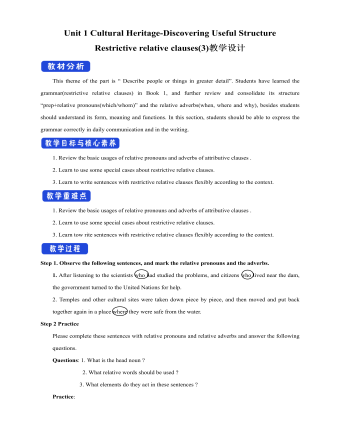
This theme of the part is “ Describe people or things in greater detail”. Students have learned the grammar(restrictive relative clauses) in Book 1, and further review and consolidate its structure “prep+relative pronouns(which/whom)” and the relative adverbs(when, where and why), besides students should understand its form, meaning and functions. In this section, students should be able to express the grammar correctly in daily communication and in the writing. 1. Review the basic usages of relative pronouns and adverbs of attributive clauses . 2. Learn to use some special cases about restrictive relative clauses.3. Learn to write sentences with restrictive relative clauses flexibly according to the context.1. Review the basic usages of relative pronouns and adverbs of attributive clauses .2. Learn to use some special cases about restrictive relative clauses.3. Learn tow rite sentences with restrictive relative clauses flexibly according to the context.Step 1. Observe the following sentences, and mark the relative pronouns and the adverbs. 1. After listening to the scientists who had studied the problems, and citizens who lived near the dam, the government turned to the United Nations for help.2. Temples and other cultural sites were taken down piece by piece, and then moved and put back together again in a place where they were safe from the water.Step 2 PracticePlease complete these sentences with relative pronouns and relative adverbs and answer the following questions.Questions: 1. What is the head noun ?2. What relative words should be used ?3. What elements do they act in these sentences ?
新人教版高中英语必修2Unit 5 Music-Reading and Thinking教案一
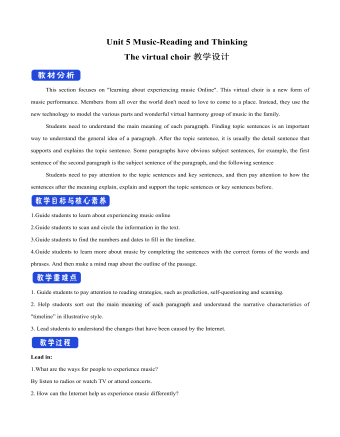
This section focuses on "learning about experiencing music Online". This virtual choir is a new form of music performance. Members from all over the world don't need to love to come to a place. Instead, they use the new technology to model the various parts and wonderful virtual harmony group of music in the family. Students need to understand the main meaning of each paragraph. Finding topic sentences is an important way to understand the general idea of a paragraph. After the topic sentence, it is usually the detail sentence that supports and explains the topic sentence. Some paragraphs have obvious subject sentences, for example, the first sentence of the second paragraph is the subject sentence of the paragraph, and the following sentenceStudents need to pay attention to the topic sentences and key sentences, and then pay attention to how the sentences after the meaning explain, explain and support the topic sentences or key sentences before.1.Guide students to learn about experiencing music online2.Guide students to scan and circle the information in the text.3.Guide students to find the numbers and dates to fill in the timeline.4.Guide students to learn more about music by completing the sentences with the correct forms of the words and phrases. And then make a mind map about the outline of the passage.1. Guide students to pay attention to reading strategies, such as prediction, self-questioning and scanning.2. Help students sort out the main meaning of each paragraph and understand the narrative characteristics of "timeline” in illustrative style.3. Lead students to understand the changes that have been caused by the Internet.
人教版高中语文必修5《咬文嚼字》教案
【教学过程】第一课时一、导入新课清代唐彪在《读书作文谱》中引用武叔卿的话说:“文章有一笔写成不加点缀而工者,此神到之文,尚矣。其次须精思细改,如文章草创已定,便从头至尾—一标点。”同学们能列举出文学史上的作家哪些属于前者,哪些属于后者吗?前者有李白。后者如贾岛、王安石、欧阳修、曹雪芹等。(贾岛有关于推敲的典故。王安石修改“春风又绿江南岸”句传为佳话。欧阳修《醉翁亭记》的开头便是精心改成的。《红楼梦》更是“披阅十载,增删五次。”)提问:古今的伟大作家为什么像李白式的诗人很少,而大多数人却都要“咬文嚼字”,苦苦修改呢?这节课我们就来研究一下这个问题。二、整体感知1.快速浏览全文,熟悉主要内容。2.根据“学习重点”,确立学习目标。三、课文分析1.理清观点与材料的关系。首先,让学生找出本文在论证中所运用的材料。
人教版高中语文必修5《林教头风雪山神庙》教案
②林冲无辜受害,被刺配到沧州,远离了京城,高俅一伙,陆谦、富安又追到沧州,在李小二的酒店里密谋陷害林冲。林冲从李小二那里听说了这件事之后是什么态度?表现出林冲的什么性格?明确:林冲听到李小二的报信,并确知从东京来的尴尬人就是陆虞候时,马上意识到“那泼贱贼”是要“来这里害我”,他识破了仇人的阴谋,激起了复仇的怒火,气愤地说:“休要撞着我,只叫他骨肉为泥!”说罢,便怒冲冲地“先去街上买把解腕尖刀,带在身上,前街后巷一地里去寻”,次日,“带了刀,又去沧州城里城外,小街夹巷,团团寻了一日”。这说明,当迫害逼到眼前时,林冲也具有了强烈的反抗意识。但是,“街上寻了三五日,不见消耗”时,“林冲也自心下慢了”,对仇人有所怀疑,却失去了应有的警惕性,刚刚点燃起来的复仇怒火又慢慢熄灭了。这说明林冲的反抗并不坚决,幻想得过且过,委曲求全。
人教版高中语文必修5《谈中国诗》教案
教师提示:1.这句话的本体不是一般意义上的“中国诗”,即不是指中国诗歌中的某一类作品或某位诗人的作品,而是指中国诗的发展特点。早熟,是指“纯粹的抒情诗的精髓和峰极,在中国诗里出现得异常之早”;早衰,是指“中国诗一蹴而至崇高的境界,以后就缺乏变化,而且逐渐腐化”(腐化,是对诗的思想内容和艺术价值而言的)。这句话,借助比喻和比喻中的对比(“早熟”与“早衰”),从诗歌发展的角度,简要地说明了中国诗的艺术特征和由此产生的负面影响。2.这句话有两层意思:一是借梵文的《百喻经》阐释中国的艺术和思想体构上的缺欠,旨在批评;二是点明造成这种缺欠的根本原因。“一个印度愚人要住三层楼而不许匠人造底下两层”这样的建筑物就是“飘飘凌云的空中楼阁”,作者以此作喻,批评中国的艺术和思想体构缺乏严密的逻辑性,往往脱离客观实际,没有坚实的基础,其结果必定影响艺术的健康、稳定地发展。
人教版高中语文必修1《荆轲刺秦王》教案
教学目标:1、知识与能力:①了解荆轲刺秦王的历史背景和过程,整体感知课文。②掌握文言文中重要的字、词、句解释,提高翻译能力。③学会从人物的对话、动作、神态描写入手,分析主要人物形象。2、情感与态度:正确看待荆轲刺秦王这一事件,学会历史而辩证地评价人物。重点难点:评价历史事件,分析人物形象。教学方法:朗读法、提问法、讨论法课时安排:三课时教学过程:第一课时一、导入:(课前展示雕塑照片)来到正定讲课,我感到非常高兴,一进县城,就被这里浓郁的历史文化气息所感染。我们住在华阳假日酒店,外面正在兴建文化广场,刚才的照片就是在那里拍摄的。在此,我进一步了解到正定这座文化古城悠久的历史渊源,这里有南越王赵佗,常胜将军赵云,一代名家颜真卿等等,可谓物华天宝、人杰地灵。因此我相信我们正定中学的同学们一定都非常优秀。这也让我更深刻地体会到一个道理:语文的外延就是生活的外延。
人教版高中语文必修1《别了,“不列颠尼亚”》教案
(“节马”:1841年1月7日,英国侵略者义律进攻虎门,沙田炮台副将陈连升率众浴血奋战,壮烈牺牲。其马“神骏”守护主人遗体,不屈敌之羁绊,不食敌之草料,不畏敌之鞭打刀刺,终不就范。“祖逖鞭”:祖逖,东晋名将,著名爱国将领,曾率军北伐,收复许多失地。此句大意为若要扬眉吐气,意气风发,仍需祖逖的这种精神。)八、本文反映的就是香港回归这一重大历史事件本文是一篇新闻特写。特写性消息,也称新闻速写、新闻素描,要求用类似电影“特写镜头”的手法来反映事实,是作者深入新闻事件现场,采写制作的一种新闻价值高、现场感较强、篇幅短小精粹的消息文体。特写性消息侧重于“再现”,往往采用文学手法,集中、突出地描述某一重大事件的发生现场,或某些重要和精彩的场面,生动、形象地将所报道的事实再现在读者面前。
人教版高中语文必修1《烛之武退秦师》教案
四、讲读第一段(10分钟)1.抽生朗读本段,注意生字词读音。2.讲析本段译释由学生完成,师只作扼要补纠和简要分析。分析内容包括伏笔手法和语句深意,全段作用。3.让学生齐读全段。4.处理练习一之中的第1小题,要求学生试译回答,然后指导学生背诵本段。五、讲读第二段(15分钟)1.抽生朗读本段,注意生字词读音。2.讲析本段①重点讲析三个文言词“若”、“之”、“辞”的用法和人物对话。②字词句的理解仍然注意发挥学生的能动性,让他们完成为主,师纠补为辅。对要求掌握的三个文言词的用法要板书列于黑板上,对话部分要让学生试作语气练习。③小结的内容包括情节的曲折性、写法的详略和表达的特点。3.生齐读本段,然后处理相关练习。
人教版高中语文必修4《李贺小传》教案
一、明确目标1.注意小传的写作特色,如小传的“小”以及是怎样小中见大的。2.引导学生进行综合把握和比较阅读以更好地理解课文内容,看看在写法上各自有什么不同。3.一词多义的准确知识运用二、整体感知1.解题李商隐的《李贺小传》有别于一般传记文的客观直叙,是一篇性情之文;同时也和作者的诗歌风格相异,写得朴实自然而又不乏意趣。2.本文所体现的“小传”的特点本文最大的特点在于:小传虽小,但小中有大、以小见大。其“小”在于:作者并没有全面勾勒诗人李贺的一生,对他的生平经历也记叙不多,而是选取了他生活中的若干小片段进行插叙,以小片段撑起传记的主干。此外,在篇幅上,全文寥寥数百字,语言极为精练。而其“大”又体现在:极小极短的篇幅却具有很大的容量,集叙事、议论和曲折的抒情于一体。内容浑厚,意味深长。
人教版高中语文必修5《陈情表》教案
【教学目标】1.熟读全文,掌握文中出现的重要的实词、虚词、古汉语句式;2.鉴赏本文融情于事的表达和形象精粹的语言;3.深入体会文章凄切婉转的陈情技巧。【教学重点】重要的古汉语语词知识【教学难点】理解作者当时的处境和李密祖孙间真挚深厚的感情【教学方法】作为教读课,选择串讲的方式,突出朗读,以期能做到既落实知识,又能体会文章之美。课时安排为两课时。要重点做好预习工作。【教学步骤】一、以苏轼的评论导入读《出师表》不下泪者,其人必不忠;读《陈情表》不下泪者,其人必不孝;读《祭十二郎文》不下泪者,其人必不友二、预习检测1、下列红色字注音完全正确的一项()A、臣以险衅(xìn)夙遭闵(mǐn)凶终鲜(xiǎn)兄弟常在床蓐(rù)B、猥(wěi)以微贱责臣逋(bǔ)慢犹蒙衿(jīn)育宠命优渥(wò)C、岂敢盘桓(huán)有所希冀(yì)日薄(bó)西山除臣洗(xiǎn)马D、逮(dǎi)奉圣朝过蒙拔擢(zhuó)门衰祚(zuò)薄更(gēng)相为命分析:B责臣逋(bū)慢,C有所希冀(jì),D逮(dài)奉圣朝。
人教版高中语文必修4《张衡传》教案
采用明段意分段法:先逐段概括段意,然后用合并同类项法把相关联紧缩密的自然段合在一起。全文五个自然段中,二、三、四自然段讲的都是张衡取得的科学成就,自然应合为一大段。这样,就理清了文章的结构。全文可分为三个部分:(1)写张衡的品格和文才①(2)写张衡在科学技术上取得的成就(②③④)(3)写张衡的政治才干(⑤)第二部分是文章的重点,又可分为两层:一是仕途情况,以及制作浑天仪和著《灵宪》、《算图论》的情况;一是专门介绍候风地支仪。显然,后者又是第二部分的重点。作者这样处理文章的详略安排。无疑是非常正确的,因为张衡一生有多方面的才能和成就,而他在科技方面的才能和创造发明最为突出,理应成为本文记叙的重点。四、小结1.了解全文的内容和结构,掌握明段意分段法。2.了解文章的详略安排。五、作业
人教版高中语文必修5《孟浩然》教案
【教学过程】导入:如果说唐诗是中国文学史中的一朵奇葩,那孟浩然则是点缀其上的一滴晶莹露珠,其充满魅力与特色的诗风在盛唐独树一帜,也为其在人才济济的诗史上刻下了永恒的印记。同学们能否先回忆一下,我们学过的孟浩然的诗歌有哪些?(《春晓》、《宿建德江》、《望洞庭湖赠张丞相》、《过故人庄》。)我们常说"中国古诗写胸襟,是人格美的自然流露",那么孟诗在语言和思想情感上留给你怎样的印象和感受?整体感知:本文作者闻一多先生也是一位诗人,所谓"英雄惜英雄",相同的志向与情趣使闻一多似乎带着我们在与孟浩然进行了一场心灵的对话。那么同学们在快速阅读文章之后,能否先找出作者是选择了一个怎样的角度对孟浩然评价的?(诗如其人,人如其诗。)
人教版高中语文必修4《苏武传》教案
二、课堂教学:1、学生简介背景:教师掌握:汉武帝开始对匈奴进行长期的讨伐战争,其中取得了三次具有决定意义的胜利,时间为公元前127年、前121年、前119年。匈奴的威势大大削弱之后,表示愿意与汉讲和,但双方矛盾还是根深蒂固。所以,到公元前100年,苏武出使匈奴时,却被扣留,并迫使他投降。《苏武传》集中叙写了苏武出使匈奴被扣留期间的事迹,热烈颂扬了他在敌人面前富贵不能淫,贫贱不能移,威武不能屈,饥寒压不倒,私情无所动的浩然正气,充分肯定了他坚毅忠贞,大义凛然,视死如归的民族气节。2、作者介绍:班固(32——92年),字孟坚,扶风安陵(今陕西咸阳市东)人。东汉著名的史学家。《后汉书·班固传》称他“年九岁,能属文,诵诗赋。及长,遂博贯载籍,九流百家之言,无不穷究。所学无常师,不为章句,举大义而已”。其父班彪曾续司马迁《史记》作《史记后传》,未成而故。
人教版高中语文必修4《李清照词两首》教案
2.【提问】《醉花阴》反映的是早年丈夫赵明诚游宦在外,作者一个人留在家中的生活状况和内心感受。对于这样的“闺怨”题材,应当怎样评价呢?【明确】作者作为一个封建时代的妇女,能够坦率地表达出自己对于丈夫深深的思恋之情,描写了闺中生活的孤独寂寞,这在当时乃是一种很大胆的行为。所以,有人批评说:李清照作词是“无顾忌”地“肆意落笔”。其实,感情的充沛、真挚,敢于正面地展露自己的行为和内心世界,正是她创作成功的重要原因之一,也正是她的词最值得珍视的地方。3.【提问】古人常常爱用花比喻人之美貌,如“芙蓉如面柳如眉”,“人面桃花相映红”等,而李清照却说“人比黄花瘦”,这样的比喻有什么丰富的内涵?【明确】黄色的菊花不止外形上雅淡、清秀,与作者因相思而消瘦的体态相近,而且在菊花品格的传统象征意义上,也酷似作者清高、淡泊的精神,这样的比喻正比较恰切地反映了当时作者由于离开丈夫而孤独、愁闷的生活状态和内心情感。
人教版高中语文必修4《哈姆莱特》教案
一、作者简介:威廉·莎士比亚(1564~1616),英国文艺复兴时期伟大的戏剧家和诗人。(人文主义:欧洲文艺复兴时期新兴资产阶级反封建的社会思潮。资产阶级人道主义的最初形式。它肯定人性和人的价值,要求享受人世的欢乐,要求人的个性解放和自由平等,推崇人的感性经验和理性思维。)一生共写有37部戏剧,154首14行诗,两首长诗和许多其他诗歌。主要代表作有早期的历史剧、喜剧———《亨利四世》、《仲夏夜之梦》、《威尼斯商人》和《罗密欧与朱丽叶》等;中期的悲剧———《哈姆莱特》、《奥瑟罗》、《李尔王》和《麦克白》等;后期的传奇剧———《暴风雨》等。二、莎士比亚创作《哈姆莱特》的社会背景:莎士比亚是欧洲文艺复兴时期英国伟大的戏剧家和诗人。他生活在欧洲历史上封建制度日趋没落、资本主义兴起的交替时代。哈姆莱特是丹麦古代的王子。莎士比亚故意以超越时代的误差将哈姆莱特搬到伊丽莎白统治未年的英国现实中来。
人教版高中语文必修1《鸿门宴》教案
刘邦:先看刘邦对项伯的表白(此话也是有意让项伯转述给项羽听的):“秋毫不敢有所近”——说“不敢”而不说“不曾”,多么恭顺!“籍吏民,封府库,而待将军”——“待”,多么虔诚!“日夜望将军至”——说“望”而不说“等”,多么迫切!再看刘邦的卑词“谢罪”:他言必称“将军”,说自己与项羽“戮力而攻秦”,是战友而非敌人;将“先入关破秦”说成是不自意,以表自己的力量不如项羽;把“得复见将军于此”当作是自己莫大的荣幸以满足项羽的虚荣心;最后,他还把项羽的愤怒归咎于“小人”的挑拨,为项羽推卸责任,及时给项羽一个台阶下。小结:项羽:沽名钓誉、轻敌自大、寡谋轻信、不善用人、刚愎自用、优柔寡断的一介武夫。刘邦:狡诈多谋、遇事果断、临危不惧、能屈能伸、善于用人。