-
三角形内角和定理教案教学设计
活动内容:① 已知,如图,在三角形ABC中,AD平分外角∠EAC,∠B=∠C.求证:AD∥BC分析:要证明AD∥BC,只需证明“同位角相等”,即需证明∠DAE=∠B.证明:∵∠EAC=∠B+∠C(三角形的一个外角等于和它不相邻的两个内角的和)∠B=∠C(已知)∴∠B=∠EAC(等式的性质)∵AD平分∠EAC(已知)∴∠DAE=∠EAC(角平分线的定义)∴∠DAE=∠B(等量代换)∴AD∥BC(同位角相等,两直线平行)想一想,还有没有其他的证明方法呢?这个题还可以用“内错角相等,两直线平行”来证.
人教版高中政治必修2参与政治生活的基础和准则说课稿
观点一:没有无义务的权利,也没有无权利的义务;观点二权利与义务是完全对等的。根据学生的回答,教师点拨归纳,一般来说,权利与义务是对等的,因为没有义务的权利只能是特权,而没有权利的义务只能是奴役,只有将权利与义务有机结合起来,才能构成一个符合社会发展要求的公民社会,在讨论和思考中,使学生树立正确的观点,引导学生多方面、多角度地辩证认识权利与义务的关系。(3)个人利益和国家利益相结合的原则。引出汶川大地震中一些先进人物事迹,但另外也有一些人发国难财的人,如黑心棉事件等,针对上述材料,请同学们谈谈自己的看法。引导学生理解国家和公民个人利益在根本上是一致的,当个人利益与国家利益发生矛盾时,个人利益要服从国家利益。通过案例分析,培养学生获取信息的能力,自主学习的能力以及全面看问题的能力,再结合教师的讲授,给学生一种茅塞顿开的感觉。
北师大版小学数学四年级上册《从结绳计数说起》说课稿
教学内容从结绳计数说起教学目标1、让学生读懂教材中呈现的材料,介绍记数的演变过程。2、渗透数学的文化教育,使学生了解我国古代劳动人民的伟大创举。教学重点让学生读懂教材中呈现的材料,介绍记数的演变过程。教学难点让学生读懂教材中呈现的材料,介绍记数的演变过程。教学准备挂图教学流程一、创设情境,导入新课。1、师:你知道古时候我们是怎样计数的吗?这节课我们来了解记数的演变过程“从结绳记数”说起。2、看到了这个课题,你想到了什么?你想知道什么?二、学习新知。1、请学生阅读书本上的有关知识,然后在小组内交流。2、交流:(1)在远古时代,为了记下猎物的多少,人们用石子计数或结绳记数。是一一对应的。
初中数学人教版二元一次方程组教学设计教案
(一)例题引入篮球联赛中,每场比赛都要分出胜负,每队胜1场得2分,负1场得1分。某队在10场比赛中得到16分,那么这个队胜负场数分别是多少?方法一:(利用之前的知识,学生自己列出并求解)解:设剩X场,则负(10-X)场。方程:2X+(10-X)=16方法二:(老师带领学生一起列出方程组)解:设胜X场,负Y场。根据:胜的场数+负的场数=总场数 胜场积分+负场积分=总积分得到:X+Y=10 2X+Y=16
大班数学活动设计《认识时钟》课件教案
2、发展幼儿的逻辑思维能力。3、教育孩子珍惜时间,养成按时作息的好习惯。活动准备:1、幼儿人手一份硬纸片钟。2、动物手偶3、实物钟活动过程:一、引入并简单认识钟及其作用。1、 引入并简单认识钟的种类及其作用。教师调闹钟闹铃引入提问:⑴你们猜猜是什么声音?(闹钟的闹铃)⑵家里还有哪些钟?是什么形状的?(有闹钟,手表,挂钟和大座钟)⑶钟有什么作用?(钟不停的走,告诉人们几点了,人们就按照时钟上的时间进行学习休息)2、简单认识钟面。教师:今天老师也带来了一个钟,看看它是什么形状的?(圆形)请你仔细观察钟面上有什么?总结:有两根针和12个数字。提问:⑴这两根针有什么不同?(长度不同)教师:他们都有自己的名字,长的叫分针,短的叫时针。我们在看看数字,提问:⑵正上面的是数字多少?(12)⑶正下面的是数字多少?(6)二、由时针、分针赛跑,引导幼儿感知时针、分针的运转规律。教师:今天呀,时针和分针要进行依次跑步比赛,现在他们都摘在数字12的起跑线上了。请你们猜猜谁回赢?好,比赛就要开始了,预备— 开始!(教师操作钟表)提问:⑴谁跑的快?(分针)议论:分针和时针跑的时候,他们之间有什么秘密呢?教师反复操作。总结:分钟走一圈,时钟走一格,这就是一小时。
大班数学活动设计:趣味接龙课件教案
重点:了解接龙游戏的规律,并能运用比较、对应的经验合作制作接龙卡。难点:1.孩子对前后卡片的界限区分。成因是接龙卡本身有两小部分所组成,容易会造成孩子辨别卡片上的混淆。2.操作中的前后推理。成因是由于幼儿的逆向思维发展尚不成熟,容易被附近一个已知数所误导。解决策略:1.逐步化解法:借助双色的卡片做教具,以层层递进的方式从顺向推理向逆向推理逐步过渡。2.资源共享法:以小组合作形式开展操作活动,能以兵兵互教的形式化解补缺的难点,达到资源共享。活动目标:1.了解接龙游戏的规律,并能运用比较、对应的经验合作制作接龙卡。 2.尝试用简洁语言介绍和交流自己的操作结果,能运用以往的数学经验表明意思。
简单随机抽样教案教学设计
1、交流与发现为了了解本校学生暑假期间参加体育活动的情况,学校准备抽取一部分学生进行调查,你认为按下面的调查方法取得的结果能反映全校学生的一般情况吗?如果不能反映,应当如何改进调查方法?方法1:调查学校田径队的30名同学;方法2:调查每个班的男同学;方法3:从每班抽取1名同学进行调查;方法4:选取每个班级中的一半学生进行调查.通过前面的活动,学生亲身经历了一次数据的调查过程,并通过对所得数据的计算和分析,了解了自己在家干家务活的时间所处的位置和水平,在调查过程中体会到调查方便有效的重要性.接下来,就能很好地解决交流与发现中的问题.师生共同讨论完成交流与发现.
一元一次方程教案教学设计
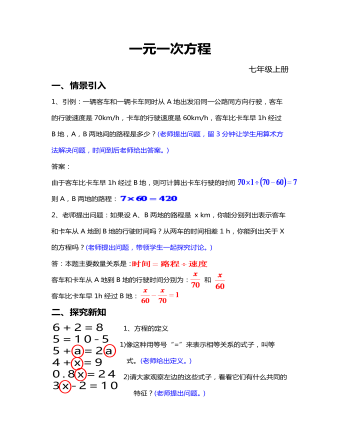
1、方程的定义1)像这种用等号“=”来表示相等关系的式子,叫等式。(老师给出定义。)2)请大家观察左边的这些式子,看看它们有什么共同的特征?(老师提出问题。)3)列方程时,要先设字母表示未知数,然后根据问题中的相等关系,写出含有未知数的等式叫做方程。(学生思考后,老师给出新学内容方程的定义。)4)判断方程的两个关键要素: ①有未知数 ②是等式(老师提问,并给出。)
大班语言教案:《m, f》教学设计
2.学会声母“b”和单韵母“a”拼读音节的方法。 3.学会拼读“b p m f”与“u、o”组成的音节。 教学难点 掌握拼读声母和韵母组成的音节。 教学过程 一、谈话导入 我们已经认识了韵母家族的6个朋友(出示a o e i u ü)一起读读,你们读得真准,能不能按字母顺序摆一摆,再按顺序读一读。你们记得真清楚。这节课我们一起到拼音王国里再认识四个声母家族的朋友,你们愿意吗? 二、学习“b p m f ”的音形 (一)学习“b”的音形 1.出示“b”的图 (1)引导学生提问:图上的小朋友在干什么? (2)问:这个字母念什么?学生试读“b”。 (3)讲:听广播的“播”读得轻短些,发音时,把两片嘴闭合,把气 憋住,然后突然放开,让气流冲出双唇就是“b”的音。 (4)教师范读。 (5)学生学读,体会发音方法。 (6)开火车读。 2.学习“b”的形 (1)引导学生提问:怎样记住“b”的形?或“b”与图中的哪一部分很像? (2)你们能编一个记忆“b”的小儿歌吗? 拉开天线听广播“b b b”。 右下半圆“b b b”。 6字“b”。…… 3.指导书写b(1)讲:我们先认识一个字母基本笔画:“丨”上竖。 (2)请同学们观察书中字母“b”先写哪笔,再写哪笔,几笔写成?占什么格?同桌同学互相说说。(3)学生说笔顺、位置,教师范写,强调“b”的第一笔在上格的三分之一处起笔到第三条线停笔。 (4)学生书空笔顺。 (5)学生在拼音本上抄字头。教师行间巡视,进行个别辅导。纠正学生的写姿和执笔方法。对姿势正确的学生及时表扬鼓励。
频率的稳定性教案教学设计
活动内容:教师首先让学生回顾学过的三类事件,接着让学生抛掷一枚均匀的硬币,硬币落下后,会出现正面朝上、正面朝下两种情况,你认为正面朝上和正面朝下的可能性相同吗?(让学生体验数学来源于生活)。活动目的:使学生回顾学过的三类事件,并由掷硬币游戏培养学生猜测游戏结果的能力,并从中初步体会猜测事件可能性。让学生体会猜测结果,这是很重要的一步,我们所学到的很多知识,都是先猜测,再经过多次的试验得出来的。而且由此引出猜测是需通过大量的实验来验证。这就是我们本节课要来研究的问题(自然引出课题)。
角平分线的性质教案教学设计
这是本节课的重点。让同学们将∠aob对折,再折出一个直角三角形(使第一条折痕为斜边),然后展开,请同学们观察并思考:后折叠的二条折痕的交点在什么地方?这两条折痕与角的两边有什么位置关系?这两条折痕在数量上有什么关系?这时有的同学会说:“角的平分线上的点到角的两边的距离相等”.即得到了角平分线的性质定理的猜想。接着我会让同学们理论证明,并转化为符号语言,注意分清题设和结论。有的同学会用全等三角形的判定定理aas证明,从而证明了猜想得到了角平分线的性质定理。
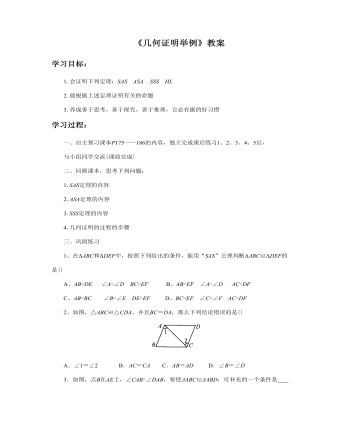
几何证明举例教案教学设计
学习过程:一、自主预习课本P175——186的内容,独立完成课后练习1、2、3、4、5后,与小组同学交流(课前完成)二、回顾课本,思考下列问题:1.SAS定理的内容2.ASA定理的内容3.SSS定理的内容4.几何证明的过程的步骤
二元一次方程组教案教学设计
1、问题1的设计基于学生已有的一元一次方程的知识,学生独立思考问题,同学会考虑到题中涉及到等量关系,从中抽象出一元一次方程模型;同学可能想不到用方程的方法解决,可以由组长带领进行讨论探究.2、问题2的设计为了引出二元一次方程,但由于同学的知识有限,可能有个别同学会设两个未知数,列出二元一次方程;如果没有生列二元一次方程,教师可引导学生分析题目中有两个未知量,我们可设两个未知数列方程,再次从中抽象出方程模型.根据方程特点让生给方程起名,提高学生学习兴趣.3、定义的归纳,先请同学们观察所列的方程,找出它们的共同点,并用自己的语言描述,组内交流看法;如果学生概括的不完善,请其他同学补充. 交流完善给出定义,教师规范定义.
大班语言教案:《i,u,ü》教学设计
2、学会正确认读i、u、ü的带调韵母。知道ü上标声调时,上面的小圆点不写。3、会在四线格里抄写i、u、ü三个单韵母。课时安排:2课时第一课时 教学目标:教学单韵母i、u并抄写。 教学过程: 一、 复习检查。 1、猜谜语。 (1)白鹅倒影是什么韵母? (2)圆脸小姑娘,小辫右边扎。这是什么韵母? (3)像个圆圈是什么韵母? 2、抽读字母卡片。 二、 教学单韵母i。 1、看图说话引出i。 图上画着什么?图上画着一件衣服。i的发音与“衣”的音相同。 2、教学i的发音,认清字形。 (1)发音要领:发音时嘴比发e时开得更小,只留一条小缝,舌前部升高,接近上腭,舌尖抵住下齿背,让气从舌尖和上腭中间自然流出。 (2)教师范读、领读。 (3)记忆字形。 i像什么?顺口溜:“像支蜡烛i、i、i。” 3、书写指导:先写竖,再写点,两笔写成。 三、 教学单韵母u。 1、看图说话引出u。 图上画着什么?“树上有一只乌鸦。”乌鸦的“乌”就是u。 2、教学u的发音,认清字形。 (1)发音要领:发音时把嘴唇收拢,嘴唇比发o时更圆更小,舌尖后缩,舌根抬高,让气从小洞中出来。 (2)教师范读,领读。 (3)记忆字形。 可用顺口溜:“像只茶杯u、u、u。” 3、书写指导:u一笔写成。 四、 巩固复习。
大班数学《设计门牌号码》说课稿
数学活动的内容具有生活性,这是指数学教育活动内容与幼儿的生活实际紧密相连,这些内容是幼儿所熟悉的,也是他们所能理解的,让他们感受到数学可以解决人们生活中遇到的问题。数字在我们的生活中无处不在,教师可以引导幼儿通过观察、发现周围环境中哪些地方、哪些物体上有数字,这些数字表示什么。例如:房屋上的门牌号码、书上的页码、汽车和汽车站上的数字、日历上的日期等等,它们分别表示着不同的意义。若能通过与幼儿生活实际相联系数学活动,让他们感到学习的内容是熟悉的,不仅能激发他们的兴趣,而且能让他们感受到数学就在他们身边是很有用的,并能激发幼儿更加注意,发现周围与数学有关的事务和现象。大班数学活动《设计门牌号码》就是运用生活中的序数经验,引导幼儿体验生活中数字的作用。
新人教版高中英语必修3Unit 1 Festivals and celebrations-Discovering Useful Structure教学设计
4.That was an experience that frightened everyone. →That was _____________________. 答案:1. taking 2. being discussed 3. in the reading room 4. a frightening experienceStep 6 The meaning and function of V-ing as the predicative动词-ing形式作表语,它通常位于系动词后面,用以说明主语“是什么”或“怎么样”一种表示主语的特质、特征和状态, 其作用相当于形容词; 另一种具体说明主语的内容, 即主语等同于表语, 两者可互换。The music they are playing sounds so exciting. 他们演奏的音乐听起来令人激动。The result is disappointing. 结果令人失望。Our job is playing all kinds of music. 我们的工作就是演奏各种音乐。Seeing is believing. 眼见为实。Step 7 Practice1. It is ________(amaze) that the boy is able to solve the problem so quickly.2. Buying a car is simply _______(waste) money. 3. Please stop making the noise—it’s getting ________(annoy). 4. complete the passage with the appropriate -ing form.La Tomatina is a festival that takes place in the Spanish town Bunol every August. I think many food festivals are __________ because people are just eating. however, this festival is _________ because people don't actually eat the tomatoes. Instead, they throw them at each other! the number of people ________ part in this tomato fight, can reach up to 20,000, and it is a very __________ fight that lasts for a whole hour. The _______ thing is how clean Bunol is after the tomatoes are washed away after the fight. this is because the juice form tomatoes is really good for making surfaces clean!答案:1. amazing 2. wasting 3. annoying4. boring interesting taking exciting amazing
新人教版高中英语必修3Unit 1 Festivals and Celebrations-Reading for Writing教学设计一
The topic of this part is “Write about your festival experience”.During the Listening and Speaking and Talking, students are just asked to say out their festival experiences such as the Spring Festival, Mid-autumn Day, but this part students will be asked to write down their own festival experiences. During the reading part, it introduces the Naadam Festival in Inner Mongolia Autonomous Region, which can give students a good example to imitate. Students not only learn the festival, but touch and feel the Inner Mongolian’s character, the spirit and cultural atmosphere, which can help students form the cultural awareness and learn to enjoy and value the diversity of Chinese culture.Concretely, the dairy tells the experience that the author spent the Naadam Festival in Inner Mongolia Autonomous Region with his/her friend. The structure is clear. In the opening paragraph, it introduces the topic of the Naadam Festival and the whole feeling. Then it introduces the items of the festival like the ceremony, wrestling and horse racing. Finally, it summarizes this experience. Because this part is a travel journal, we must guide students pay more attention to these details: 1. use the first person. 2. use the past tense to tell the past thing and use the present or future tense to describe the scenery. 3. use the timeline to tell the development. 4. be careful for the author’s psychology, emotion and feeling, etc.1. Read quickly to get main idea; read carefully to get the detailed information about Naadam Festival.2. Learn the structure of the reading article and language.3. Write an article about a festival experience4. Learn to use the psychology, emotions and feeling in the writing.1. Write an article about a festival experience.2. Use the structure of the reading article and language.
新人教版高中英语必修3Unit 2 Morals and Virtues-Reading for Writing教学设计
1. 这个寓言是一个关于一位国王古寓言。 The fable is an old fable about a king.2.作者用这个故事让读者对于社区的问题负有个人责任的必要印象深刻。The author used the story to impress upon readers with the need to take personal responsibility for problems in the community.3. 这个故事十分成功的实现了它的目的。The story was quite successful in achieving its purpose.Step 7 WritingPlease write a review of the story according the outline above.The fable is an old fable about a king who thought his people are lazy, so he put a large stone in the middle of the road and hides and waited to see if anyone will try to move it.The author used this story to impress upon readers with the need to take personal responsibility for problems in the community. The story was quite successful in achieving its purpose, and I liked it because it had a clear moral.However, while the moral of the story is clear, the actions of the king seemed pointless to me, because none of the characters in the story learnt anything. For this reason, I think there are better stories that can be used to impress upon people with the need for personal responsibility.Step 8 Pair workExchange drafts with a partner. Use this checklist to help your partner revise his/her draft.1. Does the writer give a short description of the story ?2. Does the description include the most important details of the story ?3. Does the writer give his or her opinion about the character or their actions ?4. Is the review well-organised ? 5. Does the writer use the -ing form as the adverbial correctly in the writing ?6. Are there any grammar, spelling, or punctuation errors ?Step 9 HomeworkPut up your revised draft in the classroom or read it to your class.
新人教版高中英语必修3Unit 3 Diverse Cultures-Discovering Useful Structure教学设计
Step 4 PracticeRead the conversation. Find out which words have been left out.Justin: Linlin, I’m going to Guizhou Province next month. I’m super excited! Any recommendations for places to visit?Linlin: Wow, cool! Guizhou is a province with a lot of cultural diversity. Places to visit...well, definitely the Huangguoshu Waterfall first.Justin: What’s special about the waterfall?Linlin: Well, have you ever heard of the Chinese novel Journey to the West ?Justin: Yes, I have. Why ?Linlin: In the back of the waterfall, you will find a cave, which is the home of the Monkey King.Justin: Really? Cool! I’ll definitely check it out.Linlin:And I strongly recommend the ethnic minority villages. You’ll find Chinese culture is much more diverse than you thought.Justin:Sounds great, thanks.Answers:Justin: Linlin, I’m going to Guizhou Province next month. I’m super excited! Do you have any recommendations for places to visit?Linlin: Wow, that’s cool! Guizhou is a province with a lot of cultural diversity. What are some places to visit in Guizhou ? Well, definitely the Huangguoshu Waterfall is the first place to visit in Guizhou Province.Justin: What’s special about the waterfall?Linlin: Well, have you ever heard of the Chinese novel Journey to the West ?Justin: Yes, I have heard of the Chinese novel Journey to the West . Why do you ask if I have heard of the Chinese novel Journey to the West?Linlin: In the back of the waterfall, you will find a cave, which is the home of the Monkey King from Journey to the West.Justin: That’s really true? It’s Cool! I’ll definitely check it out.Linlin:And I strongly recommend the ethnic minority villages on your trip to Guizhou Province. You’ll find Chinese culture is much more diverse than you thought it was.Justin:This all sounds great, thanks.
新人教版高中英语必修3Unit 3 Diverse Cultures-Listening &Speaking&Talking教学设计
1. In Picture 1 and Picture 2, where do you think they are from? How do you know?From their wearings, we can know they are from ethnic minority of China--- Miao and Dong.Picture 1, they are playing their traditional instrument lusheng in their traditional costumes.Picture 2. the girls are Miao because they wear their traditional costumes and silver accessory.2. In Picture 3, can you find which village it is? What time is it in the picture?It is Dong village. It is at night. Step 2 While-listeningJustin met a new friend while traveling in Guizhou. Listen to their conversation and complete the summaries below.Part 1Justin and Wu Yue watched some Miao people play the lusheng. The instrument has a history of over 3,000 years and it is even mentioned in the oldest collection of Chinese poetry. Then they watched the lusheng dance. Justin wanted to buy some hand-made silver/traditional accessories as souvenirs. He was told that the price will depend on the percentage of silver. Part 2They will go to a pretty Dong minority village called Zhaoxing. they will see the drum towers and the wind and rain bridges. They may also see a performance of the Grand Song of the Dong people.Step 3 Post-listening---TalkingWork in groups. Imagine Justin is telling some friends about his trip to Guizhou. One of you is Justin and the rest of you are his friends. Ask Justin questions about his trip and experience. The following expressions may help you.