-
新人教版高中英语必修2Unit 2 Wildlife Protection-Reading for Writing教案二
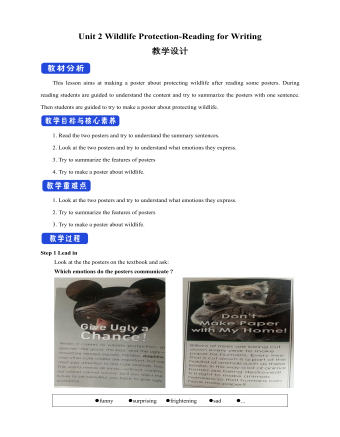
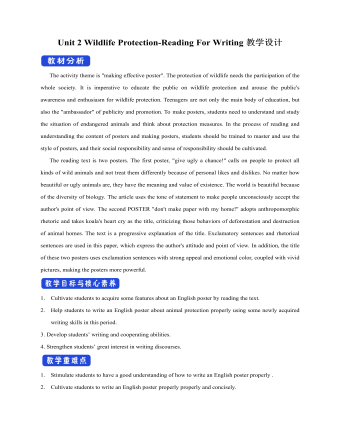
This lesson aims at making a poster about protecting wildlife after reading some posters. During reading students are guided to understand the content and try to summarize the posters with one sentence. Then students are guided to try to make a poster about protecting wildlife.1. Read the two posters and try to understand the summary sentences.2. Look at the two posters and try to understand what emotions they express.3. Try to summarize the features of posters4. Try to make a poster about wildlife.1. Look at the two posters and try to understand what emotions they express.2. Try to summarize the features of posters3. Try to make a poster about wildlife.Step 1 Lead inLook at the the posters on the textbook and ask:Which emotions do the posters communicate ?Step 2 Read the poster and answer the questions.1. What do you think of the animals in the poster on the left ?I think it is frightening and ugly.2. Why do we should protect the ugly animals ?All species--the good, the bad, and the ugly-- should be treated equally.The world needs all kinds--without variety, our planet cannot survive.3. Why are billions of trees being cut down every year ?To make paper for humans.4. What result will be lead to after the trees are cut down ?A lost of animal homes are being destroyed./The habitat of wildlife is being destroyed.Step 3 Find the feature of posters1. What does each poster use to stir up emotions ?On the left, it makes us a little frightened and it looks a little ugly, but it can activate our curiosity--What is it? And What is wrong with it?On the right, it makes us feel a little sad and want to protect them.
新人教版高中英语必修2Unit 1 Cultural Heritage-Reading and Thinking教案二
1. This section focuses on "Understanding how a problem was solved”, which is aimed to guide students to analyze and discuss the challenges and problems faced by cultural heritage protection during the construction of Aswan Dam, as well as the solutions. On the basis of understanding, students should pay attention to the key role of international cooperation in solving problems, and attach importance to the balance and coordination between cultural heritage protection and social and economic development. Students are encouraged to face challenges actively, be good at cooperation, and make continuous efforts to find reasonable ways and means to solve problems.2. Enable students to understand the main information and text structure of the reading text;3. Motivate students to use the reading strategy "make a timeline" according to the appropriate text genre;4. Enable students to understand how a problem was solved;5. Enable students to understand the value of protecting cultural heritage by teamwork and global community;1. Guide students to pay attention to reading strategies, such as prediction, self-questioning and scanning.2. Help students sort out the topic language about protecting cultural relics and understand the narrative characteristics of "time-event" in illustrative style3. Lead students to understand the value of protecting cultural heritage by teamwork and global community;
新人教版高中英语必修2Unit 1 Cultural Heritage-Reading and Thinking教案一
The theme of the reading and thinking is about “Understanding how a problem was solved”.The Listening & Speaking & Talking is about international co-work to protect the Mount Tai, in which the students from seven countries came up with many solutions even create the Mount Tai App. This section aims at showing how to solve a difficult and even tough problem about protecting the cultural heritage by the international co-work. So in this section, cultivating students’ international awareness is very clear and important. Concretely, with the economic development, how to balance the protection of cultural relics and social development is a big challenge for human. In the 1950s, the Egyptian government wanted to build the Aswan Dam across the Nile to control floods, produce electricity and water farms. But the proposal led to protests because it would destroy a lot of cultural relics. The Egyptian had no choice but ask the UN for help. Therefore, a international cooperation about how to protect the cultural relics began, which involved the time length about 20 years and a large amount of fund. Then, the problems was solved. 1. Read quickly to get the main idea and the structure of the article; read careful to get detailed information.2. Learn to use the reading strategy---making a timeline3. Learn how to solve a tough problem by asking for help and cooperation4. Have the international awareness and understand the great strength of international cooperation.1. Read quickly to get the main idea and the structure of the article; read careful to get detailed information.2. Learn to use the reading strategy---making a timeline.3. Learn how to solve a tough problem by asking for help and cooperation.
新人教版高中英语必修2Unit 2 Wildlife Protection-Reading and Thinking教案一
The listening and speaking part aims at how to protect and help endangered animals by listening, speaking and talking about the facts and reasons. This lesson analyzes the decreasing clause of Tibetan antelope population and the measures of protecting Tibetan antelopes. So students can be guided to learn to analyse the title and use different reading skills or strategies, like scanning, skimming and careful reading.1. Read quickly to get the main ideas and the purpose of going to Tibetan; read carefully to understand what the author see and think.2. Understand the sentences of the present continuous passive voice such as “Much is being done to protect wildlife.” and the inverted sentence “Only when we learn to exist in harmony with nature can we stop being a threat to wildlife and to our planet.”3. Enhance the awareness of protecting wildlife.4. Cultivate the reading methods according to different materials.1. Read quickly to get the main ideas and the purpose of going to Tibetan; read carefully to understand what the author see and think.2. Understand the sentences of the present continuous passive voice such as “Much is being done to protect wildlife.” and the inverted sentence “Only when we learn to exist in harmony with nature can we stop being a threat to wildlife and to our planet.”3. Cultivate the reading methods according to different materials.Step 1 Leading-inWatch a video about elephants and whales and then ask:Why are they endangered ? They are killed/hunted
新人教版高中英语必修2Unit 2 Wildlife Protection-Listening and Speaking教案
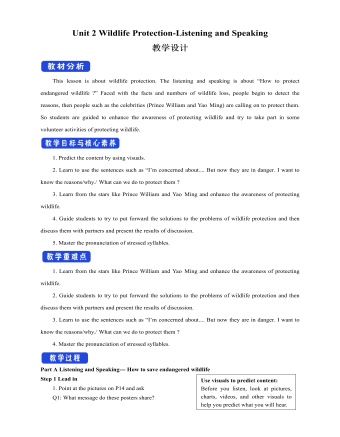
This lesson is about wildlife protection. The listening and speaking is about “How to protect endangered wildlife ?” Faced with the facts and numbers of wildlife loss, people begin to detect the reasons, then people such as the celebrities (Prince William and Yao Ming) are calling on to protect them. So students are guided to enhance the awareness of protecting wildlife and try to take part in some volunteer activities of protecting wildlife.1. Predict the content by using visuals. 2. Learn to use the sentences such as “I’m concerned about.... But now they are in danger. I want to know the reasons/why./ What can we do to protect them ?3. Learn from the stars like Prince William and Yao Ming and enhance the awareness of protecting wildlife.4. Guide students to try to put forward the solutions to the problems of wildlife protection and then discuss them with partners and present the results of discussion.5. Master the pronunciation of stressed syllables.1. Learn from the stars like Prince William and Yao Ming and enhance the awareness of protecting wildlife.2. Guide students to try to put forward the solutions to the problems of wildlife protection and then discuss them with partners and present the results of discussion.3. Learn to use the sentences such as “I’m concerned about.... But now they are in danger. I want to know the reasons/why./ What can we do to protect them ?4. Master the pronunciation of stressed syllables.Part A Listening and Speaking--- How to save endangered wildlifeStep 1 Lead in1. Point at the pictures on P14 and ask Q1: What message do these posters share?
新人教版高中英语必修2Unit 2 Wildlife Protection-Reading and Thinking教案二
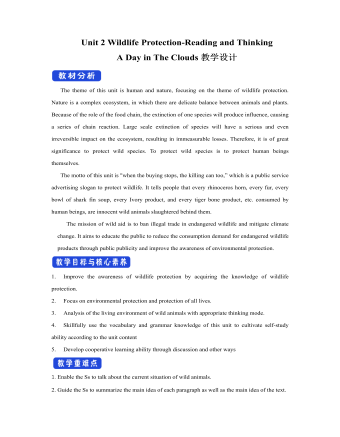
The theme of this unit is human and nature, focusing on the theme of wildlife protection. Nature is a complex ecosystem, in which there are delicate balance between animals and plants. Because of the role of the food chain, the extinction of one species will produce influence, causing a series of chain reaction. Large scale extinction of species will have a serious and even irreversible impact on the ecosystem, resulting in immeasurable losses. Therefore, it is of great significance to protect wild species. To protect wild species is to protect human beings themselves. The motto of this unit is "when the buying stops, the killing can too,” which is a public service advertising slogan to protect wildlife. It tells people that every rhinoceros horn, every fur, every bowl of shark fin soup, every Ivory product, and every tiger bone product, etc. consumed by human beings, are innocent wild animals slaughtered behind them. The mission of wild aid is to ban illegal trade in endangered wildlife and mitigate climate change. It aims to educate the public to reduce the consumption demand for endangered wildlife products through public publicity and improve the awareness of environmental protection.1. Improve the awareness of wildlife protection by acquiring the knowledge of wildlife protection.2. Focus on environmental protection and protection of all lives.3. Analysis of the living environment of wild animals with appropriate thinking mode.4. Skillfully use the vocabulary and grammar knowledge of this unit to cultivate self-study ability according to the unit content5. Develop cooperative learning ability through discussion and other ways1. Enable the Ss to talk about the current situation of wild animals.2. Guide the Ss to summarize the main idea of each paragraph as well as the main idea of the text.
新人教版高中英语必修2Unit 2 Wildlife Protection-Reading For Writing教案一
1. 标题首先根据海报的特点、格式写明标题。海报中往往把内容作为大标题。例如: Save the earth, Save the birds。2. 正文部分不同的海报其正文部分的侧重点不同。对于介绍性的海报, 首先要引出话题, 其次列出原因, 最后是总结。对于宣传类的海报, 要写明具体内容, 如: 活动内容, 地点以及参加活动的注意事项, 主持或举办单位等。1. 图片: 要选择引人注目的图片, 与主题要相关, 色彩明亮。话题句式 1. It is a treasure of our country. 它是我国的国宝。2. Believe it or not, at present only several thousand pandas exist in the world. 信不信由你, 目前世界上仅现存几千只熊猫。 3.It’s because of human activities that tigers are endangered. 正是因为人类的活动, 老虎处于濒危的状态。4. Many wild animals are in danger of dying out. 很多野生动物面临着灭绝的危险。 5. The government has taken effective measures to protect them. 政府已采取有效的措施来保护它们。6. People should raise the awareness of the protection of wild animals. 人们应该提高保护野生动物的意识。 7. It’s amazing that there are merely less than 1, 000 finless porpoises living in China. 非常令人吃惊, 目前中国仅有不足1 000只江豚。
新人教版高中英语必修2Unit 3 The Internet-Discovering Useful Structure教案一
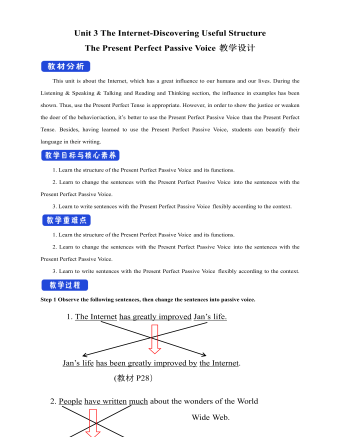
This unit is about the Internet, which has a great influence to our humans and our lives. During the Listening & Speaking & Talking and Reading and Thinking section, the influence in examples has been shown. Thus, use the Present Perfect Tense is appropriate. However, in order to show the justice or weaken the doer of the behavior/action, it’s better to use the Present Perfect Passive Voice than the Present Perfect Tense. Besides, having learned to use the Present Perfect Passive Voice, students can beautify their language in their writing. 1. Learn the structure of the Present Perfect Passive Voice and its functions. 2. Learn to change the sentences with the Present Perfect Passive Voice into the sentences with the Present Perfect Passive Voice. 3. Learn to write sentences with the Present Perfect Passive Voice flexibly according to the context. 1. Learn the structure of the Present Perfect Passive Voice and its functions. 2. Learn to change the sentences with the Present Perfect Passive Voice into the sentences with the Present Perfect Passive Voice. 3. Learn to write sentences with the Present Perfect Passive Voice flexibly according to the context. Step 1 Observe the following sentences, then change the sentences into passive voice.He has been selected to take part in the sports meeting.(肯定句)他已被挑选出来参加运动会。The ink has not been removed from his overcoat.(否定句)墨迹还没有从他外套上去掉。
新人教版高中英语必修2Unit 3 The Internet-Reading and Thinking教案二
Q5:What's Jan's next goal?Her next goal is to start a charity website to raise money for children in poor countries.Q6:What can we learn from her experiences?We learn that when we go through tough times, we can find help and support from other people online. We learn that we can feel less lonelyStep 5: While reading---rethinkingQ1: What is Jan’s attitude to the Internet ?Thankful/Grateful, because it has changed her and her life.Q2: What writing skills is used in the article ?Examples(Jan’s example, the 59-year-old man’s and the 61-year-old woman’s example)Q3: Can you get the main idea of the article ?The Internet has changed Jan’s life/Jan’s life has been changed by the Internet.Step 6 Post reading---Retell the storyMuch has been written about the wonders of the World Wide Web. There are countless articles (1)telling(tell) us how the Internet has made our lives more convenient. But the Internet has done a lot (2)more(much) for people than simply make life more convenient. People’s lives (3) have been changed(change) by online communities and social networks so far. Take Jan for example, who developed a serious illness that made her (4)stuck(stick) at home with only her computer to keep (5)her(she) company. She joined an online group (6)where she could share problems, support and advice with others. She considered the ability to remove the distance between people as one of the greatest (7)benefits(benefit). She was so inspired (8)that she started an IT club in which many people have been helped. She has started to learn more about how to use the Internet to make society better. Her next goal is to start a charity website to raise money (9)for children in poor countries. Jan’s life has been (10)greatly(great) improved by the Internet.
新人教版高中英语必修2Unit 3 The Internet-Reading and Thinking教案一
Paragraph 3. Jan decided to start an IT club to teach old people how to use computers and the Internet. Paragraph 4. Jan has started taking online classes to learn more about how to use the Internet to make society better. Paragraph 5. Jan’s life has been greatly improved by the Internet. Step 5: Critical thinking:(1)How do you arrange your time spent on study and the Internet? Is it reasonable? I usually surf the Internet using my mobile phone for only an hour after class, and it is reasonable for me.(2)What are your online activities? Are they safe? I chat with my friends, read news and play games. I never give away my private information so I think they are safe.Step 4: summary Much has been written about the wonders of the World Wide Web. There are countless articles (1)______(tell) us how the Internet has made our lives more convenient. But the Internet has done a lot (2)_____(much) for people than simply make life more convenient. People’s lives (3) _________________(change) by online communities and social networks so far. Take Jan for example, who developed a serious illness that made her (4)_____(stick) at home with only her computer to keep (5)___(she) company. She joined an online group (6)______ she could share problems, support and advice with others. She considered the ability to remove the distance between people as one of the greatest (7)_______(benefit). She was so inspired (8)____ she started an IT club in which many people have been helped. She has started to learn more about how to use the Internet to make society better. Her next goal is to start a charity website to raise money (9)___ children in poor countries. Jan’s life has been (10)______(great) improved by the Internet. Step 5 Homework:Review what we have learned and find out the key language points in the text.
新人教版高中英语必修2Unit 4 History and Traditions-Listening&Speaking&Talking教案一
This unit is about history and traditions. From the opening page, we can know that this unit will introduce the history and traditions around the world. As Marcus Garvey says “A people without the knowledge of their past history, origin and culture is like a tree without roots”, it is important for students to realize the importance and value of knowing the history and traditions and their further meanings. And this part ( listening and speaking ) is divided into two parts: Part A---share views on historic sites, Part B ---talk about a visit to a historic tourist destination. By talking with a foreigner, the speakers introduce the historic attractions and their cultures. Part A is that William, a British student, who was going to visit the Confucius Temple and a Chinese student, Xiao Kong, who was going to the Confucius Temple to meet with the members of the research group, went together and exchanged their views on the Confucius Temple, Confucius, Confucius' descendants and Confucius' educational thoughts. Part B is a conversation between Xiao Yan, a youth hostel receptionist and Paul, a backpacker about the feelings and experience after visiting the Chinese famous tourist attraction Pingyao.1. Guide students to understand the content of listening texts in terms of the whole and key details; 2. Cultivate students' ability to guess the meaning of words in listening; discuss with their peers how to talk about historic spots and great person.3. Instruct students to use functional sentences of showing one’s excitement, surprise and disappointment.1. Guide students to understand the content of listening texts in terms of the whole and key details; 2. Cultivate students' ability to discuss with their peers the related topics.3. Enable students to use the functional items of showing one’s excitement, surprise and disappointment.
新人教版高中英语必修2Unit 3 The Internet-Reading for Writing教案二
8. However, the more polite you are, the less likely it is you will be attacked. 然而, 你越有礼貌, 你被攻击的可能性就越小。 Step 8 Writing---the articleHow to stay safe in the online chat roomToday I thought I’d blog about a question that has been asked many times--- how do you stay safe online and avoid bad experiences in the online chat room ? I’m not an expert, but many years as a blogger have taught me a thing or two.First of all, there’s the golden rule of the Internet: keep out of what makes you uneasy. Don’t post comments or click on anything. Second, protect your privacy. Don’t give out too much private information like your address, phone numbers, the ID numbers, etc. Third, be polite. If you are polite to others on the Internet, you won’t be attacked in normal situation. Finally, don’t believe in others easily and never meet someone you met online alone. It is very dangerous.Have you had any bad experiences online, or do you have some good advice for staying safe? Post your comments below!Step 9 Pair workExchange drafts with a partner. Use this checklist to help your partner revise his/her draft.1. Does the writer tell the reader what he/she know about the topic ?2. Are the tips and suggestions well organised ?3. Has the writer defined the new words ?4. Does the author include examples, comparison, or explanations ?5. Does the writer end by asking readers to leave comments and/or suggestions ?6. Can you find any grammar or spelling mistakes.Step 6 HomeworkPut up your revised draft in the classroom or read it to your class.
新人教版高中英语必修2Unit 4 History and Traditions-Discovering Useful Structure教案二
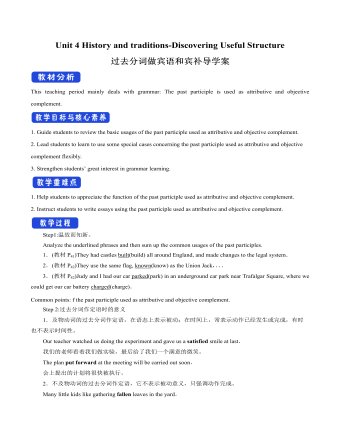
This teaching period mainly deals with grammar: The past participle is used as attributive and objective complement.1. Guide students to review the basic usages of the past participle used as attributive and objective complement.2. Lead students to learn to use some special cases concerning the past participle used as attributive and objective complement flexibly.3. Strengthen students’ great interest in grammar learning.1. Help students to appreciate the function of the past participle used as attributive and objective complement.2. Instruct students to write essays using the past participle used as attributive and objective complement.Step1:温故而知新。Analyze the underlined phrases and then sum up the common usages of the past participles.1.(教材P41)They had castles built(build) all around England, and made changes to the legal system.2.(教材P42)They use the same flag, known(know) as the Union Jack,...3.(教材P42)Judy and I had our car parked(park) in an underground car park near Trafalgar Square, where we could get our car battery charged(charge).Common points: f the past participle used as attributive and objective complement.Step 2:过去分词作定语时的意义1.及物动词的过去分词作定语,在语态上表示被动;在时间上,常表示动作已经发生或完成,有时也不表示时间性。Our teacher watched us doing the experiment and gave us a satisfied smile at last.我们的老师看着我们做实验,最后给了我们一个满意的微笑。The plan put forward at the meeting will be carried out soon.会上提出的计划将很快被执行。2.不及物动词的过去分词作定语,它不表示被动意义,只强调动作完成。Many little kids like gathering fallen leaves in the yard.
新人教版高中英语必修2Unit 4 History and Traditions-Reading and Thinking教案一
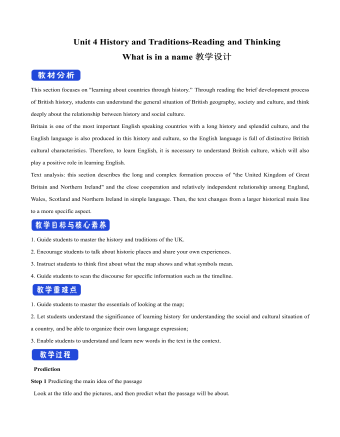
Features of languages1.Finally, in the 20th century, the southern part of Ireland broke away from the UK, which resulted in the full name we have today: the United Kingdom of Great Britain and Northern Ireland.该句是一个复合句。该句主句为:the southern part of Ireland broke away from the UK;which resulted in the full name we have today为which引导的定语从句代指前面整句话的内容,we have today为定语从句修饰先行词name。译文:最后,在20世纪,爱尔兰南部脱离英国,这导致了我们今天有的英国的全名:大不列颠及北爱尔兰联合王国。2.Almost everywhere you go in the UK, you will be surrounded by evidence of four different groups of people who took over at different times throughout history.该句是一个复合句。该句主句为:you will be surrounded by evidence of four different groups of people;其中Almost everywhere you go in the UK为让步状语从句; who took over at different times throughout history为定语从句修饰先行词people。译文:几乎无论你走到英国的任何地方,你都会发现历史上有四种不同的人在不同的时期统治过英国。3.The capital city London is a great place to start, as it is an ancient port city that has a history dating all the way back to Roman times.该句是一个复合句。该句主句为:The capital city London is a great place to start; as it is an ancient port city that has a history dating all the way back to Roman times.为原因状语从句;dating all the way back to Roman times为现在分词短语作定语修饰history。
新人教版高中英语必修2Unit 4 History and traditions教案
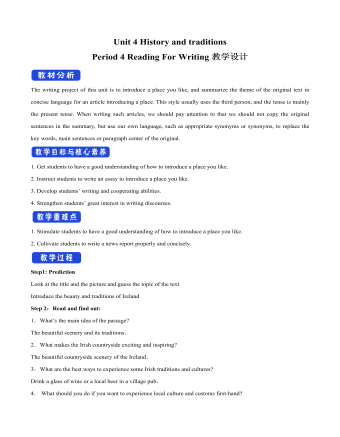
这个地区有着深厚的传统。既学既练:为了让更多的外国游客了解中国文化,欣赏中国美丽的自然风光,感受中国发生的巨大变化,某外文杂志社将出版一本英语小册子来介绍中国的旅游景点。该杂志社邀请你为该小册子写一篇英语短文来介绍杭州,内容包括:1.杭州的位置(中国东南部)、面积(16 000多平方公里)及历史(2 200多年)等;2.杭州的旅游特色(自然风景、传统文化、特色小吃等);3.希望更多的游客来杭州参观。注意:1.词数80左右;2.可适当增加细节,以使行文连贯。Located in the southeast of China, Hangzhou is a beautiful city.Dating back more than 2,200 years, Hangzhou covers an area of more than 16,000 square kilometers.In Hangzhou, you can visit the West Lake, whose scenery is fascinating.In addition, you can’t miss its cultural relics and historical sites, from which you will learn more about excellent Chinese traditional culture and traditions.In Hangzhou, the special snacks are famous and visitors from different parts of the world think highly of them.As a tourist attraction, Hangzhou attracts a large number of visitors from home and abroad every year.Once you come to China, Hangzhou is a scenic spot you can’t miss.
新人教版高中英语必修2Unit 5 Music-Discovering Useful Structures教案二
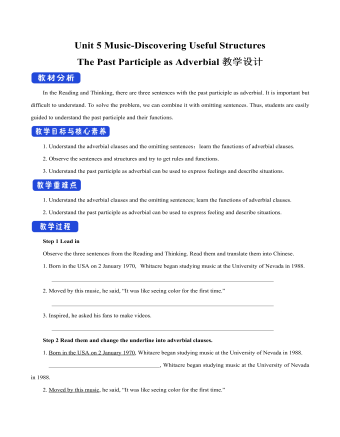
4. When he got absorbed in his world of music, he felt as if he could “see” the beauty of the world around him, like he had in his previous life.P·P as adverbial: _________________________________________________________________.Function: _______________________________________________________________________.Step 5 Solid Complete the passage with the words in brackets in their correct forms.Well known as a successful band, the Impact members show quite a few striking qualities. They never ever give up. When _____________(question) by the media, they are not _____________(discourage) and practise even harder. They are improving themselves by attending several master training class. They are united. _____________(fill with) team spirit, they act as a whole, always aiming for glory. Step 6 Difference and similarity from -ingObserve the following examples.1. He went out, shutting the door behind him.=He went out, ________________________________________________________.2. Not knowing what to do, he went to his parents for help.=__________________________________________, he went to his parents for help.Similarity: _______________________________________________________________________________________________________________________________________________________.Difference : _______________________________________________________________________________________________________________________________________________________.Step Practice1. ________ in a hurry, this article was not so good. 因为写得匆忙, 这篇文章不是很好。2. ________ carefully, he found something he hadn’t known before. 他仔细读书时, 发现了一些从前不知道的东西。3. ________ why he did it, the monitor said it was his duty. 当被问及他为什么要这么做时, 班长说这是他的职责
新人教版高中英语必修2Unit 5 Music-Listening&Speaking&Talking教案
choir memberspeople to run food stands people to sell festival ticketspeople to sell music CDspeople to set up equipmentmusical performersStep 2: Listen to the announcement again and answer the questions. ? 1. What kind of songs will Grace Davis sing at the festival?? 2. Who can try out as a performer?? 3. What can those who think they do not have musical talent do?? 4. How can students volunteer to take part?? Talking about preferences:? Would you prefer doing ..?? What would you prefer to do?? Would you rather do .... or ….?? What would you rather do?? I'd prefer .... to ..? I'd rather have ... than .. Step 3: Speaking ProjectWork in groups. Role-play the conversation or make a new one.? Debbie: Where have you been? You missed the announcement about the music festival.? John: I was at the doctor's office. Music festival?? Frank: Yes, it's going to be next month on the school sports field. John, you can play the piano. How about playing it at the festival?? John: Well, I'd rather play the violin. I can play Liang Zhu.? Frank: Wow! Sounds good. What about you, Debbie? ? Debbie: Actually, I don't have much musical ability. I'd prefer just to help out with the crowds.? Frank: You can sell tickets or work at a food stand.? John: So can I assume that the aim of the festival is to raise money?? Debbie: Yes. All of the money will go to charity.
新人教版高中英语必修2Unit 5 Music-Listening and Speaking教案
This lesson is about music. Students can classify the types of music through the instruments and its sound and can talk about their preferences about music, even join some activities and play a role in them according to their musical talents. On the basis, they are guided to use the languages to express their preferences and some plosive sounds and their rules.1. Classify the music types through the instruments and its sound.2. Listen and understand what the speakers’ preferences are and the reasons; talk about their own preferences and give their own reasons, using these sentences: “What kind of music do you like? And why? “ “Because it makes/gives me energy/peaceful.../touches my heart...”.3. Learn some plosives and the rules.4. Join some activities and play a role in them according to the talents. 1. Listen and understand what the speakers’ preferences are and the reasons;2. talk about their own preferences and give their own reasons, using these sentences: “What kind of music do you like? And why? “ “Because it makes/gives me energy/peaceful.../touches my heart...”.3. Learn some plosives and incomplete plosives and its rules.Step 1 Lead inPoint at the pictures on P50 and ask Q1: What are the people doing in the pictures below?Q2: What kind of music they are?Then play the MP3s one by oneStep 2 ListeningTask 1: A reporter from the school newspaper is interviewing students about music. Listen to the interviews. Draw lines between the words to make complete sentences. Some words will not be used.
新人教版高中英语必修2Unit 5 Music-Reading for Writing教案二
The Internet celebrity Gao Yifeng. Years ago, he owned 5 companies and the staffs over 1,000, but during the economy crisis, he became nothing but debt. He was so worried that his hair became white overnight. There was a time when he wanted to killed himself. But after listening to the song Start Over by Liu Huan, he decided to cheer himself up. He started a steamed bun shop and gradually became a national chain shops. Now he became successful again.Walter Haddon said, “Music is the medicine of a troubled mind.” Music contains such a pleasant and inspiring force. Music gave him courage and bravery. When he listened to the song, it made his spirit fly like a kite in the wind. Music gave him strength and brought him relief. It was the rock I leant on to become strong and to get through those hard times. I hope none of us have to go through the same kind of suffering that he did. At the same time, we all go through various periods when we feel sad or alone. During those times, music can help us in the same way that it helped him. I hope we all will somehow begin to treasure music and make it a part of our life. Thank you for your listening !5.Revise your writing each other.Does he/she explain how music has changed his/her/someone else’s life?Are some of the rhetorical devices included and used properly ?Does he/she talk about how music makes him/her/someone feel?Is the first word in each sentences capitalised?Does he/she use correct punctuation ?
新人教版高中英语选修1Unit 2 Looking into the Future教案
【设计意图】以“新科技是一把双刃剑”为主题开展讨论活动。这个话题比较大,所以给了一定的限制,首先需要以智能家居为例来阐述科技发展对未来生活产生的影响,然后列举其优点和缺点,最后就以上现象发表自己的观点。这个活动是对整个文本的创意性总结与意义的升华,留给学生一定的想象空间,学生借此机会可以运用文本内容和语言表达自己对科技发展的看法和态度。Assignments:1. Finish Exercise 4 on Page 15 of the textbook.A smart home is one that integrated computers into the structure of the building itself. In this way, many of the things that we now do ourselves become automatic. For example, the smart home could control the air conditioning and lights so that you would no longer have to turn switches on and off, and so that your home would be more energy-efficient. The smart home could also monitor itself to make sure that everything is working as it should, and send you warnings if there is a problem. Such smart homes could even be programmed to detect your health problems, and then give you reasonable advice as to the food you should eat or if you should see a doctor. So, in a sense, smart homes will lead us to living smarter lives.2.Create a smart function for your home, and share your creation in the next period.