-
新人教版高中英语必修1Unit 3 Sports and Fitness-Reading for Writing教案
Then have them write a short paragraph to describe and explain their changes. After that, get the Ss to exchange their drafts with their partners and use the checklist to give feedback on their drafts, and finally revise it.Step 5 Summary of how to write a wellness book1.健康书的审题步骤:第一步:明确要求该写作属于经验分享,故要用第一人称来写;时态以一股现在时为主。第二步:确定段落该类文章可以从以下三个方面人手:Para.1首先表明写作的目的Para.2自己的做法及心得体会Para.3表示期望及感谢第三步:提炼要点2.健康书常见句式:1) It is an honor for me to share my favorite sport with you,2) It makes me feel relaxed playing with my friends.3) It makes me rid myself of stress while playing with my friends.4) Moreover, it provides me a valuable chance to communicate with others.5) I we eat too little or too much, or if we choose the wrong food, we may become sick.6) We can do something to change the poor situation.Step 6Homework假如你的老师让你在班级Wellness Bok上分享自己的亲身经历及心得,请根据以下要点写一篇80字左右的文章1. 你喜欢的运动是什么?2. 你最喜欢的原因是什么?3. 你参加锻炼的体会。
新人教版高中英语必修1Unit 4 Natural Disasters-Reading & Thinking教案
5. Read to get detailed information about Paragraph 5.Q1. What shows the revival of Tangshan?Q2. How can Tangshan revive itself and get up on its feet again?Q3. In times of disasters, how can we go through it?T: In times of disasters, we should unify, show the wisdom and stay positive.Step 4 Activity 4 Highlighting the theme and reflecting1. Make a summary of the text.2. Further understand the titleQ: After our learning, why do you think the earth didn’t sleep on that night?T: An earthquake happened. The people in the earthquake suffered a lot, and the people outside Tangshan were concerned about the people there a lot.3. Reflect through discussion on what can be learnt after reading.T: Disasters are powerful. Unpreparedness can be deadly. Life is weak, but if people work together to help each other, disasters can be defeated.There is no love from disaster, but we have love in the human heart.Step 5 Assignment How does the writer convey that the earthquake was deadly, and that people were helpless during the earthquake? Try to find some attractive and impressive expressions and note them down.
新人教版高中英语必修1Welcome Unit-Discovering Useful Structures & Listening and Talking教案
常跟双宾语的动词有:(需借助to的)bring, ask, hand, offer, give, lend, send, show, teach, tell, write, pass, pay, promise, return等;基本句型 五S +V + O + OC(主+谓+宾+宾补)特点:动词虽然是及物动词,但是只跟一个宾语还不能表达完整的意思,必须加上一个补充成分来补足宾语,才能使意思完整。 判断原则:能表达成—宾语 是…/做…注:此结构由“主语+及物的谓语动词+宾语+宾语补足语”构成。宾语与宾语补足语之间有逻辑上的主谓关系或主表关系,若无宾语补足语,则句意不够完整。可以用做宾补的有:名词,形容词,副词,介词短语,动词不定式,分词等。如:He considers himself an expert on the subject.他认为自己是这门学科的专家。We must keep our classroom clean.我们必须保持教室清洁。I had my bike stolen.我的自行车被偷了。We invited him to come to our school.我们邀请他来我们学校。I beg you to keep secret what we talked here.我求你对这里所谈的话保密。用it做形式宾语,而将真正的宾语放到宾语补足语的后面,以使句子结构平衡,是英语常用的句型结构方式。即:主语+谓语+it+宾补+真正宾语。如:We think it a good idea to go climb the mountain this Sunday.
新人教版高中英语必修2Unit 1 Cultural Heritage-Discovering Useful Structure教案二
This theme of the part is “ Describe people or things in greater detail”. Students have learned the grammar(restrictive relative clauses) in Book 1, and further review and consolidate its structure “prep+relative pronouns(which/whom)” and the relative adverbs(when, where and why), besides students should understand its form, meaning and functions. In this section, students should be able to express the grammar correctly in daily communication and in the writing. 1. Review the basic usages of relative pronouns and adverbs of attributive clauses . 2. Learn to use some special cases about restrictive relative clauses.3. Learn to write sentences with restrictive relative clauses flexibly according to the context.1. Review the basic usages of relative pronouns and adverbs of attributive clauses .2. Learn to use some special cases about restrictive relative clauses.3. Learn tow rite sentences with restrictive relative clauses flexibly according to the context.Step 1. Observe the following sentences, and mark the relative pronouns and the adverbs. 1. After listening to the scientists who had studied the problems, and citizens who lived near the dam, the government turned to the United Nations for help.2. Temples and other cultural sites were taken down piece by piece, and then moved and put back together again in a place where they were safe from the water.Step 2 PracticePlease complete these sentences with relative pronouns and relative adverbs and answer the following questions.Questions: 1. What is the head noun ?2. What relative words should be used ?3. What elements do they act in these sentences ?
新人教版高中英语必修2Unit 1 Cultural Heritage-Discovering Useful Structure教案一
This teaching period mainly deals with grammar “restrictive relative clauses.” To begin with, teachers should lead students to revise what they have learned about the relative pronouns and relative adverbs. And then, teachers move on to stress more special cases concerning this grammar, such as the “preposition+ relative pronouns which and whom” and cases where we can omit the relative pronouns. This period carries considerable significance to the cultivation of students’ writing competence and lays a solid foundation for the basic appreciation of language beauty. The teacher is expected to enable students to master this period thoroughly and consolidate the knowledge by doing some exercises. 1. Guide students to review the basic usages of relative pronouns and adverbs of attributive clauses.2. Lead students to learn to use some special cases concerning restrictive relative clauses flexibly.2. Enable students to use the basic phrases structures flexibly.3. Strengthen students’ great interest in grammar learning.1. Help students to appreciate the function of relative pronouns and adverbs of attributive clauses in a sentence2. Instruct students to write essays using the proper relative pronouns and adverbs of attributive clauses.本节语法思考:定语从句在复合句中的作用是什么? 关系词有哪些?定语从句在复合句中的作用相当于形容词,它在句中作定语修饰名词或代词。他们在先行词和定语从句之间起到联系作用,同时在意义上代表先行词并在定语从句中担任一个成分。被定语从句所修饰的词称先行词,定语从句一般放在先行词的后面。
新人教版高中英语必修2Unit 1 Cultural Heritage-Reading and Thinking教案一
The theme of the reading and thinking is about “Understanding how a problem was solved”.The Listening & Speaking & Talking is about international co-work to protect the Mount Tai, in which the students from seven countries came up with many solutions even create the Mount Tai App. This section aims at showing how to solve a difficult and even tough problem about protecting the cultural heritage by the international co-work. So in this section, cultivating students’ international awareness is very clear and important. Concretely, with the economic development, how to balance the protection of cultural relics and social development is a big challenge for human. In the 1950s, the Egyptian government wanted to build the Aswan Dam across the Nile to control floods, produce electricity and water farms. But the proposal led to protests because it would destroy a lot of cultural relics. The Egyptian had no choice but ask the UN for help. Therefore, a international cooperation about how to protect the cultural relics began, which involved the time length about 20 years and a large amount of fund. Then, the problems was solved. 1. Read quickly to get the main idea and the structure of the article; read careful to get detailed information.2. Learn to use the reading strategy---making a timeline3. Learn how to solve a tough problem by asking for help and cooperation4. Have the international awareness and understand the great strength of international cooperation.1. Read quickly to get the main idea and the structure of the article; read careful to get detailed information.2. Learn to use the reading strategy---making a timeline.3. Learn how to solve a tough problem by asking for help and cooperation.
新人教版高中英语必修2Unit 1 Cultural Heritage-Reading For Writing教案
This report is short, concise and has typical news content and language features. The title uses the verb phrases, embodying the characteristics of being concise and general. The introduction is the first two sentences in the first paragraph, describing the general situation of the cultural heritage protection project, including time, place, characters, events and other news elements, so that readers can see the main points of the news report at a glance. The main body is the second and third paragraphs, which report the important historical and cultural value of Mogao Grottoes and the production of Mogao Grottoes Material digital photos, which are of great significance to the inheritance of historical culture and the promotion of international cultural understanding, exchange and cooperation. Direct citation is used in the report, as well as background introduction and other news writing techniques.1. Get students to have a good understanding of some features about a news report by reading the text.2. Instruct students to write a summary about a news report properly using some newly acquired writing skills in this period.3. Develop students’ writing and cooperating abilities.4. Strengthen students’ great interest in writing discourses.1. Stimulate students to have a good understanding of how to a summary about a news report 2. Cultivate students to write a news report properly and concisely.Step 1: Lead in Do you think it is necessary for us to circulate our cultural heritage to the world? Why or why not?Do we need to learn more about other countries’ cultural heritage? Why or why not?Step 2: Read to discover details concerning the main body of the news report.
人教版高中地理必修1河流地貌的发育教案
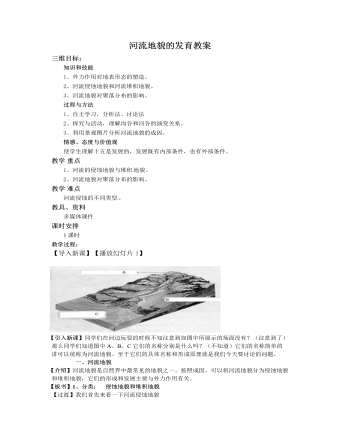
【引入新课】同学们在河边玩耍的时候不知注意到如图中所展示的场面没有?(注意到了)那么同学们知道图中A、B、C它们的名称分别是什么吗?(不知道)它们的名称简单的讲可以统称为河流地貌。至于它们的具体名称和形成原理就是我们今天要讨论的问题。一、河流地貌【介绍】河流地貌是自然界中最常见的地貌之一。按照成因,可以将河流地貌分为侵蚀地貌和堆积地貌,它们的形成和发展主要与外力作用有关。【板书】1、分类: 侵蚀地貌和堆积地貌【过渡】我们首先来看一下河流侵蚀地貌【板书】2、河流侵蚀地貌【介绍】河流在流动过程 中,会破坏并掀起地表的物质,形成侵 蚀地貌。河流侵蚀地貌是由溯源侵蚀、下蚀和侧蚀共同作用形成的。【引导读书】请同学们快速阅读教材P83倒数 第二段,添出以下表格。
人教版高中地理必修1气压带和风带教案
知识和技能 1、指导学生绘制气压带和风带分布示意图,从中分析大气运动的规律性,并培养和提高学生绘制原理形成示意图的地理技能。2、运用海陆热力差异原理进行解释,加强学 生对半球冬夏季气压中心的形成和分布的理解解。3、使学生理解气压带和风带对气候的影响。过程与方法 1、通过三圈环流模拟演示,培养学生的空间思维能力。2、通过对海陆分布对大气环流影响的两图示的对比分析,让学生读图思考气压带、风带的分布规律和原因。3、利用成因分析法引导学生探究气压带和风带对气候的影响机制。情感、态度与价值观1、培养学生辩证唯物主义观。2、培养学生理论联系实际的能力。教学重点1、气压带和风带的分布。2、北半球气压中心冬夏分布及对气候的影响。3、气压带和风带对气候的影响。
人教版高中地理必修1水资源的合理利教案
知识和技能 1、了解水资源的概念和衡量水资源的具体指标。2、运用图表说明全球和我国水资源的时空分布不 均的特点。3、说明在不同生产力条件下,水资源的数量和质量对人类生存和发展的意义。4、树立水资源可持续利用的观念,了解解决水资源供需矛盾的策略。过程与方法 1、自组学习。2、案例分析法3、合作探究教学法。情感、态度与价值观1、辩证的看待人类对水资源的利用情况。2、树立资源利用的可持续发展观点。教学重点1、水资源对人类生存和发展的意义。2、合理利用水资源。教学难点说明在不同的生产力条件下,自然资源的数量、质量对人类生存与发展的意义。教具、资料多媒体课件课时安排1课时教学过程:一、水资源及其分布 1.概念:广义——水圈内的水量总体狭义——陆地上的淡水资源(即通常所指)
人教版高中语文必修1《小狗包弟》教案2篇
巴金在十年浩劫中的大致经历:放弃包弟并没有换得保全一家人,1968年8月,巴金被关进牛棚改造,随后经受了大字报、挂牌游街等形式的批斗。1970年,到农村改造,掏大粪、喂猪、背稻草、种地……1972年,妻子萧珊在饱受精神折磨后患上癌症,病逝。巴金的儿子在劳动改造的过程中也饱受精神和肉体上的折磨,性格变得内向抑郁,疾病缠身。此时,巴金69岁。巴金曾在《病中》一文写道:“当姚文元拿着棒子的时候,我给关在牛棚里除了唯唯诺诺之外,敢于做过什么事情?十年间我不过是一条含着眼泪等人宰割的牛。”小结:(幻灯片12)社会是病态的社会,政治是高压的政治,人性是扭曲的人性。十年文革,十年浩劫,给多少人留下了累累不可弥合的精神创伤。即使一条小狗,也可能摆脱不了“文革”无情的迫害,比如包弟,比如艺术家邻居的小狗。
人教版高中语文必修1《烛之武退秦师》教案
四、讲读第一段(10分钟)1.抽生朗读本段,注意生字词读音。2.讲析本段译释由学生完成,师只作扼要补纠和简要分析。分析内容包括伏笔手法和语句深意,全段作用。3.让学生齐读全段。4.处理练习一之中的第1小题,要求学生试译回答,然后指导学生背诵本段。五、讲读第二段(15分钟)1.抽生朗读本段,注意生字词读音。2.讲析本段①重点讲析三个文言词“若”、“之”、“辞”的用法和人物对话。②字词句的理解仍然注意发挥学生的能动性,让他们完成为主,师纠补为辅。对要求掌握的三个文言词的用法要板书列于黑板上,对话部分要让学生试作语气练习。③小结的内容包括情节的曲折性、写法的详略和表达的特点。3.生齐读本段,然后处理相关练习。
人教版高中语文必修1《鸿门宴》教案
刘邦:先看刘邦对项伯的表白(此话也是有意让项伯转述给项羽听的):“秋毫不敢有所近”——说“不敢”而不说“不曾”,多么恭顺!“籍吏民,封府库,而待将军”——“待”,多么虔诚!“日夜望将军至”——说“望”而不说“等”,多么迫切!再看刘邦的卑词“谢罪”:他言必称“将军”,说自己与项羽“戮力而攻秦”,是战友而非敌人;将“先入关破秦”说成是不自意,以表自己的力量不如项羽;把“得复见将军于此”当作是自己莫大的荣幸以满足项羽的虚荣心;最后,他还把项羽的愤怒归咎于“小人”的挑拨,为项羽推卸责任,及时给项羽一个台阶下。小结:项羽:沽名钓誉、轻敌自大、寡谋轻信、不善用人、刚愎自用、优柔寡断的一介武夫。刘邦:狡诈多谋、遇事果断、临危不惧、能屈能伸、善于用人。
人教版高中语文必修1《荆轲刺秦王》教案
教学目标:1、知识与能力:①了解荆轲刺秦王的历史背景和过程,整体感知课文。②掌握文言文中重要的字、词、句解释,提高翻译能力。③学会从人物的对话、动作、神态描写入手,分析主要人物形象。2、情感与态度:正确看待荆轲刺秦王这一事件,学会历史而辩证地评价人物。重点难点:评价历史事件,分析人物形象。教学方法:朗读法、提问法、讨论法课时安排:三课时教学过程:第一课时一、导入:(课前展示雕塑照片)来到正定讲课,我感到非常高兴,一进县城,就被这里浓郁的历史文化气息所感染。我们住在华阳假日酒店,外面正在兴建文化广场,刚才的照片就是在那里拍摄的。在此,我进一步了解到正定这座文化古城悠久的历史渊源,这里有南越王赵佗,常胜将军赵云,一代名家颜真卿等等,可谓物华天宝、人杰地灵。因此我相信我们正定中学的同学们一定都非常优秀。这也让我更深刻地体会到一个道理:语文的外延就是生活的外延。
人教版高中语文必修1《论语》教案2篇
【教学意图】要了解中国传统文化,必须阅读古诗文名著名篇。但在中国文化形成过程中影响最大的是什么?可以说是儒家学说,包括《论语》这部经典。《论语》等书是读书人求仕做官的必修课本,是知识分子的思想言行基础,而且影响到整个社会生活,内容包括伦理道德、教育体制、民间习俗等方面的思想。因此,要了解中国传统文化,有必要读一读《论语》。【教学设计】因《论语》的年代已久远,对学生而言,要理解透彻文句是比较深奥困难的,因此必须在充分理解文意的基础上,对《论语》进行思想上的解读。可由教师从《论语》中概括出几点与生活、现实相关的要点,要求学生分组进行透彻的学习和领会,如“小人与君子”、“学习的方法”、“教育的理念”等等。〖教学重点、难点〗读《论语》知儒家思想。〖教学方法〗讲解启发、探究梳理、拓展延伸。
人教版高中历史必修1辛亥革命教案2篇
①从政府人员组成看,南京政府是一个以资产阶级革命派为主体的政府。②从政府颁发的法令和措施看,这些法令体现了资产阶级民主革命的要求,对于发展民族资本主义经济、资产阶级民主政治和文化教育以及改革社会风气,都起了积极作用。③从颁布的《中华民国临时约法》看,宪法体现了三权分立的政治体制,体现了资产阶级民主主义的要求,是中国历史上第一部资产阶级民主宪法,具有反封建专制制度的进步意义。(2)从南京临时政府的内外政策分析南京政府的根本弱点①未彻底地反封建。它没有采取比较彻底的反对封建主义的措施,特别是对封建统治的基础——地主阶级土地所有制没有触动,这样,南京临时政府也就不能真正地把广大人民群众动员起来,因而缺乏真正的群众基础。
人教版高中历史必修1抗日战争教案
【备课资料】百团大战八路军从8月20日起,在华北敌后出动105个团,约40万兵力,在2500公里长的战线上,发动了规模最大的“以彻底破坏正太路若干要隘,消灭部分敌人截断该线交通”为目的的举世闻名的“百团大战”。八路军提出“不留一根铁轨、不留一根枕木、不留一个车站、不留一个碉堡、不留一座桥梁”的口号,“让敌人用脚同我们赛跑”,“让敌人用牛驴搬炮弹、飞机大炮”。八路军展开攻坚战,端掉敌一系列据点。据有关资料记载,从8月20日到12月5日,在历时三个半月的“百四大战”中,我军共进行大小战斗1824次,毙伤日伪军25800余人,俘日伪军18600余人,缴获了大批武器、弹药和军用食品等;破坏铁路470多公里,公路1500多公里,桥梁、车站、隧道等260余处,使正太铁路停运月余;攻克日伪据点2993个,巩固和扩大了抗日军民占领区。
人教版高中历史必修1马克思主义的诞生教案
【合作探究】分析说明巴黎公社是无产阶级建立政权的第一次伟大尝试(1)从巴黎公社产生的情况来看,它是在巴黎无产阶级通过暴力革命,推翻反动的资产阶级政府的基础上,通过普选建立起的新型国家。(2)从巴黎公社的政权的领导人和阶级成分来看,通过民主选举产生的公社委员会的成员,大多数是工人,其中有些委员会虽然从事不同的职业,有的不是马克思主义者,但公认是公认阶级的代表。(3)从巴黎公社实行的政策措施来看,这是最能说明公社性质的一个方面。公社在建设新政权的同时,打碎资产阶级国家机器,做出建立无产阶级专政国家机器的伟大尝试。公社的社会经济措施和其他民主措施,都在一定程度上体现了它的无产阶级性质。没收逃亡资本家的工厂,触及资本主义私有制,具有明显的无产阶级性质。
人教版高中历史必修1鸦片战争教案2篇
1.知识与能力:(1)通过引导学生分析鉴赏19世纪以来有代表性的音乐与美术作品,了解这些作品产生的时代背景及其艺术价值。(2)通过分析世界艺术产生的历史背景,可以帮助学生正确认识人类文化的多样性、时代性和民族性,培养学生结合历史背景分析历史问题的能力。(3)通过对19世纪以来的音乐与美术史实的分析、综合、比较、归纳、概括等认知活动,培养历史思维和解决问题的能力。2.过程与方法:(1)让学生在搜集资料、自主探究、合作交流过程中,发展学生在社会中学习、网络学习、终身学习的能力。(2)通过上网了解艺术大师及分析鉴赏其各类美术、音乐作品,感受其艺术价值。 (3)思维方法:学会知识迁移,在从感知历史到不断积累历史知识,进而不断加深对历史和现实的理解过程中,提高分析理解问题能力。学会善于从不同的角度发现问题,积极探索解决问题的方法,从而做到论从史出、史论结合。
人教版高中历史必修1祖国统一大业教案2篇
教材分析改革开放后我国的综合国力不断增强,人民对祖国统一的愿望越来越迫切。本节课以“一国两制”构想的提出,香港、澳门的回归和海峡两岸关系的发展为中心,说明实现祖国统一,完成中华民族复兴是历史发展的必然。第一目“‘一国两制’构想的提出”主要讲述了“一国两制”的含义及历史意义。第二目“香港、澳门的回归”着重讲述了香港回归、澳门回归的经过及历史意义,这是“一国两制”成功的实践。第三目“海峡两岸关系的发展”讲述了大陆注重发展与台湾的关系,促进海峡两岸的经济文化交流与合作,打破了几十年来海峡两岸的隔绝状态,促进了祖国统一的进程。此外,教材还通过“资料回放”“历史纵横”“学思之窗”等栏目,为学生学习提供了一些详细的史料。在教学中要分析图表资料,引导学生理解完成祖国统一大业,实现中华民族的复兴,是任何人也阻挡不了的历史潮流。